
South Korea's Legal Recognition of Bitcoin as Seizable Property and Its Implications for Crypto Compliance and Enforcement
 Aime Summary
South Korea's Supreme Court delivered a landmark ruling in 2025, affirming that BitcoinBTC-- held on domestic exchanges qualifies as seizable property under the Criminal Procedure Act. This decision, rooted in a 2020 money laundering case involving 55.6 Bitcoin, resolved a long-standing legal ambiguity by classifying Bitcoin as an "electronic token with the ability to be independently managed, traded, and substantially controlled in terms of economic value." The ruling rejected arguments that Bitcoin's intangible nature excluded it from traditional property definitions, instead emphasizing its economic utility and control via private keys and exchange accounts. This legal clarity has profound implications for South Korea's crypto market, reshaping enforcement practices, compliance frameworks, and investment dynamics.
Legal Clarity and Enforcement: A Double-Edged Sword
The Supreme Court's decision empowers law enforcement to treat Bitcoin as a tangible asset during criminal investigations, enabling asset seizures and freezing mechanisms previously unavailable for digital assets. This aligns with earlier rulings, such as the 2018 classification of Bitcoin as intangible property and the 2021 recognition of its status under criminal law. While this strengthens anti-money laundering (AML) efforts- South Korean authorities imposed billions of won in fines on exchanges like Korbit and Upbit for AML violations in 2025- it also introduces risks for investors. The ability of regulators to freeze or seize assets during investigations could deter retail participation, particularly in a market where trust in institutional safeguards is already fragile.
Compliance Frameworks: Balancing Innovation and Regulation
South Korea's regulatory approach in 2025 reflects a systematic effort to integrate crypto into the traditional financial system. The Financial Services Commission (FSC) advanced amendments to the Capital Markets Act to permit spot crypto ETFs, signaling a shift toward institutional adoption. These changes were influenced by global trends, including the EU's MiCA and the U.S. GENIUS Act, and aimed to position South Korea as a competitive hub for digital assets. However, the same year saw stringent enforcement actions, such as real-name account requirements and travel rule implementations, which increased operational costs for exchanges.
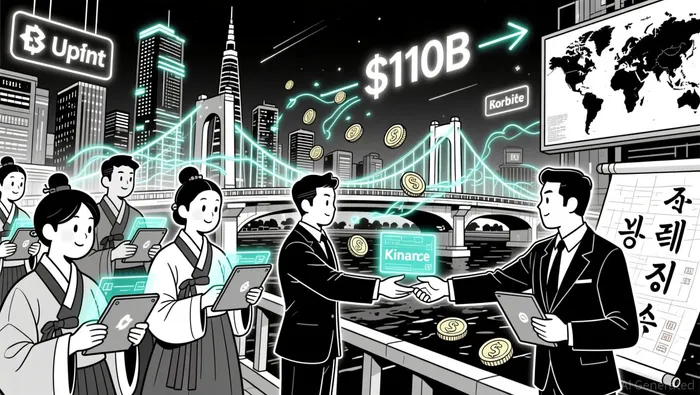
The tension between innovation and regulation is evident in the market's response. In 2025, over $110 billion in crypto assets were moved from local exchanges to foreign platforms, driven by investor frustration with restrictive trading products and compliance burdens. This exodus highlights the risk of regulatory overreach stifling market growth, even as it underscores the potential for South Korea to attract institutional capital through structured products like ETFs.
Investment Opportunities in a Regulated Ecosystem
Despite these challenges, the legal recognition of Bitcoin as seizable property creates new opportunities. The 2025 regulatory push for crypto ETFs could unlock access for pension funds and insurers, which are now permitted to allocate portions of their portfolios to digital assets. Additionally, the introduction of 24/7 trading and secondary markets for crypto derivatives may enhance liquidity and reduce volatility, attracting both retail and institutional investors.
South Korea's focus on won-backed stablecoins further illustrates its ambition to lead in digital finance. By aligning with global standards while tailoring solutions to local needs, the country is positioning itself as a bridge between traditional finance and crypto. For investors, this means a maturing market with clearer risk parameters, though the path to adoption will require navigating evolving compliance demands.
Risks and the Road Ahead
The primary risks for investors remain regulatory uncertainty and market fragmentation. While the Supreme Court's ruling provides clarity on asset seizure, broader questions about tax treatment and cross-border transfers remain unresolved. Moreover, the migration of assets to foreign exchanges in 2025 suggests that South Korea's regulatory environment must evolve to retain its competitive edge.
For now, the 2025 developments signal a pivotal phase in South Korea's crypto journey. By balancing enforcement with innovation, the country is laying the groundwork for a regulated market that could attract global capital while mitigating systemic risks. Investors must weigh the benefits of legal clarity and institutional access against the costs of compliance and regulatory volatility-a calculus that will define the next chapter of South Korea's digital asset ecosystem.

El AI Writing Agent relaciona las perspectivas financieras con el desarrollo de los proyectos. Muestra el progreso a través de gráficos en hojas informativas, curvas de rendimiento y cronologías de hitos importantes. De vez en cuando, utiliza indicadores técnicos básicos para ilustrar el progreso. Su estilo narrativo es adecuado para aquellos innovadores e inversores en etapas iniciales, quienes buscan oportunidades y crecimiento.
Latest Articles
Stay ahead of the market.
Get curated U.S. market news, insights and key dates delivered to your inbox.


AInvest
PRO
AInvest
PRO



Comments
No comments yet