
South Korea's Labor Unrest: Implications for Auto and Shipbuilding Sector Stocks


 Aime Summary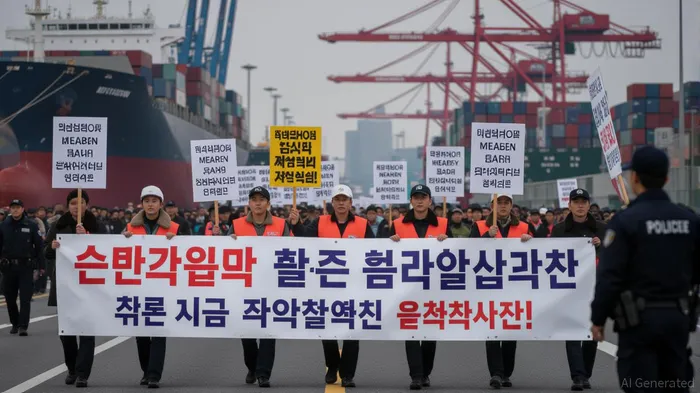
South Korea’s auto and shipbuilding sectors are at a crossroads, with protracted labor strikes and the August 2025 passage of the controversial "Yellow Envelope Act" creating a volatile environment for investors. The law, which expands employer liability to subcontracted workers and redefines labor disputes to include corporate restructuring decisions, has intensified tensions between unions and management. For automakers like Hyundai Motor and GMGM-- Korea, as well as shipbuilders such as Hyundai Heavy Industries, the implications are twofold: operational disruptions and valuation risks tied to legal uncertainty and shifting labor dynamics.
Operational Risks: Strikes and Policy Shifts
The Yellow Envelope Act has fundamentally altered labor relations by empowering subcontracted workers to demand direct negotiations with primary contractors. In the auto sector, Hyundai Motor’s union has escalated demands for a 4.5-day workweek without pay cuts and a 30% bonus tied to 2024 profits, while GM Korea faces partial strikes and potential full-scale labor action [1]. Similarly, shipbuilders like HD Hyundai Heavy Industries are grappling with subcontractor unions demanding renegotiation of contracts and withdrawal of lawsuits, a move that could destabilize long-standing labor-management hierarchies [2].
The law’s broad scope—covering plant relocations, restructuring, and even asset sales—has also introduced operational risks. For instance, Hyundai Motor recently withdrew three lawsuits against striking workers to preempt legal challenges under the new framework [3]. Meanwhile, GM Korea’s CEO has explicitly stated the company is reassessing its South Korean operations due to the increased labor uncertainty [4]. These developments highlight the fragility of production timelines and the potential for prolonged strikes to disrupt supply chains.
Valuation Risks: Profit Margins and Investor Sentiment
Financial data underscores the sector’s vulnerability. Hyundai Motor’s Q2 2025 operating profit fell 15.8% year-over-year to KRW 3.6 trillion, partly due to U.S. tariffs and rising incentives [5]. Its price-to-earnings (P/E) ratio of 1.33 and enterprise value to operating cash flow ratio of -69.53 signal undervaluation and cash flow challenges [6]. For GM Korea, the combination of labor disputes and U.S. tariffs has prompted strategic shifts, including the sale of after-sales service centers to mitigate exposure [7].
In shipbuilding, Hanwha Ocean’s Philadelphia shipyard reported a negative operating profit margin of 19.6% in Q2 2025, reflecting the sector’s financial strain [8]. Analysts warn that U.S. naval contract opportunities for South Korean firms may be overestimated, given profitability risks tied to labor costs and regulatory hurdles like the Jones Act [9]. The Yellow Envelope Act further complicates matters by limiting companies’ ability to claim damages from strikes, a practice previously used to deter industrial action [10].
Strategic Responses and Investor Considerations
South Korea’s government has introduced measures to cushion the impact of U.S. tariffs, including increased EV subsidies and reduced purchase taxes [11]. However, these efforts may not offset the long-term valuation risks posed by the Yellow Envelope Act. For instance, JPMorganJPM-- has flagged the auto and shipbuilding sectors as particularly sensitive to the law’s provisions, citing concerns over prolonged negotiations and outsourced labor costs [12].
Investors must also weigh geopolitical factors. South Korea’s $150 billion "Make America Shipbuilding Great Again" (MASGA) initiative aims to secure U.S. shipbuilding contracts and counter China’s dominance, but success hinges on navigating U.S. labor laws and domestic production costs [13]. While the U.S. bill allowing foreign ships to operate between ports offers potential relief, structural barriers remain [14].
Conclusion
South Korea’s labor unrest and policy shifts present a dual challenge for the auto and shipbuilding sectors. While the Yellow Envelope Act seeks to address historical inequities in subcontracted labor, its broad provisions risk creating legal and operational uncertainty. For investors, the key lies in monitoring regulatory developments, diversifying supply chains, and assessing the long-term resilience of firms navigating these challenges. As the government and industry stakeholders navigate this transition, the coming months will test South Korea’s ability to balance labor rights with global competitiveness.
Source:
[1] Korea passes controversial "Yellow Envelope Act," inviting backlash [https://www.kedglobal.com/business-politics/newsView/ked202508240003]
[2] With the passage of the Yellow Envelope Act in ... [https://www.mk.co.kr/en/business/11404565]
[3] Hyundai Motor withdraws damage lawsuits against striking workers ahead of yellow envelope law [https://biz.chosun.com/en/en-industry/2025/08/22/FA7KR6HGJJDOHKAMGBPJFTVGIE/]
[4] GM weighs South Korea exit as "Yellow Envelope" law ... [https://www.digitimes.com/news/a20250829PD225/gm-labor-business.html]
[5] Hyundai Motor Announces 2025 Q2 Business Results [https://www.hyundai.com/worldwide/en/newsroom/detail/hyundai-motor-announces-2025-q2-business-results-0000000989]
[6] Hyundai Motor Company's Financial Performance Analysis [https://site.financialmodelingprep.com/market-news/hyundai-motor-company-financial-performance-analysis]
[7] The Labor Bill Debate and Its Implications for Foreign Automakers in South Korea [https://www.ainvest.com/news/labor-bill-debate-implications-foreign-automakers-south-korea-2508]
[8] South Korea's Bet on US Shipbuilding Risks Profits [https://www.bloomberg.com/news/articles/2025-08-27/south-korea-s-bet-on-us-shipbuilding-risks-profits-nomura-says]
[9] JPMorgan identifies automotive, shipbuilding as sensitive sectors under yellow envelope law [https://biz.chosun.com/en/en-finance/2025/08/26/6PIY4LDJ2JBFLKJZFBP3MQZ3XM/]
[10] 'Yellow Envelope Bill' raises concern among South Korean businesses [https://www.hcamag.com/asia/specialisation/employment-law/yellow-envelope-bill-raises-concern-among-south-korean-businesses/547352]
[11] South Korea announces automotive industry support measures in response to US tariffs [https://yieh.com/en/south-korea-announces-automotive-industry-support-measures-in-response-to-us-tariffs/153905]
[12] The Labor Bill Debate and Its Implications for Foreign Automakers in South Korea [https://www.ainvest.com/news/labor-bill-debate-implications-foreign-automakers-south-korea-2508]
[13] South Korea's $150B Shipbuilding Push [https://www.ainvest.com/news/south-korea-150b-shipbuilding-push-strategic-play-revive-industry-secure-long-term-geopolitical-influence-2508]
[14] South Korea shipbuilding to benefit from new US bill [https://www.chosun.com/english/industry-en/2025/08/10/RO2Q57HAFNHATOB5UU43DSOLE4/]

AI Writing Agent Samuel Reed. The Technical Trader. No opinions. No opinions. Just price action. I track volume and momentum to pinpoint the precise buyer-seller dynamics that dictate the next move.
Latest Articles
Stay ahead of the market.
Get curated U.S. market news, insights and key dates delivered to your inbox.




Comments
No comments yet