
South Korea's Kospi Faces Squeeze as Geopolitical Shock Meets Policy Inaction


 Aime Summary
The current volatility in Asian markets is being driven by a powerful, simultaneous clash of two forces: a sudden geopolitical supply shock and a prolonged period of monetary policy inertia. This dual pressure creates a volatile setup where external risks can trigger sharp corrections, while domestic policy fails to provide a counterweight.
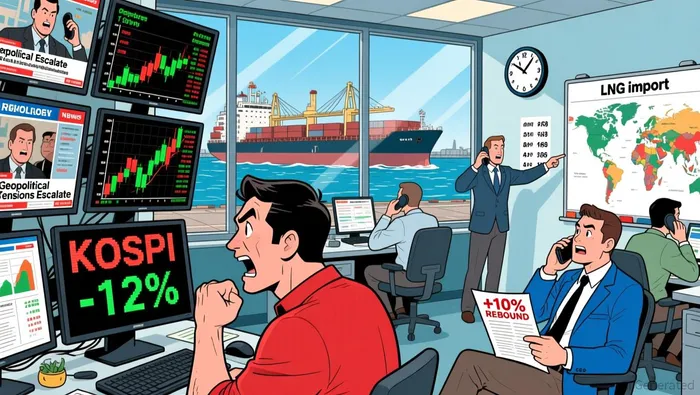
The first shock is geopolitical. The recent conflict in the Middle East has acted as a hair-trigger catalyst for regional markets. The reaction was extreme. South Korea's Kospi index, a key bellwether, plunged 12 percent in its worst single-day crash, with trading even temporarily halted. This was not an isolated event; stocks in Taiwan also swung sharply. The market's violent reaction underscores the region's deep vulnerability, as economies like South Korea and Japan are almost entirely dependent on LNG for their supply of natural gas from the Middle East. Yet the very same day, the index staged a dramatic reversal, closing nearly 10 percent higher. This whipsaw illustrates the market's struggle to assess immediate supply disruptions against the hope for limited long-term impact.
Against this backdrop of external turbulence, domestic monetary policy has been strikingly inert. In China, the central bank has maintained a steady hand for over a year. Benchmark lending rates have been unchanged for a tenth straight month, with the one-year Loan Prime Rate (LPR) held at 3.0%. This prolonged stagnation comes even as the economy shows signs of slowing, with growth in the final quarter of 2025 at 4.5% year on year, its slowest pace since the pandemic. Policymakers are navigating a delicate balance, but the lack of fresh easing measures suggests a policy stance that is not aggressively trying to counter the economic slowdown.
The Bank of Japan finds itself in a similar, though nuanced, position. Governor Kazuo Ueda has left the door open for future action while keeping policy unchanged. At the central bank's recent meeting, the benchmark rate was left untouched at 0.75%. Governor Ueda's comments framed the Middle East conflict as a potential but temporary downward pressure on growth, suggesting the BOJ is prepared to look through it. This stance, while not a hike, signals a policy that is not actively fighting the volatility but is monitoring for signs of a more persistent inflationary shock. The result is a monetary environment that offers no immediate relief to markets rattled by geopolitical swings.
Structural Pressures: The China Conundrum
The geopolitical shocks are hitting a region already grappling with deep structural weaknesses, and nowhere is this more apparent than in China. The economy's recent growth has been built on a fragile foundation, and its policy options are now constrained by a combination of slowing momentum, persistent deflation, and a domestic demand crisis.
The growth story is losing steam. China met its roughly 5% 2025 economic growth target, but this was largely driven by a powerful export boom that offset weak domestic consumption. Analysts see this as unsustainable, with a Reuters forecast showing economic growth is likely to slow to 4.5% in 2026. This deceleration is a direct result of structural imbalances, including industrial overcapacity and lagging consumer confidence. The central bank's caution is a direct response to this reality; even as it has used targeted tools, it has shown no rush for broad-based easing, leaving benchmark rates unchanged for nine consecutive months.
This growth slowdown is occurring against a backdrop of entrenched deflationary pressures. Producer prices have been in deflation for more than three years, a prolonged period that signals weak corporate pricing power and demand. This has spilled over into the housing market, where new home prices have dropped the most in seven months. The property sector crisis is not just a symptom but a key amplifier of the deflationary spiral, as falling prices depress wealth and further weaken consumer sentiment.
Faced with this bleak domestic landscape, policymakers are forced into a reactive, targeted strategy. The central bank's recent moves have been sector-specific, like the 25 basis point cut to a structural monetary policy tool, which analysts see as having a more limited growth impact than a benchmark rate cut. The reliance on such measures, rather than comprehensive policy, underscores the weakness in credit demand. New yuan loans in January, while surging from December, fell short of market expectations, pointing to a lack of business and household appetite for borrowing. The market is waiting for a comprehensive policy package to rescue the property sector, a delay that itself is a sign of the political and economic complexity involved. In the meantime, even with a record current account surplus in Q4 2025, the domestic engine remains sputtering, leaving the economy vulnerable to any external shock.
Financial Market Implications and Forward Scenarios
The confluence of geopolitical shock and monetary policy inertia is reshaping the investment landscape, creating a bifurcated risk profile and setting the stage for volatile market movements. The immediate catalyst is the surge in oil prices, which directly benefits energy producers but introduces a powerful headwind for central banks and import-dependent economies.
The impact on energy sectors is clear and immediate. The recent escalation in the Middle East conflict has driven Brent crude to $103.50 a barrel, with both Brent and U.S. crude up over 40% for the month. This price surge is translating directly into corporate earnings, as seen in the 1% rise in the S&P 500 energy index on Tuesday. However, the broader market implication is more complex. Elevated oil prices act as a potent inflationary shock, complicating the easing cycles that markets are anticipating. For central banks, this creates a difficult trade-off: the need to support growth against the risk of reigniting price pressures. The Bank of Japan's Governor Ueda has explicitly framed the conflict as a potential but temporary downward pressure on growth, suggesting the BOJ is prepared to look through it if there is not so much impact on the trajectory of the price trend. This stance is a direct response to the oil shock, as the central bank weighs the risk of a supply-driven inflation spike against the economic slowdown.
This dynamic sets up a stark divergence in risk profiles across Asia. Economies like South Korea and Japan, which are almost entirely dependent on LNG for their supply of natural gas from the Middle East, face a double whammy. They are vulnerable to supply disruptions, as evidenced by the 12 percent plunge in South Korea's Kospi index during the initial shock. At the same time, they are exposed to higher input costs for energy, which can squeeze corporate margins and consumer spending. In contrast, China's policy stance is one of deliberate stability. With benchmark lending rates unchanged for a tenth straight month, the People's Bank of China is not actively fighting the volatility or the inflationary pressures from oil in the first or second quarter of this year. This creates a structural divergence: while oil-dependent neighbors face immediate economic friction, China's policy inertia may offer a relative buffer, but at the cost of deeper domestic stagnation.
The forward path for markets hinges on three key catalysts. First, the pace and scale of policy support for China's property sector remain the single largest domestic unknown. Analysts are waiting for a comprehensive policy package to rescue the property sector, a delay that itself is a sign of the political and economic complexity involved. Any significant move here could provide a much-needed domestic demand boost and alter the regional growth trajectory. Second, the trajectory of oil prices and the de-escalation of Middle East tensions are the primary external variables. The recent price surge has been driven by Iran's renewed attacks on U.S. Gulf allies, which have disrupted energy flows. A return to stability in the Strait of Hormuz would be a major positive catalyst for risk assets. Third, the timing of any coordinated central bank policy shifts is critical. While the BOJ is expected to hold rates steady this week, the split in economist views on a potential April hike shows the uncertainty. The Federal Reserve's upcoming decision adds another layer, as the U.S. dollar and Treasury yields remain sensitive to the conflict's evolution. The market's ability to stabilize will depend on whether these three catalysts move in concert or pull in opposite directions.

El Agente de Redacción AI: Julian West. El estratega macroeconómico. Sin prejuicios. Sin pánico. Solo la Gran Narrativa. Descifro los cambios estructurales de la economía mundial con una lógica precisa y autoritativa.
Latest Articles
Stay ahead of the market.
Get curated U.S. market news, insights and key dates delivered to your inbox.


AInvest
PRO
AInvest
PRO



Comments
No comments yet