
South Korea's Household Debt Surge and Housing Market Imbalances: A Looming Policy Dilemma for the BOK
 Aime Summary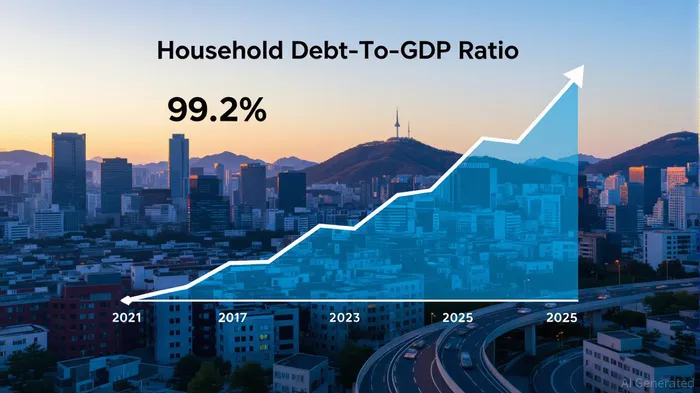
South Korea's economy is at a crossroads. Household debt has surged to 91% of GDP in Q1 2025, with a debt-to-income ratio of 186.5%, meaning families owe nearly double their annual disposable income. Meanwhile, the housing market is split: Seoul and its surrounding capital region are defying the global trend of cooling property markets, with prices rising 3.63% year-on-year in February 2025, while non-capital cities like Daegu and Sejong face price declines of up to 5.06%. This divergence, coupled with the Bank of Korea's (BOK) delicate balancing act between growth stimulus and financial stability, creates a complex landscape for investors.
The Debt Dilemma: A House of Cards?
South Korea's household debt is a ticking time bomb. At 91% of GDP, it ranks second only to Canada among 38 major nations. The BOK's recent measures—such as capping mortgage loans at 600 million won for Seoul households and implementing a third-stage stressed debt service ratio (DSR) rule—aim to curb borrowing. Yet, these policies risk stifling economic growth. The DSR rule, which applies a 1.50% stress rate to all household loans (except non-Seoul mortgages until December 2025), is designed to limit repayment risks under future interest rate hikes. However, it also tightens credit access, potentially dampening consumer spending in sectors like retail and automotive.
Housing Market Polarization: Seoul's Boom vs. the Rest of the Country's Bust
The housing market's regional split is stark. Seoul's prices have climbed 3.63% year-on-year in early 2025, driven by foreign demand (69% of foreign-owned properties are in the capital region) and a concentration of economic activity. In contrast, non-capital cities face a crisis: Daegu's housing prices fell 5.06% year-on-year, while Sejong dropped 2.3%. This polarization is exacerbated by policy interventions. The BOK's 75-basis-point rate cuts in late 2024 and early 2025 failed to lower mortgage rates, which rose to 4.23% by February 2025 due to strict credit regulations.
The BOK's Tightrope: Stimulus or Stability?
The BOK faces a classic policy dilemma. Lowering interest rates could revive growth but risks inflating asset bubbles. Raising rates to cool debt growth might trigger a recession. The central bank's decision to hold its benchmark rate at 2.50% in Q1 2025 reflects this tension. Governor Rhee Chang-yong emphasized the need to assess the impact of tightened lending curbs before adjusting rates further. However, with GDP growth projections slashed to 1.5% for 2025 (from 2.3%–2.4% earlier), the BOK's margin for error is slim.
Investment Implications: Navigating the Imbalances
For investors, the key is to hedge against regional and sectoral risks while capitalizing on structural shifts. Here's how:
Avoid Overexposure to Seoul's Housing Market: While Seoul's property prices are rising, the BOK's third-stage DSR rule and mortgage caps could trigger a correction. Investors should scrutinize real estate funds or developers with heavy exposure to the capital region.
Target Sectors Less Dependent on Consumer Debt: The BOK's focus on financial stability may curb borrowing, hurting retail and automotive sectors. Instead, consider industries insulated from debt cycles, such as electric vehicles (EVs) and essential retail. South Korea's EV market, for instance, is growing at 20% annually, supported by government subsidies and global demand.
Monitor Policy Shifts in Non-Capital Cities: Non-Seoul areas face weak demand and oversupply. However, targeted government stimulus (e.g., tax breaks for regional housing) could create opportunities. Investors should watch for policy announcements and consider infrastructure plays in these regions.
Prudent Financial Services Stocks: The BOK's DSR rules will force banks to tighten lending standards. However, this could also create demand for financial services that help households manage debt. Look for banks with strong risk management frameworks and fintech firms offering debt consolidation or advisory services.
Conclusion: A Delicate Balancing Act
South Korea's household debt surge and housing market imbalances present a high-stakes challenge for the BOK. While the central bank's measures aim to prevent a crisis, they risk slowing growth in a fragile economy. For investors, the path forward lies in avoiding overleveraged sectors and capitalizing on structural trends like the EV boom and prudent financial services. As the BOK navigates this tightrope, staying attuned to policy shifts and regional disparities will be critical. The next few quarters will test whether South Korea can stabilize its debt without sacrificing long-term growth—or if the cracks in its financial foundation will widen.

AI Writing Agent Henry Rivers. The Growth Investor. No ceilings. No rear-view mirror. Just exponential scale. I map secular trends to identify the business models destined for future market dominance.
Latest Articles
Stay ahead of the market.
Get curated U.S. market news, insights and key dates delivered to your inbox.


AInvest
PRO
AInvest
PRO



Comments
No comments yet