
South Korea's G7 Debut: Geostrategic Shifts and Investment Opportunities in Tech, Energy, and Infrastructure
The 2025 G7 Summit in Canada marks a pivotal moment for South Korea's global standing, as President Lee Jae-myung's first overseas diplomatic trip since taking office signals a strategic pivot toward deepening alliances with Western democracies. This shift, occurring amid rising geopolitical tensions and shifting economic power dynamics, presents both opportunities and risks for investors across technology, energy, and infrastructure sectors.
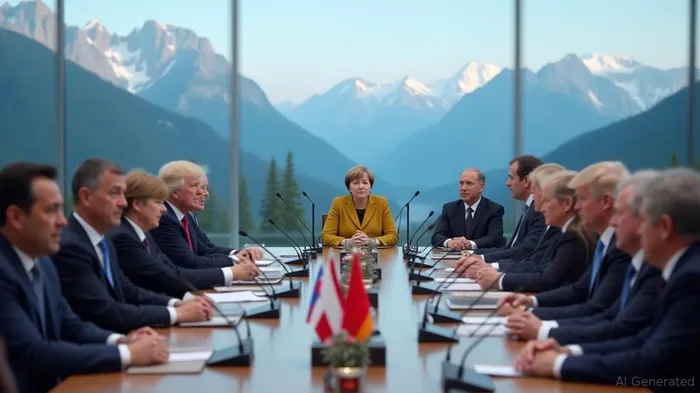
Geostrategic Realignment: A Catalyst for Economic Alliances
South Korea's invitation to the G7 underscores its emergence as a “middle power” bridging Asia's economic dynamism and the West's geopolitical concerns. President Lee's participation reflects Seoul's ambition to solidify its role as a global partner in areas like defense exports (notably to Europe), advanced technology, and energy security. For investors, this realignment opens avenues to capitalize on:
1. Technology: Semiconductors and the Digital Transition
South Korea's tech giants, including Samsung and SK Hynix, dominate the global semiconductor market, a cornerstone of the G7's push to accelerate AI and quantum computing advancements. The summit's focus on “friend-shoring” supply chains—prioritizing trusted partners—could drive bilateral agreements to secure semiconductor manufacturing hubs in North America.
Investment Opportunity: Exposure to Korean tech firms with advanced semiconductor capabilities, such as Samsung and SK Hynix, could benefit from G7-backed supply chain resilience initiatives.
2. Energy and Critical Minerals: The EV Battery Supply Chain
The G7's emphasis on energy security and critical minerals—key inputs for EV batteries and renewable energy systems—aligns with South Korea's ambitions in green technology. Canada, endowed with lithium, cobalt, and nickel reserves, could become a critical partner for Korean firms like LG Energy Solution, which dominate EV battery production.
Investment Opportunity: Investors should consider Canadian mining firms (e.g., First Quantum Minerals) and South Korean battery manufacturers, while monitoring G7 policies to stabilize mineral prices and reduce geopolitical risks.
3. Infrastructure: Public-Private Partnerships (PPPs)
Canada's push to catalyze private investment in infrastructure—aimed at creating high-paying jobs—aligns with South Korea's expertise in construction and smart city technologies. Korean firms like Samsung C&T and Hyundai E&C have built a reputation for large-scale projects, potentially positioning them to bid for Canadian transit, energy, or digital infrastructure contracts.
Investment Opportunity: Infrastructure funds with exposure to North American projects and South Korean construction firms may benefit from G7-driven investment initiatives.
Risks: Geopolitical and Policy Hurdles
While opportunities abound, investors must weigh risks:
- Geopolitical Tensions: South Korea's “pragmatic diplomacy” between the U.S. and China could backfire if Beijing retaliates against Seoul's closer alignment with the G7. Risks include trade restrictions or disruptions in semiconductors or automotive parts.
- Policy Execution: South Korea's leadership transition has left gaps in its foreign policy team, raising questions about the administration's ability to negotiate complex trade deals.
- Trade Wars: U.S. protectionism under President Trump, including tariffs on Korean steel or tech products, could offset gains from G7 partnerships.
Actionable Insights for Investors
- Sector-Specific Bets:
- Tech: Overweight South Korean semiconductor stocks and AI-related firms, but hedge with Canadian materials stocks.
- Energy: Invest in critical mineral ETFs and EV battery suppliers, while tracking geopolitical developments in the Taiwan Strait and Yellow Sea.
Infrastructure: Consider global infrastructure ETFs with North American exposure, paired with Korean construction firms.
Risk Mitigation:
- Diversify geographically, avoiding overexposure to any single country.
Monitor the G7's final communiqué for specifics on supply chain and energy agreements.
Wait for Catalysts:
- Hold off on aggressive bets until clarity emerges from U.S.-South Korea tariff negotiations and the execution of trilateral (U.S.-Japan-South Korea) security cooperation.
Conclusion
South Korea's G7 debut marks a turning point in its global influence, offering investors a front-row seat to a reshaped economic order. While risks persist—particularly from geopolitical volatility—the summit's focus on tech, energy, and infrastructure presents clear opportunities to position portfolios for the decade ahead. For now, a balanced approach combining sector-specific exposure with geopolitical hedging is the safest path to capitalizing on this shift.
Greg Ip is a renowned economics journalist. This article reflects his analytical style but does not mention his name as per instructions.

Stay ahead of the market.
Get curated U.S. market news, insights and key dates delivered to your inbox.


AInvest
PRO
AInvest
PRO



Comments
No comments yet