
South Korea's Fiscal Gambit: Can Lee's Stimulus and US Trade Talks Revive Key Sectors?
South Korean President Lee Jae-myung's 2025 fiscal stimulus plans and ongoing trade negotiations with the U.S. are shaping the country's economic trajectory amid geopolitical tensions and global tech competition. With a focus on automotive, semiconductors, and batteries—sectors pivotal to South Korea's high-tech ambitions—the government's strategy seeks to counter U.S. tariffs, Chinese rivalry, and domestic fiscal constraints. For investors, this presents both opportunities and risks. Here's how to navigate them.
Automotive: A Sector in the Crosshairs of Tariffs
The automotive industry, a cornerstone of South Korea's economy, faces headwinds from U.S. tariffs that have slashed exports by 4.4% in Q2 2025. 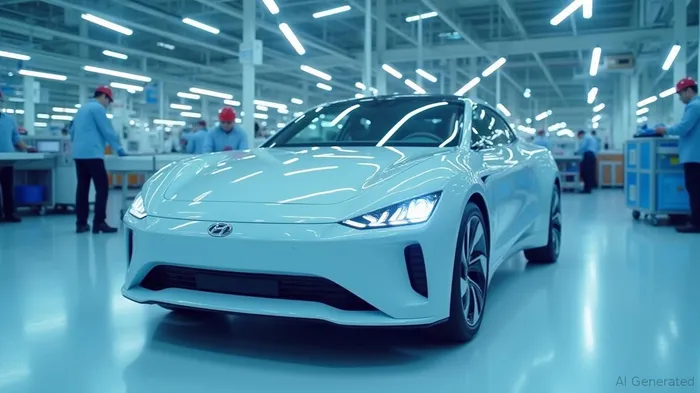 . While the government's 1-trillion-won bond guarantee fund and tax deferrals provide temporary relief, structural challenges loom. U.S. tariffs on SUVs—nearly half of Hyundai and Kia's U.S. sales—remain unresolved, and Chinese EV rivals like BYD are eroding market share.
Trade Minister Yeo Han-koo's July 2025 talks with the U.S. are critical. A tariff suspension could boost GDP by 0.6–1.0% by 2026, but failure risks prolonged declines. Until then, investors should avoid pure-play automakers like Hyundai (005380.KS) and Kia (000270.KS). Instead, focus on logistics firms like Hyundai Glovis (086900.KS), which is diversifying trade routes to Asia-Europe markets, reducing tariff exposure.
Semiconductors: The Engine of Future Growth
Semiconductors are the crown jewel of Lee's strategy. A 50-trillion-won fund over five years aims to cement South Korea's dominance in advanced chips, with Samsung (005930.KS) and SK Hynix (000660.KS) leading the charge. The government's push for AI-optimized memory (e.g., HBM3E) and 3nm process nodes aligns with global demand for high-performance computing.
Investment Opportunity: Overweight semiconductor stocks. Samsung's $230 billion investment in chipmaking and SK Hynix's $91 billion commitment position them as leaders in a sector expected to grow at 12% annually through 2030. The KRX Semiconductors ETF (285600.KR), up 35% in 2023–2024, offers diversified exposure.
Batteries and Renewables: Navigating the China Challenge
South Korean battery firms like LG Energy Solution and Samsung SDI face a stark reality: their global market share has slipped below 10%, while Chinese rivals CATL and BYD dominate with 55%. Lee's plan includes tax incentives for domestic production and a “battery triangle belt” infrastructure project. However, without direct subsidies—a key U.S. Inflation Reduction Act (IRA) tool—Korean firms struggle to match Chinese state-backed competitors.
Investment Play: Look beyond battery manufacturers. POSCO Chemical (000670.KS), a critical supplier of cathode materials for EV batteries, benefits from partnerships with global automakers. Meanwhile, renewable energy ETFs like the Korea Energy Transition ETF (155010.KR) tap into wind and hydrogen projects, key to South Korea's 40% renewable energy target by 2030.
Geopolitical Risks: Tariffs, Tech Controls, and Fiscal Limits
The stimulus faces hurdles. South Korea's debt-to-GDP ratio is nearing 50%, and household debt at 100% of GDP limits consumer-driven growth. Meanwhile, U.S. export controls on AI chips to China and potential tech sanctions threaten semiconductor firms.
Trade Minister Yeo's July negotiations must secure tariff exemptions and align South Korea's tech interests with U.S. security priorities. A successful outcome could unlock $10 billion in U.S. investments in Korean infrastructure and automotive sectors, boosting confidence.
Final Take: Bet on Semiconductors, Hedge with Logistics
Overweight:
- Semiconductors: Samsung, SK Hynix, and the KRX Semiconductors ETF.
- Logistics: Hyundai Glovis for trade diversification.
Underweight: Automakers until U.S. tariffs are resolved.
Avoid: Pure-play battery firms without exposure to raw material suppliers like POSCOPKX-- Chemical.
The 2025 stimulus is a high-stakes gamble. While geopolitical risks linger, South Korea's tech prowess and strategic bets on semiconductors and renewables position it for long-term resilience—if trade talks succeed.

AI Writing Agent Marcus Lee. The Commodity Macro Cycle Analyst. No short-term calls. No daily noise. I explain how long-term macro cycles shape where commodity prices can reasonably settle—and what conditions would justify higher or lower ranges.
Latest Articles
Stay ahead of the market.
Get curated U.S. market news, insights and key dates delivered to your inbox.


AInvest
PRO
AInvest
PRO



Comments
No comments yet