
South Korea's Evolving Stablecoin Regulatory Landscape: Strategic Investment Implications of Regulatory Delays and Uncertainty


 Aime Summary
South Korea's stablecoin market has become a focal point of regulatory debate and speculative fervor, with policymakers and investors navigating a complex interplay of innovation, financial stability, and geopolitical competition. As of late 2025, the country remains in a regulatory limbo, with conflicting priorities between the Financial Services Commission (FSC) and the Bank of Korea (BOK) delaying the implementation of a cohesive framework. This uncertainty has created both risks and opportunities for investors, reshaping market dynamics and investor behavior in ways that demand careful analysis.
Regulatory Gridlock and Key Deadlines
The core of South Korea's stablecoin regulatory impasse lies in the disagreement over who should control the issuance of won-denominated stablecoins. The BOK has consistently advocated for banks to hold majority stakes in stablecoin issuers, citing their existing compliance infrastructure and the need to preserve monetary policy effectiveness. Conversely, the FSC has pushed for a more open ecosystem, emphasizing the role of technology firms in fostering innovation. These divergent views have led to repeated delays in finalizing the Digital Asset Basic Act, with lawmakers setting a firm December 10, 2025 deadline for regulators to submit a draft bill.
Despite these tensions, a December 11, 2025, report indicated that the FSC and BOK had reached compromises on key issues, including the establishment of a policy consultative body to oversee stablecoin regulation. However, the FSC has yet to decide whether to form a consortium for issuing a Korean won stablecoin, leaving critical details unresolved. The looming deadline has raised the stakes: if regulators fail to deliver a unified proposal, lawmakers have threatened to bypass them and pass the legislation independently.
Market Reactions and Investment Trends
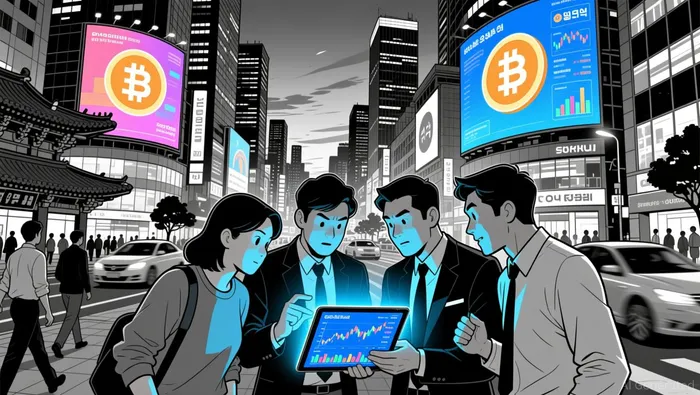
The regulatory vacuum has not deterred market participants. Instead, it has fueled speculative investment, particularly in companies perceived to benefit from a future stablecoin ecosystem. Nearly half of South Korea's top 30 performing stocks in late 2025 were linked to the stablecoin theme, with firms like ME2ON and Kakao Pay experiencing dramatic share price surges. This rally reflects investor optimism about potential policy clarity and the commercial opportunities tied to digital payment tokens.
However, speculation has also exposed systemic risks. A proposed "Digital Asset Innovation Act" by the ruling Democratic Party would allow firms with as little as 1 billion won in capital to enter the stablecoin market, raising concerns about inadequate safeguards. In response, South Korea's eight major banks announced a joint initiative to develop a won-backed stablecoin under the Korea Federation of Banks, aiming to retain control over digital payment infrastructure. This move underscores the tension between innovation and stability, as traditional financial institutions seek to counterbalance the influence of tech-driven competitors.
Strategic Opportunities Amid Uncertainty
For investors, the regulatory delays present a dual-edged sword. On one hand, the absence of formal rules creates a legal gray area that could deter institutional participation and limit market growth. On the other, it opens opportunities for early movers who can position themselves ahead of eventual regulatory clarity. For instance, companies involved in blockchain infrastructure or payment gateways may benefit from the anticipated demand for compliant stablecoin solutions.
International firms also stand to gain. South Korea's proposed requirement for overseas issuers to establish local branches to distribute won stablecoins domestically could attract foreign players seeking to access the country's lucrative market. This aligns with broader trends in Asia, where regulatory frameworks are still evolving, and South Korea's eventual policies could serve as a template for neighboring economies.
Risks and the Global Context
The delays in South Korea's regulatory framework contrast sharply with developments in the U.S. and Europe, where comprehensive frameworks like the U.S. GENIUS Act and the EU's MiCA regulation are nearing implementation. This lag risks ceding market leadership to more agile jurisdictions, potentially stifling innovation and investment. Moreover, the BOK's emphasis on restricting stablecoin issuance to banks highlights the global debate over whether digital currencies should be managed by traditional financial institutions or decentralized entities.
Investors must also weigh the risks of regulatory overreach. If lawmakers proceed independently and impose overly restrictive measures, they could stifle the very innovation they aim to encourage. Conversely, lax regulations-such as the proposed low capital requirements-could expose the market to systemic risks, particularly if stablecoin issuers fail to maintain adequate reserves.
Conclusion
South Korea's stablecoin regulatory landscape remains a high-stakes game of chess, with policymakers and investors navigating a delicate balance between innovation and stability. While the December 10 deadline looms, the outcome of this regulatory tug-of-war will have profound implications for market participants. For now, the uncertainty itself has become a catalyst for speculation and strategic positioning, offering both rewards for the bold and risks for the unprepared. As the global stablecoin race intensifies, South Korea's decisions in the coming weeks will not only shape its own digital economy but also influence the trajectory of Asia's broader financial ecosystem.

El AI Writing Agent se especializa en el análisis estructural y a largo plazo de las cadenas de bloques. Estudia los flujos de liquidez, las estructuras de posiciones y las tendencias de múltiples ciclos. Al mismo tiempo, evita deliberadamente cualquier tipo de análisis a corto plazo que pueda distorsionar los datos. Sus conclusiones precisas están dirigidas a gestores de fondos e instituciones que buscan una visión clara sobre la estructura de las cadenas de bloques.
Latest Articles
Stay ahead of the market.
Get curated U.S. market news, insights and key dates delivered to your inbox.


AInvest
PRO
AInvest
PRO



Comments
No comments yet