
South Korea's Evolving Kimchi Premium and Its Implications for Global Crypto Arbitrage Strategies


 Aime Summary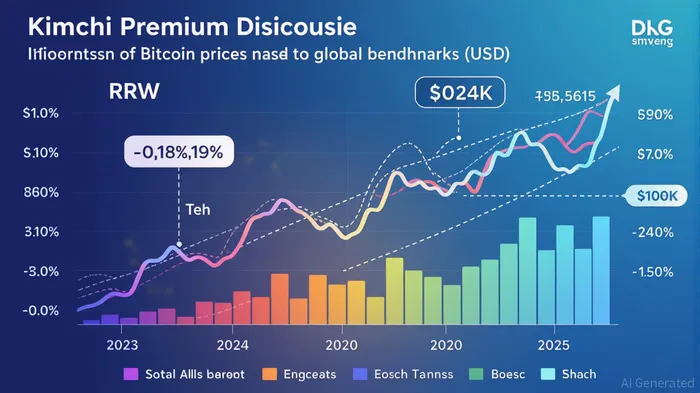
The Kimchi Premium, once a defining feature of South Korea's cryptocurrency market, has undergone a historic metamorphosis. By August 2025, BitcoinBTC-- traded at a -0.18% Kimchi Discount in South Korea—the first time in years that local prices fell below global averages. This reversal marks a pivotal shift in a market long characterized by speculative fervor, regulatory experimentation, and structural inefficiencies. For global arbitrageurs and institutional investors, the implications are profound: a maturing market is emerging, reshaped by regulatory rigor, evolving retail behavior, and macroeconomic forces.
Regulatory Shifts: From Speculation to Structure
The Virtual Asset User Protection Act (VAPUA), implemented in mid-2024, has been the most transformative force in this evolution. By enforcing stringent KYC/AML protocols, delisting non-compliant tokens, and mandating reserve transparency, the law has curtailed liquidity and speculative trading. On-chain analytics reveal a 22% decline in KRW deposits to South Korean exchanges by July 2025, directly correlating with the Kimchi Discount's emergence. While these reforms have enhanced investor protection, they have also stifled the arbitrage opportunities that once thrived in a fragmented, retail-driven market.
Capital controls further compound these effects. South Korea's foreign exchange regulations, which restrict large-scale fiat transfers, have prevented arbitrageurs from exploiting price gaps. A notable example is the $2,569 Bitcoin price disparity in July 2025, which persisted unaddressed due to regulatory friction. These structural barriers, though not unique to crypto, underscore the localized inefficiencies that persist even in a globally traded asset like Bitcoin.
Retail Behavior: From Hype to Hedging
South Korean retail investors, once the lifeblood of the Kimchi Premium, have shifted toward more diversified and cautious strategies. The surge in 3x leveraged foreign ETF investments—from $190 million in 2020 to $5.8 billion in 2023—reflects a broader trend toward institutional-grade approaches. This behavioral shift is further reinforced by macroeconomic factors: prolonged bear markets and global uncertainty have prompted profit-taking and capital preservation. In July 2025, EthereumETH-- and SolanaSOL-- traded at -0.23% and -0.13% discounts, respectively, signaling a market less susceptible to retail-driven volatility.
The government's impending approval of spot Bitcoin ETFs in late 2025 will likely accelerate this transition. Such products will attract institutional capital, further aligning local prices with global benchmarks. For arbitrageurs, this means reduced opportunities but also a more predictable market structure.
Macroeconomic Triggers: A Global Barometer
The Kimchi Discount is not merely a local phenomenon; it reflects broader macroeconomic trends. Prolonged bear markets and global liquidity constraints have forced investors to prioritize capital preservation over speculative gains. South Korea's market, once insulated by retail-driven anomalies, is now more responsive to global signals. This alignment is evident in the synchronized discounts observed across major altcoins, which mirror global liquidity conditions rather than localized sentiment.
However, residual inefficiencies persist. In late August 2025, Bitcoin briefly surged to a 0.25% Kimchi Premium, highlighting the lingering influence of retail-driven retail behavior. These short-term fluctuations suggest that while the market is maturing, it is not yet fully rationalized.
Strategic Implications for Investors
For arbitrageurs, the Kimchi Discount signals a need for agility. While large-scale arbitrage is no longer viable, fleeting opportunities may arise from regulatory updates, liquidity shifts, or cross-border capital flows. Investors must monitor these dynamics closely, particularly as South Korea's regulatory framework continues to evolve.
Institutional players, meanwhile, should focus on the infrastructure developments reshaping the market. The approval of spot Bitcoin ETFs, for instance, could catalyze further integration with global pricing mechanisms. For now, the Kimchi Premium remains a barometer of South Korea's path toward full integration into the global digital asset economy—a path marked by both progress and persistent challenges.
In conclusion, South Korea's Kimchi Premium has transformed from a retail-driven anomaly into a fluctuating indicator of market maturity. Regulatory shifts, evolving retail behavior, and macroeconomic forces have collectively reshaped arbitrage strategies, favoring discipline over speculation. As the market continues to align with global standards, investors must adapt to a landscape where efficiency and institutional-grade infrastructure prevail. The Kimchi Premium, now a Kimchi Discount, is no longer a relic of the past but a harbinger of a more integrated future.

Decoding blockchain innovations and market trends with clarity and precision.
Latest Articles
Stay ahead of the market.
Get curated U.S. market news, insights and key dates delivered to your inbox.






Comments
No comments yet