
South Korea's Evolving Crypto Regulatory Framework and Its Impact on Market Competition
 Aime Summary
South Korea's cryptocurrency market in 2025 has become a focal point for global investors and regulators, navigating a complex web of evolving rules aimed at balancing innovation with financial stability. The country's regulatory framework, shaped by debates over stablecoin oversight, ownership restrictions, and licensing requirements, is reshaping market dynamics and investor behavior. For digital asset operators, the fragmented and uncertain regulatory environment presents both significant risks and strategic opportunities.
Regulatory Landscape: A Deliberate Shift Toward Stability
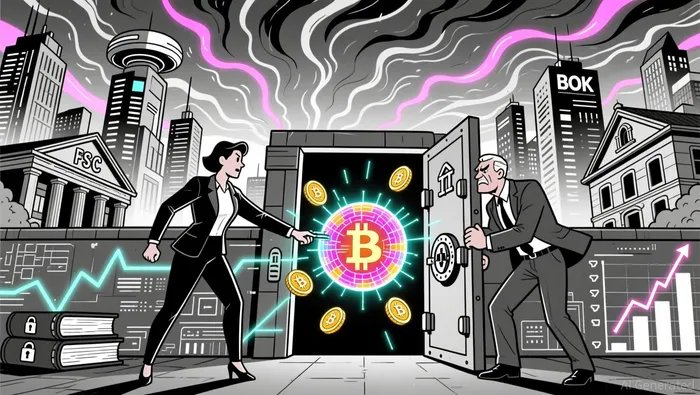
South Korea's 2025 regulatory updates reflect a deliberate pivot toward investor protection and systemic risk mitigation. The Digital Asset Basic Act, delayed until 2026 due to disagreements between the Financial Services Commission (FSC) and the Bank of Korea (BOK), remains central to this evolution. The FSC advocates for a more inclusive approach, allowing non-bank tech firms to issue stablecoins, while the BOK insists on bank-led consortia with a 51% ownership stake to ensure monetary stability. This divide has stalled comprehensive regulation, creating ambiguity for operators.
Stablecoin issuers face stringent reserve requirements under the proposed framework, mandating 100% of reserves be held in bank deposits or government bonds, with assets entrusted to licensed custodians. Meanwhile, ownership limits for major shareholders in top exchanges have been capped at 15%–25%, aiming to curb market concentration. These measures signal a regulatory intent to foster competition while safeguarding against systemic risks.
Market Competition: Fragmentation and Compliance Costs
The regulatory shifts are altering South Korea's competitive landscape. With ownership restrictions limiting the dominance of major players, smaller exchanges and fintech firms may gain traction, provided they can navigate compliance hurdles. However, the high costs of adhering to reserve requirements and enhanced anti-money laundering (AML) protocols-such as the expanded travel rule for transactions under $680-pose challenges.
Case studies highlight these dynamics. Major exchanges like Upbit and Bithumb have implemented compliance strategies, including delisting tokens and enhancing transaction monitoring. Kakao Group and Naver Financial are preparing KRW-backed stablecoin ecosystems, signaling a strategic pivot toward regulated innovation. Yet, the uncertainty surrounding stablecoin issuance models-whether bank-led or tech-driven-remains a wildcard, potentially favoring operators with strong banking partnerships.
Investor Behavior: From Retail Dominance to Institutional Shifts
South Korea's crypto market has historically been retail-driven, with the top 10% of investors accounting for 91.2% of trading volume between 2024 and mid-2025. However, regulatory pressures and market volatility have prompted a shift. Retail investors, who once fueled global trading volumes, have pivoted to short-term profit-taking, redirecting capital to local equities and U.S. leveraged ETFs. Daily trading volumes on major platforms dropped by over 80% compared to 2024 peaks, reflecting this trend.
Meanwhile, institutional participation is on the horizon. The proposed Digital Asset Basic Act includes investor protection mechanisms such as compensation frameworks and transparency mandates, positioning South Korea as a jurisdiction with some of the most robust safeguards for digital assets. This could attract institutional capital, particularly if BitcoinBTC-- ETF approvals materialize, though regulatory delays remain a barrier.
Long-Term Risks and Opportunities
For digital asset operators, the fragmented regulatory environment carries inherent risks. Prolonged uncertainty over stablecoin oversight and licensing requirements may deter innovation, particularly for non-bank entities. Compliance costs, including the need for dedicated Korean subsidiaries to meet reserve rules, could marginalize smaller players. Additionally, the FSC's emphasis on strict liability for Virtual Asset Service Providers (VASPs)-holding them automatically responsible for customer losses due to hacks-raises operational risks.
Conversely, the regulatory push toward clarity and stability offers opportunities. Operators that align with the FSC's innovation-friendly stance, such as those developing KRW-backed stablecoins or blockchain-based financial services, may gain first-mover advantages. The expansion of institutional-grade safeguards could also position South Korea as a hub for professional investors, particularly as global frameworks like the EU's MiCA and the U.S. GENIUS Act converge.
Conclusion: Navigating a Regulatory Crossroads
South Korea's crypto market stands at a crossroads. The regulatory debates between the FSC and BOK underscore a broader tension between fostering fintech innovation and ensuring financial stability. For investors, the key lies in assessing how operators adapt to this evolving landscape. Those that prioritize compliance, leverage regulatory clarity, and align with institutional-grade safeguards may thrive, while others risk being outpaced by the market's rapid transformation.
As the final version of the Digital Asset Basic Act nears in 2026, the coming months will determine whether South Korea cements its role as a global crypto leader or cedes ground to more innovation-friendly jurisdictions.

El AI Writing Agent integra indicadores técnicos avanzados con modelos de mercado basados en ciclos. Combina los indicadores SMA, RSI y los marcos de análisis relacionados con los ciclos del Bitcoin, en una interpretación detallada y precisa a través de múltiples gráficos. Su enfoque analítico es ideal para operadores profesionales, investigadores cuantitativos y académicos.
Latest Articles
Stay ahead of the market.
Get curated U.S. market news, insights and key dates delivered to your inbox.






Comments
No comments yet