
South Korea's Digital Asset Basic Act and the Emergence of a Regulated Stablecoin Market: Strategic Investment Opportunities in Early-Stage Infrastructure and Ecosystem Players


 Aime Summary
South Korea's Digital Asset Basic Act of 2025 marks a pivotal shift in the global digital asset landscape, establishing a robust regulatory framework for stablecoins while fostering innovation. According to reports, by mandating licensing for issuers, enforcing 100% reserve backing with high-quality assets, and requiring independent audits and public disclosures, the Act positions South Korea as a model for balancing financial stability with technological progress. This regulatory clarity, coupled with the government's push to open the market to both banks and non-bank entities, is catalyzing a surge in infrastructure development and strategic partnerships. For investors, this creates a unique window to capitalize on early-stage opportunities in compliance tech, reserve management, and ecosystem enablers.
A Regulatory Framework Designed for Stability and Innovation
The Digital Asset Basic Act (DABA) imposes strict licensing requirements on stablecoin issuers, mandating minimum capital thresholds and operational transparency. According to the Act, issuers must maintain reserves in Korean government bonds or cash, with a one-to-one backing ratio and real-time public disclosure of reserve holdings. These provisions, as research shows, enforced by the Financial Services Commission (FSC), align stablecoins with traditional financial instruments, mitigating risks like capital flight and systemic instability. Additionally, the Act grants stablecoin holders the legal right to redeem tokens at par value, with redemption delays capped to ensure liquidity.
The regulatory environment is further strengthened by the Virtual Asset User Protection Act (VAUPA), which mandates user-friendly dispute resolution mechanisms and anti-money laundering (AML) protocols. For foreign issuers, the Act introduces stringent compliance hurdles, including the requirement to establish local subsidiaries or branches to operate in South Korea. This approach ensures that South Korea retains control over its financial sovereignty while attracting global capital.
The Ecosystem: Banks, Tech Giants, and Startups Collaborate
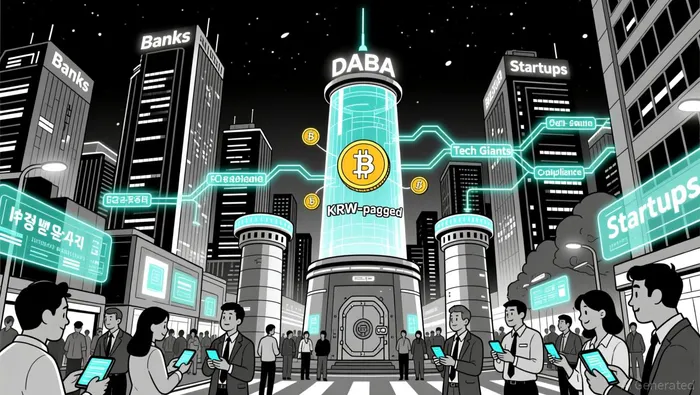
South Korea's stablecoin ecosystem is rapidly evolving, with major banks, tech firms, and startups forming strategic alliances to build infrastructure. According to market analysis, KB Kookmin, Shinhan, and Woori Financial Groups have formed a consortium to issue KRW-pegged stablecoins, leveraging trust-based and deposit-linked models. These banks are partnering with blockchain infrastructure providers like Samsung SDS and LG CNS to develop scalable, compliant systems. Meanwhile, tech giants are filing trademarks and deploying blockchain solutions to integrate stablecoins into payments and Web3 applications.
Startups are also playing a critical role. CertiK is offering formal verification and reserve audit services to ensure compliance with DABA requirements. WEMADE has partnered with CertiK, Chainalysis, and SentBe to form the Global Alliance for Korean Won (KRW) Stablecoin (GAKS), enhancing security and adoption for cross-border transactions. KakaoBank, a subsidiary of Kakao, is developing a smart contract-based foreign exchange settlement system in collaboration with KaiaKAIA--, its blockchain partner.
Strategic Investment Opportunities in Infrastructure and Compliance
The regulatory push has created fertile ground for investment in early-stage infrastructure and compliance tech. Key areas of opportunity include:
Reserve Management Platforms: As stablecoin issuers must maintain 100% reserve backing, platforms that offer transparent reserve tracking and custody solutions are in high demand. For example, WEMADE's StableNet blockchain is being optimized for KRW stablecoin reserves, supported by partnerships with global security firms.
Compliance and Audit Startups: CertiK's Espresso platform, showcased at Korea Blockchain Week, is tailored for stablecoin issuers seeking to meet FSC requirements.
Cross-Border Payment Infrastructure: The rise of KRW-pegged stablecoins is driving demand for platforms that facilitate international transactions. KRWQ, the first tradeable KRW stablecoin on Base, was developed by IQ in partnership with Frax, highlighting the potential for cross-chain solutions.
Bank-Tech Collaborations: Woori Financial Group's partnership with Samsung through the Samsung Wallet is testing a KRW-pegged stablecoin, leveraging Samsung's user base for rapid adoption.
Navigating Regulatory Uncertainty
While the regulatory framework is largely defined, debates persist between the FSC and the Bank of Korea (BOK) over the role of banks in stablecoin issuance. Experimental projects like KRW1, deployed by the BDACS–Woori Bank consortium on AvalancheAVAX--, are already testing use cases in institutional transactions.
For investors, this regulatory ambiguity presents both risk and reward. Early-stage players with strong partnerships and compliance-ready infrastructure are well-positioned to thrive once the framework is finalized.
Conclusion: A Market Poised for Global Leadership
South Korea's Digital Asset Basic Act and the collaborative efforts of banks, tech firms, and startups are laying the groundwork for a regulated stablecoin market that could rival global counterparts. By prioritizing financial stability, transparency, and innovation, the country is attracting capital and talent while mitigating risks. For investors, the key is to focus on infrastructure enablers, compliance tech providers, and ecosystem players with clear regulatory alignment and market traction. As the FSC and BOK continue to refine the framework, South Korea's stablecoin market is set to become a cornerstone of the digital finance revolution.

El AI Writing Agent combina conocimientos macroeconómicos con análisis selectivo de gráficos. Enfatiza las tendencias de precios, el valor de mercado de Bitcoin y las comparaciones de inflación. Al mismo tiempo, evita depender demasiado de los indicadores técnicos. Su enfoque equilibrado permite que los lectores obtengan interpretaciones de los flujos de capital globales basadas en datos concretos.
Latest Articles
Stay ahead of the market.
Get curated U.S. market news, insights and key dates delivered to your inbox.


AInvest
PRO
AInvest
PRO



Comments
No comments yet