
South Korea's Defense Surge: A Geopolitical Pivot and Investment Playbook
The geopolitical landscape of Northeast Asia is undergoing a seismic shift, driven by North Korea's nuclear ambitions, China's military expansion, and the U.S.'s push for allies to shoulder more defense burdens. South Korea's response—bolstering its defense budget to historic levels—has created a unique investment opportunity in a sector primed for growth. Here's why investors should pay close attention.
A Geopolitical Tinderbox Requires Military Investment
South Korea's 2025 defense budget stands at $44.6 billion, or 2.32% of GDP, marking a 3.1% increase from 2024. This spending outpaces that of key U.S. allies like Japan (1.16% of GDP) and Germany (1.44%), underscoring Seoul's urgency in countering threats. North Korea's relentless missile tests and China's assertive military modernization—its defense budget surged 7.2% to $293 billion in 2024—have left South Korea with little choice but to accelerate its own capabilities.
The U.S. has pressured allies to hit a 5% GDP defense spending target, but South Korea's leaders argue this is fiscally unsustainable. Instead, they are pursuing a measured path: a 2% compound annual growth rate (CAGR) until 2030, targeting $50.1 billion by decade's end. This trajectory, while modest, reflects a strategic focus on quality over quantity.
Defense Spending: Where the Money Is Going
South Korea's military modernization is concentrated in four areas critical to regional deterrence:
- Missile Defense: The Korean Air and Missile Defense (KAMD) system is being upgraded with THAAD interceptors, AI-enabled reconnaissance drones, and the domestically produced K239 Chunmoo rocket system.
- Cybersecurity and AI: Investments in quantum-resistant cybersecurity and AI-driven logistics are being led by firms like LIG Nex1, while partnerships with U.S. firms (e.g., Palantir) enhance command-and-control capabilities.
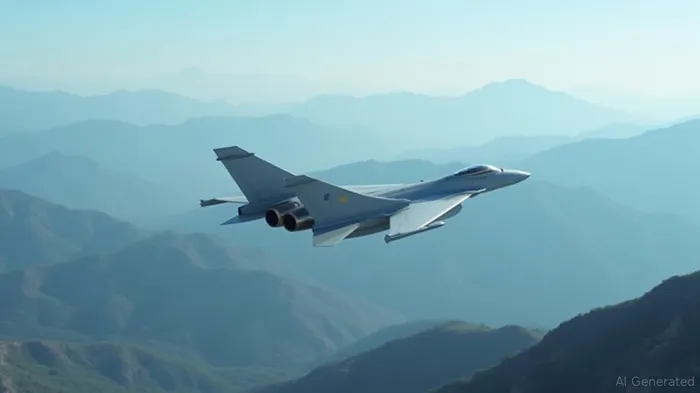
- Indigenization: South Korea aims to reduce reliance on U.S. technology through programs like the KF-21 fighter jet and K9 self-propelled howitzer. This strategy also creates export opportunities—Hanwha Defense recently secured a $2.4 billion contract with Ukraine.
- Regional Alliances: Seoul is deepening trilateral ties with the U.S. and Japan, focusing on interoperability and joint platforms to counter China's influence.
Investment Opportunities: Companies to Watch
The defense sector's growth hinges on companies executing these programs. Key players include:
- Hanwha Defense: A leader in artillery systems (K9) and missile defense, with exposure to export markets.
- LIG Nex1: Specializes in missile defense systems and cybersecurity, benefiting from rising cyber threats.
- Samsung Thales: Develops advanced radar and electronic warfare systems, crucial for modern combat platforms.
Valuation: A Sector on the Move
Despite its growth trajectory, the South Korean defense sector remains undervalued relative to its peers. Take Hanwha Defense: its price-to-earnings (P/E) ratio of 12 is below global defense giants like Lockheed Martin (16) or Raytheon (18), despite its strong export pipeline. The sector's focus on high-margin indigenous technology and export diversification also positions it well against fiscal pressures.
Risks and Considerations
- Diplomatic Shocks: A sudden peace deal with North Korea or U.S.-China détente could slow spending.
- Fiscal Limits: South Korea's public debt (now 54% of GDP) could constrain budgets if growth falters.
- Technological Overreach: Overcommitting to ambitious projects like AI integration might strain resources.
The Bottom Line: A Long-Term Play
South Korea's defense spending is less about hitting arbitrary GDP targets than about securing its place in a volatile region. Investors should focus on firms with export potential, technological differentiation, and exposure to long-term trends like missile defense and AI. With a 2% CAGR until 2030 and a geopolitical climate that demands constant vigilance, the sector offers a compelling risk-reward profile.
For now, the watchwords are: KAMD, KF-21, and self-reliance. The companies and markets that master these will thrive in South Korea's defense renaissance.

Stay ahead of the market.
Get curated U.S. market news, insights and key dates delivered to your inbox.


AInvest
PRO
AInvest
PRO



Comments
No comments yet