
South Korea's Defense Sector Earnings Surge on Record Arms Exports: A Geopolitical-Driven Investment Opportunity
 Aime Summary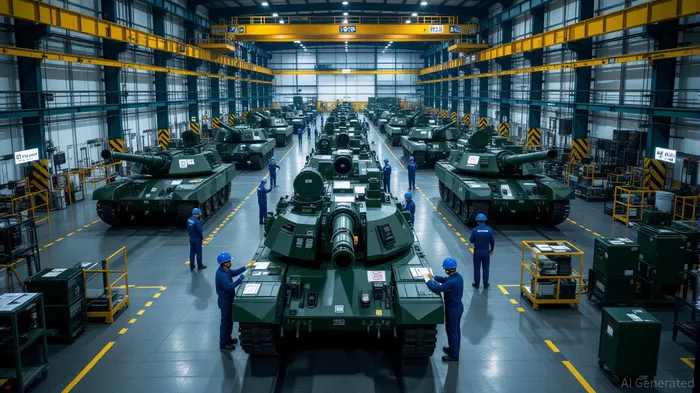
South Korea's defense industry has emerged as a geopolitical and economic powerhouse, driven by a confluence of global instability, strategic foresight, and technological innovation. From 2021 to 2025, the country's defense exports have surged from $7.3 billion to $14 billion annually, propelling it to the 10th largest arms exporter globally. This transformation is not merely a statistical anomaly but a calculated response to shifting global dynamics, particularly the Russia-Ukraine war, which has intensified demand for cost-effective, interoperable military systems. For investors, this represents a compelling long-term opportunity in a sector poised to redefine South Korea's role in international security and commerce.
Geopolitical Catalysts: From Regional Player to Global Pivotal State
South Korea's defense export boom is inextricably linked to its geopolitical ambitions under President Yoon Suk-yeol's “Global Pivotal State” vision. By aligning with like-minded democracies and leveraging its close alliance with the U.S., South Korea has positioned itself as a supplier of choice for nations seeking to modernize their militaries without the high costs of Western alternatives. The $22 billion Poland deal in 2022, for instance, was not just a commercial triumph but a strategic pivot, signaling South Korea's intent to engage deeply with European security frameworks.
The Russia-Ukraine conflict has further accelerated demand for South Korean systems, particularly the K-9 Thunder howitzer and K-2 Black Panther tank, which are interoperable with NATO standards. This compatibility, combined with faster delivery timelines and lower costs, has made South Korean exports attractive to countries like Saudi Arabia, Malaysia, and the Philippines. By 2023, South Korea had expanded its defense export markets from four to 12 countries, with six of these now ranking among the world's 40 largest importers.
Financial Performance: A Sector in Overdrive
The financial metrics of South Korea's defense industry underscore its explosive growth. In 2024, the combined sales of 31 listed defense companies reached ₩43.1 trillion ($30.3 billion), a 16% increase from 2023. Operating profits have more than tripled since 2021, reaching ₩3.64 trillion ($2.5 billion) in 2024. This outperformance is driven by companies like Hanwha Aerospace and Hyundai Rotem, which reported sales of ₩11.24 trillion and ₩4.38 trillion, respectively, in 2024.
The sector's stock market valuation reflects investor confidence. By August 2025, the aerospace and defense industry's market cap had reached ₩79.0 trillion, with a price-to-earnings (PE) ratio of 36x—well above historical averages. Earnings have grown at a 99% annual rate over three years, while revenues expanded by 24% annually. This performance is underpinned by a 3 trillion won ($2.1 billion) government investment to boost export capabilities and a $222 billion defense budget from 2021 to 2025.
Key Players: Strategic and Financial Powerhouses
Hanwha Aerospace (000240.KS) and Hyundai Rotem (012330.KS) are the sector's flagships. Hanwha's K-9 howitzer, sold to Poland, Saudi Arabia, and India, has become a global benchmark for artillery systems. Hyundai Rotem's K-2 tank, now deployed in Finland and Norway, exemplifies South Korea's ability to deliver advanced armor at competitive prices. Smaller but equally vital players like Hyundai Wia Corp. (009350.KS), the sole domestic gun barrel manufacturer, and Poongsan Corp. (009150.KS), a military ammunition supplier, have also seen sales surge by 55% and 100%, respectively.
The government's “Defense Innovation 4.0” initiative, focusing on AI, hypersonics, and quantum technologies, is further enhancing the sector's competitive edge. By 2030, South Korea aims to capture 15% of the global defense market, a target achievable given its current trajectory.
Investment Implications: Balancing Risk and Reward
For long-term investors, South Korea's defense sector offers a unique blend of geopolitical tailwinds and financial resilience. The sector's high PE ratio (36x) may appear elevated, but it is justified by its 99% earnings growth and the government's sustained investment. However, risks remain: geopolitical tensions between the U.S. and China could disrupt supply chains, and domestic political shifts might affect policy continuity.
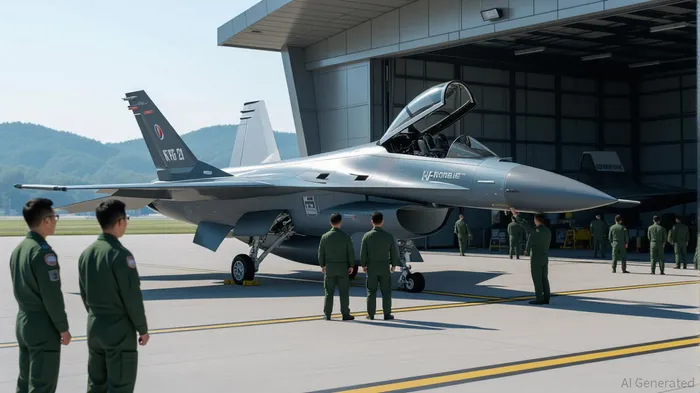
Despite these challenges, the sector's fundamentals are robust. South Korea's defense exports are projected to grow at a 6.10% CAGR through 2033, reaching $28.2 billion. For equity investors, this translates to a compelling case for exposure to companies like Hanwha Aerospace, Hyundai Rotem, and Korea Aerospace Industries (KAI), which are central to the country's export strategy.
Conclusion: A Strategic Bet on the Future
South Korea's defense sector is no longer a niche industry but a cornerstone of its global ambitions. The combination of geopolitical foresight, technological innovation, and financial discipline has created a self-reinforcing cycle of growth. For investors, this represents a rare opportunity to align with a sector that is not only economically transformative but also strategically pivotal in an increasingly fragmented world. As the Yoon administration pushes toward $20 billion in exports by 2027, the defense sector's trajectory suggests that the best is yet to come.

Stay ahead of the market.
Get curated U.S. market news, insights and key dates delivered to your inbox.


AInvest
PRO
AInvest
PRO



Comments
No comments yet