
South Korea's Debt Dilemma: Navigating Risks in Credit-Fueled Markets
South Korea's household debt has hit a record 1,928.7 trillion won ($1.39 trillion) as of March 2025, with its debt-to-GDP ratio stabilizing at 91%—still near a historic peak of 99.2% in 2021. This elevated leverage is fueled by surging mortgage loans in Seoul's luxury districts and speculative borrowing for stock and cryptocurrency investments. While regulators have tightened lending rules and hinted at interest rate cuts, the interplay between credit expansion, stock market buoyancy, and housing volatility creates a precarious balancing act for investors.
The Debt Dynamics: A Dual-Driven Expansion
The rise in household debt is split between two primary drivers. First, mortgage loans surged as Seoul's partial relaxation of land transaction permits in affluent districts like Gangnam and Seocho spurred housing price spikes. This regulatory easing, later reversed to curb speculation, temporarily boosted mortgage-driven borrowing. Second, unsecured loans for speculative investments—linked to the KOSPI index breaching 2,900 in early 2025—rebounded to 103.9 trillion won, the highest since late 2024.
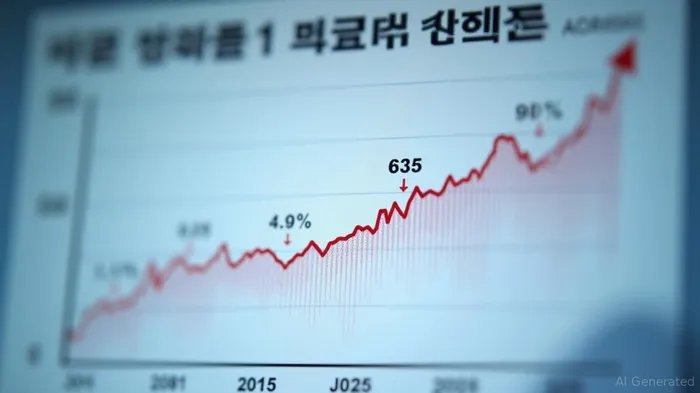
This dual boom has created a self-reinforcing cycle: rising home prices incentivize borrowing, while low interest rates and speculative financial markets sustain liquidity. However, the debt-to-disposable income ratio of 186.5%—meaning households owe nearly double their annual income—highlights systemic risks.
The Interplay: Stocks, Housing, and Borrowing
The stock and housing markets are inextricably linked to credit growth. Rising home prices in Seoul have driven mortgage demand, while the KOSPI's gains have attracted speculative capital, often funded by unsecured loans. This dynamic is precarious:
- Housing Market Volatility: Regulatory whiplash—easing land transaction rules only to reinstate them—creates uncertainty. A slowdown in Seoul's housing transactions (as seen in April 2025) could abruptly reduce mortgage-driven debt growth.
- Stock Market Speculation: Unsecured loans for crypto and stocks could reverse if the KOSPI corrects or interest rates rise. The Bank of Korea (BOK) warns that households with high debt-to-income ratios may face repayment strain if economic conditions worsen.
Risks and Regulatory Responses
The BOK has introduced stricter debt-service-coverage ratio (DSR) rules, effective July 2025, requiring lenders to stress-test loans with an additional 1.5% interest rate. While this aims to curb excessive borrowing, it may disproportionately hurt non-Seoul borrowers if exemptions expire by early 2026. Meanwhile, the BOK's hints of potential interest rate cuts—already lowering rates to 2.5%—risk encouraging further debt accumulation.
The central bank faces a dilemma: stimulate growth through lower rates or tighten to prevent a debt crisis. With household debt still near 91% of GDP, even a modest rise in unemployment or a stock market correction could trigger defaults, destabilizing banks like KB Kookmin and Shinhan Financial.
Investment Implications: Allocate Strategically
Investors must balance near-term opportunities with long-term risks. Here's how to navigate this landscape:
Avoid: Sectors Vulnerable to Credit Tightening
- Discretionary Retail and Auto: Overleveraged households may cut back on non-essential spending. Avoid retailers like Hyundai Department Store and automakers like Renault Samsung, which rely on consumer confidence.
- Speculative Real Estate: Non-essential commercial properties and luxury apartments in Seoul's restricted zones face regulatory and demand risks.
Favor: Resilient Sectors
- Essentials Retail: Companies like E-Mart and GS25 (convenience stores) benefit from stable demand for groceries and daily goods, even in downturns.
- Electric Vehicle (EV) Manufacturing: Hyundai, Kia, and battery maker LG Energy Solution align with global EV demand growth, a trend insulated from domestic credit cycles.
- Fintech and Payment Services: Firms like Kakao Pay and Naver Pay are positioned to capture digital payment adoption, while their services are less cyclical.
- Financial Institutions with Conservative Lending: Banks like Shinhan Financial that have diversified revenue streams beyond mortgages may weather tighter rules better.
Monitor: Equity Market Valuations
The KOSPI's current valuation—near 2,900—depends on speculative flows. A pullback could expose overleveraged investors.
Real Estate: Focus on Urban Regeneration and Logistics
- Urban Regeneration Projects: Government-backed initiatives in Seoul's less affluent areas may offer safer returns than luxury housing.
- Logistics REITs: Demand for warehouses and distribution centers, driven by e-commerce, is less tied to speculative cycles.
Conclusion: Prudence Amid Uncertainty
South Korea's credit-fueled growth is unsustainable at current debt levels. While sectors like EVs and essentials offer resilience, investors must remain cautious on consumer discretionary stocks and speculative real estate until the BOK's tightening cycle eases. Monitor debt-to-GDP trends and regulatory shifts closely—this is a market where preparation for volatility is key.
In the words of the BOK: “The risks are clear, but the path to resolution requires patience.” For investors, that means favoring stability over speculation—and holding cash reserves for when the cycle turns.

Stay ahead of the market.
Get curated U.S. market news, insights and key dates delivered to your inbox.


AInvest
PRO
AInvest
PRO



Comments
No comments yet