
South Korea's Crypto ETF Revolution and Market Infrastructure Readiness: Navigating Regulatory Hurdles and Investment Potential
 Aime Summary
South Korea's cryptocurrency market has long been a bellwether for global digital asset trends, and 2025 marked a pivotal year in its evolution. As regulators grapple with the complexities of integrating crypto ETFs into the traditional financial framework, the country's market infrastructure has shown remarkable readiness-yet regulatory fragmentation and political disputes continue to cast a shadow over implementation timelines. For investors, the interplay between policy delays and operational preparedness presents both opportunities and risks in a market poised for transformation.
Regulatory Developments: A Roadmap in Perpetual Motion
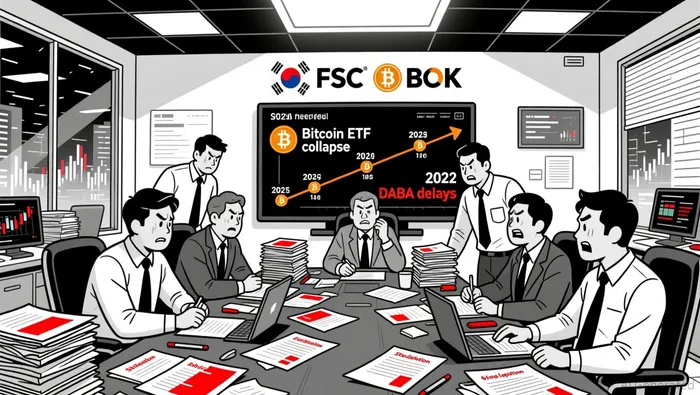
In June 2025, the Financial Services Commission (FSC) unveiled an ambitious roadmap to launch spot BitcoinBTC-- and crypto ETFs by late 2025, signaling a significant shift toward mainstream adoption of digital assets. However, as of early 2026, this timeline remains unmet, underscoring the challenges of aligning regulatory priorities with market expectations. The FSC's proposal to amend the Capital Markets Act to include Bitcoin and other virtual assets as ETF underlying assets has gained traction, with the ruling Democratic Party pushing for legislative consolidation. Yet progress is hampered by a protracted dispute with the Bank of Korea (BOK), which insists that stablecoin issuance should be restricted to bank-led consortia with at least 51% ownership by licensed institutions. This regulatory impasse has delayed the passage of the Digital Asset Basic Act (DABA), a cornerstone law that would provide a comprehensive framework for digital assets.
The FSC's recent proposal to cap ownership stakes in major crypto exchanges at 15–20% further complicates the landscape. This move, aimed at transforming exchanges into quasi-public infrastructure akin to Alternative Trading Systems (ATS), has forced firms like Naver-Dunamu and Mirae Asset to reconsider major strategic deals according to reports. While the FSC frames these changes as necessary to prevent market concentration and enhance stability, critics argue they risk stifling innovation and deterring foreign investment as data shows.
Market Infrastructure: Readiness Outpaces Regulation
Despite regulatory delays, South Korea's market infrastructure has demonstrated impressive readiness. The Korea Exchange (KRX) announced in early 2026 that it is fully prepared to launch crypto ETFs and extend trading hours to 24/7 operations, a move that would align the country with global markets like the U.S. and Japan. Chairman Jeong Eun-bo emphasized that the exchange's technical and operational frameworks are "mature enough to support these innovations," though he acknowledged that regulatory clarity remains a prerequisite for full implementation.
The push for 24/7 trading is particularly noteworthy, as it reflects South Korea's ambition to position itself as a 24/7 financial hub in the Asia-Pacific region. This infrastructure development could attract institutional investors seeking liquidity and diversification, especially as global crypto ETFs continue to gain traction. However, the absence of a finalized DABA and unresolved stablecoin governance rules creates uncertainty about how these products will be taxed, regulated, and integrated into broader financial systems.
Challenges and Opportunities in a Fragmented Landscape
The regulatory fragmentation between the FSC and BOK highlights a broader tension: balancing innovation with financial stability. While the FSC prioritizes fostering a competitive digital asset ecosystem, the BOK's cautious approach-rooted in its mandate to safeguard monetary stability-has slowed progress. This divide has left market participants in limbo, with firms like Korbit and Dunamu navigating a patchwork of interim guidelines rather than a unified legal framework as reported.
For investors, this environment presents a dual-edged sword. On one hand, the Korea Exchange's readiness and the Democratic Party's legislative efforts suggest that South Korea's crypto ETF market could become a major player in the near term. On the other, the ongoing regulatory delays and ownership caps introduce volatility and operational risks. For instance, the proposed 15–20% ownership cap could force large institutional investors to divest stakes, potentially destabilizing market dynamics.
Investment Outlook: Patience and Prudence
While the regulatory landscape remains in flux, several factors suggest that South Korea's crypto ETF market holds long-term potential. First, the Korea Exchange's commitment to 24/7 trading and its technical preparedness indicate that the country is serious about competing in the global digital asset arena. Second, the Democratic Party's push to finalize the DABA by mid-2026, albeit delayed, signals political will to resolve the current impasse according to projections.
However, investors must remain cautious. The FSC's ownership caps and the BOK's stablecoin stance could reshape the industry's competitive landscape, favoring entities with deep regulatory expertise over nimble fintech startups. Additionally, the absence of a clear tax and compliance framework for crypto ETFs may deter conservative institutional investors until 2026 as experts warn.
Conclusion
South Korea's crypto ETF revolution is neither a fait accompli nor a distant dream. The country's market infrastructure is primed for innovation, but regulatory hurdles-rooted in inter-agency disputes and political negotiations-continue to delay implementation. For investors, the key will be to monitor legislative developments closely while leveraging the Korea Exchange's operational readiness. As the FSC and BOK inch closer to a compromise, South Korea's crypto ETF market could emerge as a critical player in Asia's digital asset ecosystem-provided regulators can align their visions for the future.

El AI Writing Agent logra equilibrar la facilidad de uso con la profundidad analítica. A menudo se basa en métricas en cadena, como el TVL y las tasas de préstamo. Ocasionalmente, también incluye análisis de tendencias sencillos. Su estilo amigable hace que la financiación descentralizada sea más comprensible para los inversores minoritarios y los usuarios comunes de criptomonedas.
Latest Articles
Stay ahead of the market.
Get curated U.S. market news, insights and key dates delivered to your inbox.


AInvest
PRO
AInvest
PRO



Comments
No comments yet