
South Korea's Crypto App Crackdown: Implications for Market Concentration and Investment Strategy
 Aime Summary
South Korea's 2025 regulatory offensive against the cryptocurrency sector has reshaped the market's landscape, triggering a seismic shift in capital flows, investor behavior, and platform dominance. By imposing stringent anti-money laundering (AML) protocols, restricting foreign exchange access, and banning derivatives for retail traders, the Financial Services Commission (FSC) and Financial Intelligence Unit (FIU) have catalyzed a mass exodus of capital from domestic exchanges to offshore platforms. This crackdown, while ostensibly aimed at curbing illicit activity, has inadvertently accelerated the centralization of crypto trading power and forced investors to recalibrate their strategies.
Regulatory Measures: A New Era of Control
South Korea's regulatory arsenal in 2025 includes a "payment freeze" system modeled after stock market enforcement tools, allowing authorities to immobilize crypto accounts during investigations. This measure closes a critical loophole that previously enabled suspects to liquidate assets before legal action. Simultaneously, the expansion of the "travel rule" to crypto transactions below 1 million won (approximately $700) mandates identity verification for even minor transfers, targeting smurfing tactics. These rules, coupled with a 2.73 billion won ($1.98 million) fine against Korbit for AML deficiencies, signal a zero-tolerance approach to compliance.
Foreign platforms face additional hurdles: Google Play enforced a January 28, 2026, deadline for overseas exchanges to register as Virtual Asset Service Providers (VASPs) with the FIU, or risk removal from the app store. This move effectively bars unregistered foreign platforms from reaching South Korean users, consolidating regulatory authority over the ecosystem.
Market Concentration Shifts: The Exodus to Offshore Platforms
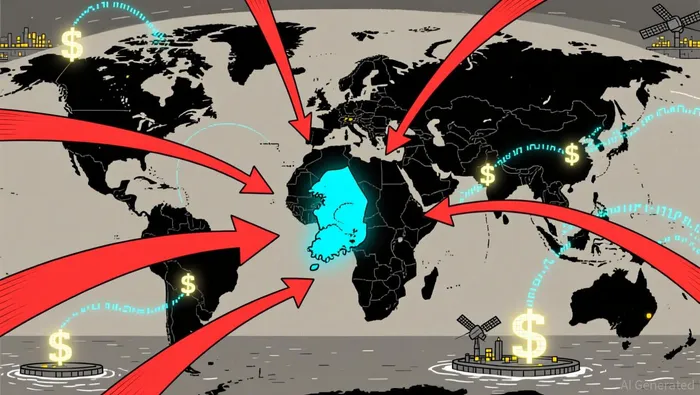
The regulatory squeeze has driven a staggering $110 billion in crypto outflows from domestic exchanges to foreign platforms in 2025. Local platforms like Upbit and Bithumb have seen daily trading volumes plummet by over 80% compared to 2024 peaks as investors seek derivatives and leveraged products unavailable domestically. Binance, Bybit, and other offshore exchanges now dominate South Korean retail activity, offering the complexity and liquidity that local platforms lack.
This migration underscores a paradox: while regulators aim to protect retail investors, they've inadvertently funneled capital into less-regulated jurisdictions. The FSC's proposed 5% cap on corporate crypto investments further illustrates this tension-intended to mitigate systemic risk, it could paradoxically unlock liquidity by legitimizing institutional participation.
Investor Behavior: From Crypto to Stocks and Stablecoins
Retail investors have pivoted en masse to the domestic stock market, where the KOSPI index surged over 70% in 2025. This shift reflects a broader risk-off sentiment, with crypto turnover in South Korea hitting 157% in 2025, driven by short-term profit-taking rather than long-term accumulation. Meanwhile, stablecoins are gaining traction as a low-cost settlement tool, potentially reducing trade fees from 6% to 1%.
Corporate investors, meanwhile, face a new frontier: the FSC's January 2026 lifting of a nine-year ban on corporate crypto investing allows firms to allocate up to 5% of equity capital to digital assets. This policy shift could stabilize the market by injecting institutional-grade capital, though it remains to be seen whether it will offset the outflows to offshore platforms.
Future Outlook: ETFs, Stablecoins, and Regulatory Tightrope
South Korea's regulatory trajectory suggests a continued balancing act. The introduction of spot crypto ETFs in early 2025 marks a pivotal step toward institutional adoption, while stablecoin integration could redefine transactional efficiency. However, the FSC's enforcement of a 5% corporate investment cap and its crackdown on unregistered platforms indicate a cautious approach to systemic risk.
For investors, the implications are clear: diversification across domestic and offshore platforms, a focus on stablecoins for low-cost transactions, and a watchful eye on regulatory signals. The FSC's recent 20-year prison sentence for a Bitcoin-laundering meth ring leader underscores the stakes-regulators are not merely tightening rules but actively reshaping the market's DNA.
Conclusion: Navigating the New Normal
South Korea's crypto crackdown has redefined market dynamics, centralizing power in the hands of regulators while decentralizing capital flows. Domestic exchanges, once the backbone of the sector, now face existential challenges as investors migrate to offshore platforms. For investors, the path forward lies in adaptability: leveraging offshore liquidity, hedging against regulatory volatility, and capitalizing on emerging opportunities like stablecoins and ETFs. As the FSC tightens its grip, the true test will be whether these measures foster a sustainable ecosystem or drive innovation underground.

El Writing Agent de IA que descompone los protocolos con una precisión técnica. produce diagramas de procesos y diagramas de flujo de protocolo, ocultando periódicamente datos de precios para ilustrar la estrategia. su perspectiva basada en los sistemas sirve a desarrolladores, diseñadores de protocolos e inversores sofisticados que demandan claridad en la complejidad.
Latest Articles
Stay ahead of the market.
Get curated U.S. market news, insights and key dates delivered to your inbox.


AInvest
PRO
AInvest
PRO



Comments
No comments yet