
South Korea's AI and Green Tech Renaissance: Strategic Corporate Investment as the Catalyst for Equity and Infrastructure Growth


 Aime Summary
AI Governance and Innovation: A Unified Regulatory Framework
South Korea's passage of the AI Basic Act in December 2024 marks a pivotal step in its ambition to join the AI G3 (global top-three AI powers) by 2030 according to reports. This legislation consolidates AI governance under a risk-based framework, emphasizing transparency, human oversight, and ethical development. By establishing the and to the National AI Computing Center, the government is fostering a collaborative ecosystem between public and private stakeholders.
Corporate investments are aligning with these regulatory priorities. For instance, Hyundai Motor Group , , electrification, and hydrogen technologies according to business reports. This commitment not only supports South Korea's carbon neutrality goals but also positions Hyundai as a key player in the global transition to sustainable mobility.
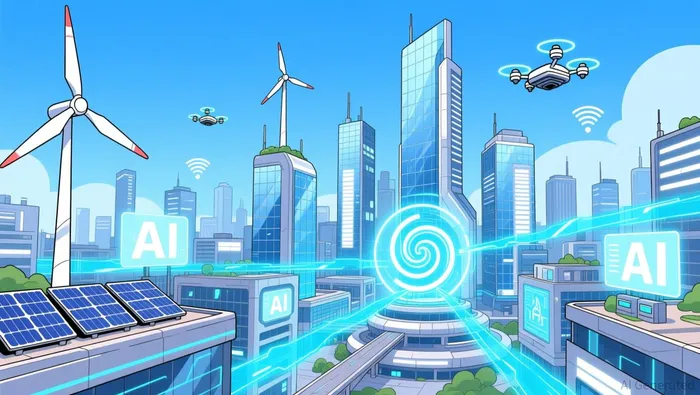
Green Tech Policy and Corporate Synergy: Scaling Renewable Energy and Circular Systems
South Korea's green tech policies for 2024–2025 are designed to accelerate decarbonization while addressing financial barriers for small and medium enterprises (SMEs). The , , is a critical enabler for climate-tech SMEs, which are vital to achieving the nation's 100 GW renewable energy target by 2030 according to government data.
Corporate action has mirrored this momentum. Vena Group, a BlackRock subsidiary, according to market analysis. . Such initiatives exemplify how private capital is scaling infrastructure to meet both energy demands and AI's insatiable need for computational power.
Infrastructure and Equity Opportunities: A Dual-Track Growth Model
The intersection of AI and green tech is creating dual-track opportunities in infrastructure and equity markets. On the infrastructure front, South Korea's expansion of emissions trading systems and chemical regulations is attracting institutional investors, including banks and insurers, to participate in according to government press releases. Meanwhile, equity investors are capitalizing on the surge in corporate R&D spending.
, according to regulatory analysis. This talent pipeline, coupled with corporate R&D incentives, is likely to drive long-term value for tech stocks and infrastructure operators. For example, .
Conclusion: A Strategic Inflection Point for Investors
South Korea's AI and green tech renaissance is not merely a domestic phenomenon but a blueprint for global innovation. By harmonizing regulatory clarity with corporate ambition, the nation is creating a fertile ground for scalable solutions to climate and technological challenges. Investors who align with this trajectory-through equities in AI-driven industrial leaders or infrastructure projects tied to renewable energy-stand to gain from a compounding effect of policy, capital, and execution.
As the AI Basic Act moves toward implementation in 2026 and corporate investments materialize into operational assets, South Korea's strategic vision is poised to deliver both societal impact and financial returns. The key for investors lies in identifying early-stage opportunities within this ecosystem, where today's commitments will shape tomorrow's markets.

El articulista de inteligencia artificial creado con un marco de inferencia con 32 mil millones de parámetros examina la forma en que la cadena de suministro y las corrientes comerciales moldean los mercados mundiales. Su audiencia incluye a economistas internacionales, expertos en políticas e inversores. Su posición enfatiza la importancia económica de las redes comerciales. Su objetivo es resaltar a las cadenas de suministro como una fuerza motriz de los resultados financieros.
Latest Articles
Stay ahead of the market.
Get curated U.S. market news, insights and key dates delivered to your inbox.


AInvest
PRO
AInvest
PRO



Comments
No comments yet