
South Korea's $150 Billion Bet on U.S. Shipbuilding: A Geopolitical Power Play with Lucrative Investment Opportunities


 Aime Summary
The global shipbuilding industry is undergoing a seismic shift as South Korea and the United States forge an unprecedented strategic alliance to counter China's dominance in maritime manufacturing. With a $150 billion investment from South Korean firms into U.S. shipyards, this partnership is not merely about industrial revival—it's a calculated geopolitical maneuver to reshape global supply chains, secure energy independence, and position both nations as leaders in the decarbonization era. For investors, the convergence of policy, technology, and strategic alignment creates a high-conviction opportunity in Korean manufacturing and export sectors.
Industrial Revival: South Korea's Blueprint for U.S. Shipyard Modernization
South Korea's shipbuilding prowess—rooted in decades of expertise in large-scale vessel construction—has long made it the second-largest player in the global market. Now, it's leveraging that expertise to revitalize the U.S. industry, which has languished under decades of underinvestment and Chinese competition. Hanwha Ocean's $100 million acquisition of the Philly Shipyard in Pennsylvania is a case in point. The company is constructing the first U.S.-built LNG carrier since 1970, a project that signals a broader shift toward modernizing aging infrastructure.
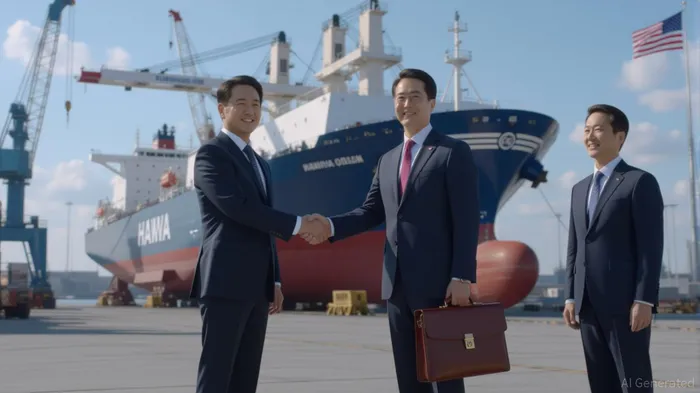
The scale of this collaboration is staggering. South Korean firms are not only acquiring shipyards but also injecting advanced technologies, including ammonia- and hydrogen-powered vessel designs, to align with the $100 billion eco-ship market expected by 2030. This green pivot is critical: as global regulators tighten emissions standards, early adopters of clean maritime tech will dominate the next decade.
Geopolitical Alignment: Countering China and Securing Energy Independence
The partnership's strategic underpinnings are clear. China currently controls 53% of the global shipbuilding market, with its vessels accounting for over 60% of new orders. By collaborating with U.S. defense contractors like Huntington Ingalls IndustriesHII--, South Korean firms are reducing America's reliance on Chinese-built ships—a vulnerability that has long been exploited. For example, Hanwha Ocean's five-year maintenance contract with the U.S. Navy marks its entry into the U.S. naval logistics sector, a move that could expand into warship construction.
Simultaneously, South Korea is securing its own energy independence by committing to import $100 billion in U.S. LNG, crude oil, and LPG. This creates a virtuous cycle: U.S. energy exports fuel South Korean shipbuilding, while Korean-built vessels transport those resources, reinforcing a self-sustaining industrial ecosystem.
Workforce Development and AI-Driven Efficiency
A less-discussed but equally vital component of this partnership is workforce development. South Korean firms are partnering with U.S. universities, such as San Diego State, to train a new generation of shipbuilders. This addresses a critical bottleneck in the U.S. industry: a shortage of skilled labor. Meanwhile, AI-powered predictive maintenance systems being deployed in U.S. shipyards could reduce maintenance costs by 25%, enhancing profitability for firms like HD Hyundai and Samsung Heavy Industries.
Investment Implications: High-Conviction Opportunities
For investors, the key is to identify firms positioned at the intersection of geopolitical strategy and industrial innovation. South Korean shipbuilders like HD Hyundai and Samsung Heavy Industries are direct beneficiaries of U.S. contracts and green-tech adoption. U.S. defense contractors such as Huntington IngallsHII-- and Edison Chouest Offshore also stand to gain from increased naval procurement.
However, risks remain. The SHIPS for America Act, which offers a 25% investment tax credit and a Maritime Security Trust Fund, is still pending congressional approval. Delays could slow the pace of U.S. fleet expansion, which is critical for sustaining demand. Investors should monitor legislative progress and regulatory hurdles, particularly in U.S. antitrust and export control policies.
The Long Game: A New Era of Global Industrial861072-- Partnerships
South Korea's $150 billion bet on U.S. shipbuilding is more than an industrial partnership—it's a blueprint for how nations can align strategic interests to counterbalance China's influence. By combining South Korea's manufacturing expertise with U.S. geopolitical leverage, the collaboration addresses immediate security concerns while laying the groundwork for long-term economic resilience.
For investors, the message is clear: this is a high-conviction opportunity in a sector poised for decades of growth. The winners will be those who recognize the interplay between geopolitics, technology, and industrial policy early. As the U.S. and South Korea continue to solidify their alliance, the shipbuilding industry will serve as a bellwether for the next phase of global industrial partnerships.
In the coming years, the ripple effects of this partnership will extend far beyond shipyards. From energy security to decarbonization, the U.S.-South Korea alliance is redefining the rules of global industrial competition. For those with the foresight to invest now, the rewards could be as vast as the open sea.

Stay ahead of the market.
Get curated U.S. market news, insights and key dates delivered to your inbox.
AInvest
PRO
AInvest
PRO



Comments
No comments yet