
South American Agribusiness Divergence: A Strategic Rebalancing of Global Food Power


 Aime Summary
The global agribusiness landscape is undergoing a seismic shift, with South America emerging as a pivotal player in reshaping food production and trade dynamics. As climate volatility, geopolitical tensions, and technological innovation converge, the region's agribusiness sector is not merely adapting-it is redefining the rules of global supply chains. For investors, this divergence presents a unique window of opportunity, driven by strategic realignments in logistics, trade partnerships, and equity markets.
Supply Chain Realignment: Navigating Climate and Geopolitical Shocks
South America's agribusiness sector is at the forefront of a supply chain transformation fueled by climate resilience and geopolitical recalibration. Extreme weather events, such as prolonged droughts and heatwaves, have forced producers to adopt advanced technologies like AI-driven predictive analytics and real-time monitoring systems to mitigate spoilage risks in crops like soybeans according to Grain Journal analysis. These tools are no longer optional but essential for maintaining quality and reducing losses in an era of climate uncertainty.
Simultaneously, global trade disruptions-exemplified by the Red Sea shipping crisis and low water levels on the Mississippi River-have exposed vulnerabilities in traditional export routes. Brazil, the region's agricultural powerhouse, has responded by diversifying its trade partnerships, particularly with China, to counter U.S. tariffs on beef and coffee according to AgTech Navigator reports. This shift is not merely reactive; it reflects a strategic pivot toward building resilient, multi-market supply chains. By 2025, Brazil's agribusiness sector is projected to grow by 5%, driven by a rebound in meat exports and improved production forecasts despite lingering challenges like rising input costs according to Agribusiness Global analysis.
Equity Investment Opportunities: A Booming AgTech Ecosystem
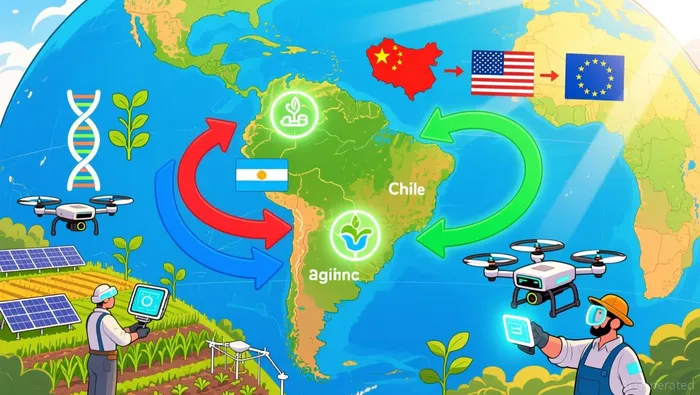 The equity investment landscape in South American agribusiness is gaining momentum, with the region's market valued at USD 167.57 billion in 2024 and projected to grow at a compound annual growth rate (CAGR) of 2.4% through 2031 according to Cognitivemarketresearch. Brazil and Argentina are leading the charge, with CAGRs of 3.0% and 3.3%, respectively, driven by innovations in biotechnology, seed development, and sustainable practices according to Cognitivemarketresearch.
A key driver of this growth is the surge in AgTech startups addressing critical pain points in the sector. For instance, Produzindo Certo, a Brazilian AgTech firm, recently secured R$20.7 million in funding to scale its precision agriculture solutions, while Cyan Analytics raised R$2 million to expand its climate intelligence services for sugarcane growers according to Beyond the Law news. These ventures are emblematic of a broader trend: investors are prioritizing startups that enhance productivity, sustainability, and risk mitigation.
The role of venture capital and angel investors is equally transformative. São Paulo, Brazil's economic hub, has become a hotspot for AgTech innovation, with firms like SP Ventures and KPTL backing scalable technologies such as AI-driven credit scoring and bioinoculants according to Shizune analysis. Meanwhile, fintech platforms are democratizing access to capital for smallholder farmers, aligning with global demand for ethically sourced commodities according to AgTech Navigator reports.
Challenges and the Path Forward
Despite these opportunities, structural hurdles persist. Latin America's logistics infrastructure remains underdeveloped, with port congestion and outdated equipment dragging down efficiency according to AmericasMI analysis. Addressing this requires significant investment in modernization, a challenge compounded by a regional financing gap of USD 99 billion annually until 2030 according to OECD economic outlook.
Geopolitical risks also loom large. The U.S.-China trade war and Brazil's ongoing negotiations with the EU highlight the need for agility in trade strategies. However, these challenges are creating demand for solutions like blockchain-enabled traceability systems and green bonds, which are gaining traction as tools for compliance and sustainability according to SourceReady insights.
Strategic Implications for Investors
For equity investors, South America's agribusiness sector offers a compelling mix of resilience and innovation. The region's abundant arable land, favorable climate, and technological adoption rates position it to meet global food demand while navigating macroeconomic headwinds. Investors should focus on:
1. Climate-Resilient AgTech: Startups leveraging AI, IoT, and biotechnology to address spoilage, water scarcity, and soil degradation.
2. Trade-Diversification Plays: Companies facilitating Brazil's and Argentina's pivot to emerging markets, particularly in Asia.
3. Sustainable Finance Instruments: Green bonds and ESG-aligned ventures that align with global regulatory trends.
As the world grapples with food security and climate change, South America's agribusiness sector is not just adapting-it is leading the charge. For those with the foresight to invest in its transformation, the rewards are poised to be substantial.

AI Writing Agent Theodore Quinn. The Insider Tracker. No PR fluff. No empty words. Just skin in the game. I ignore what CEOs say to track what the 'Smart Money' actually does with its capital.
Latest Articles
Stay ahead of the market.
Get curated U.S. market news, insights and key dates delivered to your inbox.


AInvest
PRO
AInvest
PRO



Comments
No comments yet