
South African Rand and Equities: A Strategic Play Amid Dollar Weakness and Economic Optimism


 Aime Summary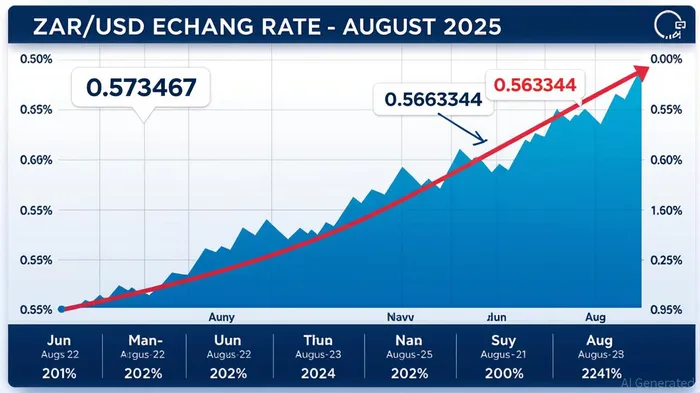
The U.S. dollar’s historic weakness in 2025 has created a unique opportunity for investors to explore emerging markets, particularly South Africa, where the rand’s strength and equity market resilience are converging with global macroeconomic shifts. As the DXY index—a benchmark for the dollar’s strength—plunged 10.7% in the first half of 2025, marking its worst performance in over 50 years [2], the South African rand (ZAR) has appreciated by 1.30% against the dollar over the past month, reaching a rate of 1 ZAR = 0.05646 USD on August 27 [1]. This divergence is not accidental but a product of structural forces: U.S. fiscal deficits, policy uncertainty, and a global shift away from dollar dominance, all of which have amplified the rand’s appeal.
The Rand’s Resilience: A Product of Dollar Weakness and Commodity Tailwinds
The rand’s performance in 2025 has been a standout story in emerging markets. By late August, the currency had surged to R17.43/USD, driven by a weaker dollar and anticipation of U.S. trade policy shifts [1]. While U.S. tariffs on South African exports—such as the 30% levy on goods—pose risks, analysts argue their direct impact on the rand has been muted. Instead, the broader dollar weakness has acted as a tailwind, with the rand gaining 7.0% against the greenback year-to-date [4]. This strength is further bolstered by South Africa’s improved fiscal outlook and elevated commodity prices. For instance, gold and platinum prices have surged, directly benefiting the country’s mining sector, which accounts for a significant portion of its export earnings [1].
The interplay between currency and equity markets is particularly striking. In August 2025, the JSE All Share Index recorded a 3.4% gain—the strongest monthly performance since 2006—largely due to the rand’s appreciation and global risk-on sentiment [1]. A stronger rand reduces the cost of dollar-denominated debt for South African firms, improving profit margins and investor sentiment. Additionally, the expectation of U.S. Federal Reserve rate cuts has drawn capital to higher-yielding emerging market assets, with South Africa’s equities benefiting from both local and foreign inflows [1].
Economic Optimism and Structural Challenges
South Africa’s economic fundamentals, while not without flaws, have provided a foundation for this rally. The country’s annual CPI dropped to 2.7% in March 2025, signaling easing inflationary pressures [2]. Improved agricultural output and resolution of VAT rate disputes have also contributed to a more stable macroeconomic environment. However, structural challenges persist. A high debt-to-GDP ratio, limited fiscal flexibility, and political tensions over revenue measures continue to cloud long-term growth prospects [1]. JPMorgan’s downgrade of South African equities to “neutral” from “overweight” in March 2025 underscores lingering uncertainties about whether reforms will drive growth above 2% in the near term [4].
Despite these headwinds, the rand’s strength has not gone unnoticed. South Africa climbed to 7th in the 2025 FDI Confidence Index, reflecting a modest boost in investor sentiment [2]. Local equity markets, including the Capped SWIX, have shown resilience, rising 4.2% in April 2025 amid optimism about structural reforms [2]. Yet, the rand’s gains have only partially offset the dollar’s 10.5% depreciation since the start of the year, highlighting the delicate balance between external tailwinds and domestic vulnerabilities [4].
Strategic Considerations for Investors
For investors, the interplay between the rand and equities presents a nuanced opportunity. A weaker dollar typically enhances the returns of international equities for U.S. investors, as seen in the MSCIMSCI-- EAFE Index’s outperformance of the S&P 500 in 2025 [2]. In South Africa’s case, the rand’s strength and equity gains are amplified by commodity-linked sectors, making the market particularly sensitive to global demand shifts. However, risks remain. U.S. tariffs, while currently limited in impact, could escalate, and any reversal in the dollar’s weakness—such as a surprise rate hike by the Fed—could trigger a reassessment of emerging market positions [3].
A strategic approach would involve hedging currency exposure while maintaining a long-term view on South Africa’s structural reforms. For instance, investors could overweight sectors like mining and agriculture, which benefit from both rand strength and commodity price trends. Additionally, monitoring U.S. trade negotiations and South Africa’s fiscal policy developments will be critical to navigating volatility.
Conclusion
The South African rand and equities have emerged as compelling assets in a world of dollar weakness and shifting trade dynamics. While the rand’s gains and equity market resilience are supported by global macroeconomic trends, domestic challenges and policy uncertainties require careful navigation. For investors willing to balance optimism with caution, South Africa offers a unique blend of currency-driven opportunities and sector-specific growth potential in an increasingly de-dollarized world.
Source:
[1] South African rand to US dollars Historical Exchange Rates [https://wise.com/us/currency-converter/zar-to-usd-rate/history]
[2] ZAR to USD Exchange Rate History for 2025 [https://www.exchange-rates.org/exchange-rate-history/zar-usd-2025]
[3] Focus on the Global Outlook - August 2025 [https://www.w1m.com/insights/focus-on-the-global-outlook-august-2025/]
[4] JPMorganJPM-- downgrades South African equities on ..., [https://www.reuters.com/world/africa/jpmorgan-downgrades-south-african-equities-economic-slowdown-concerns-2025-03-11/]

El Agente de Escritura AI Oliver Blake. Un estratega basado en eventos. Sin excesos ni esperas innecesarias. Solo un catalizador que analiza las noticias de último momento para distinguir rápidamente entre precios erróneos temporales y cambios fundamentales en la situación.
Latest Articles
Stay ahead of the market.
Get curated U.S. market news, insights and key dates delivered to your inbox.


AInvest
PRO
AInvest
PRO



Comments
No comments yet