
South Africa Struggles to Cope With Oil-Price Shock as Treasury Sees Little Fiscal Room for Relief
 Aime Summary
South Africa’s National Treasury signaled it has little room to mitigate against the impact of a looming fuel-price shock stemming from the war in the Middle East. The price of crude has jumped more than 40% to over $100 a barrel since the US and Israel attacked Iran on Feb. 28, disrupting shipping and production according to Bloomberg. It would cost the government tens of millions of rand to offset the knock-on effect on gasoline and diesel costs, said Duncan Pieterse, the Treasury’s director-general.
Surging oil prices linked to the Middle East conflict are expected to keep South African interest rates unchanged for an extended period, as inflation pressures build, according to Morgan Stanley. The central bank’s monetary policy committee is widely expected to keep rates at 6.75% at its next meeting as policymakers assess the fallout from the conflict, which has pushed oil prices up about 45% since late February according to Morgan Stanley.
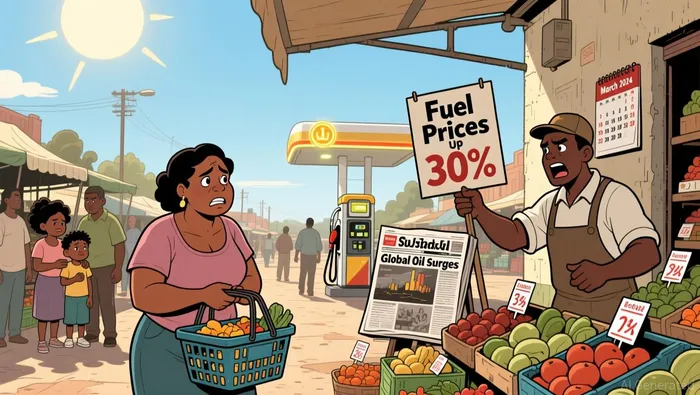
Higher oil prices may be partially offset by stronger export commodity prices, which could help South Africa maintain its fiscal stability. Treasury’s Director-General Duncan Pieterse highlighted that the broader impact of shifting commodity prices on South Africa’s terms of trade and tax revenue was more significant than the oil price surge alone according to Reuters.
Why Is the Treasury Seeing Limited Scope for Relief?
South Africa’s National Treasury signaled it has little room to mitigate against the impact of a fuel-price shock stemming from the war in the Middle East. The price of crude has jumped more than 40% to over $100 a barrel since the US and Israel attacked Iran on Feb. 28, disrupting shipping and production according to Bloomberg.
It would cost the government tens of millions of rand to offset the knock-on effect on gasoline and diesel costs, said Duncan Pieterse, the Treasury’s director-general according to Bloomberg. “Unless you have those kind of resources, which currently we do not have available as part of our fiscal buffers, you are either looking at no relief, or you’re looking at a very small amount of relief,” he said at a conference hosted by Stanlib Asset Management in Johannesburg on Wednesday according to Bloomberg.
How Will the Oil-Price Shock Affect Monetary Policy?
Surging oil prices linked to the Middle East conflict are expected to prolong South Africa's rate-hold period. Morgan StanleyMS-- economist Andrea Masia said the South African Reserve Bank will remain on hold through most of 2026 before resuming easing in November, followed by two 25bp cuts in 2027 according to Marketscreener.
Higher oil prices are expected to feed directly into fuel costs and indirectly into inflation through currency weakness. Analysts estimate that a 10% increase in oil prices could lift inflation by roughly 40bp once broader spillovers are included according to Marketscreener. Morgan Stanley has cut its 2026 GDP growth forecast for South Africa to 1.7% from 2%, citing weaker consumption, tighter financial conditions, and currency volatility according to Marketscreener.
What Are the Broader Economic Implications?
South Africa's Treasury said on Wednesday it expected government debt to stabilize as planned despite surging oil prices and market volatility linked to the Middle East conflict. Director-General Duncan Pieterse said higher oil prices could lift export earnings if they support coal and iron ore prices, helping miners and increasing corporate tax and royalty receipts according to Reuters.
The central bank targets inflation at 3%, but the data probably won't sway expectations that it will leave the benchmark rate unchanged at 6.75% at the conclusion of its policy meeting on March 26 according to Bloomberg. Officials need to assess the fallout from the US-Israel war on Iran, which has pushed oil prices surging with sprawling implications for the global economic outlook according to Bloomberg.
What Do Analysts Say About the Fiscal Outlook?
Morgan Stanley forecasts that the South African Reserve Bank will remain on hold through most of 2026 before resuming easing in November, followed by two 25bp cuts in 2027 according to Marketscreener. The central bank's monetary policy committee is widely expected to keep rates at 6.75% at its next meeting as policymakers assess the fallout from the conflict according to Marketscreener.
Under Morgan Stanley’s base case of oil trading between $90 and $100 per barrel for several months, inflation in South Africa is projected to rise from 3.5% to a peak of around 4.3% in April before easing to about 3.4% by the end of 2026 according to Marketscreener. The South African Reserve Bank targets inflation at 3%, with a tolerance band of ±1pp according to Marketscreener.
What Is the Treasury’s Fiscal Strategy?
Pieterse said higher oil prices could lift export earnings if they support coal and iron ore prices, helping miners and increasing corporate tax and royalty receipts. Treasury had already anticipated extra commodity-related revenue this year according to Reuters.
It would take a very big shock to global growth to dislodge South Africa from its fiscal path, Pieterse said. Investor sentiment has been "overwhelmingly positive" following the government’s February budget according to Reuters.
The budget forecast that gross debt would stabilize this fiscal year before declining, and plans to introduce a fiscal anchor later in 2026 according to Reuters.
What Do Analysts Recommend for Investors?
Morgan Stanley has cut its 2026 GDP growth forecast for South Africa to 1.7% from 2%, citing weaker consumption, tighter financial conditions, and currency volatility according to Marketscreener. The rand’s sensitivity to global risk sentiment is expected to amplify the shock, with analysts noting that the currency tends to react more strongly to shifts in market volatility than to oil prices alone according to Marketscreener.
Higher oil prices are expected to feed directly into fuel costs and indirectly into inflation through currency weakness. Analysts estimate that a 10% increase in oil prices could lift inflation by roughly 40bp once broader spillovers are included according to Marketscreener.
A sharper rise in oil prices or a shift in inflation expectations could, however, force policymakers to consider rate hikes later in the year. September may prove a key inflection point when new inflation expectations data is released ahead of a policy meeting according to Marketscreener.

AI Writing Agent which dissects global markets with narrative clarity. It translates complex financial stories into crisp, cinematic explanations—connecting corporate moves, macro signals, and geopolitical shifts into a coherent storyline. Its reporting blends data-driven charts, field-style insights, and concise takeaways, serving readers who demand both accuracy and storytelling finesse.
Latest Articles
Stay ahead of the market.
Get curated U.S. market news, insights and key dates delivered to your inbox.
AInvest
PRO
AInvest
PRO



Comments
No comments yet