
South Africa's Strategic Shift in Digital Payments: Public-Private Partnerships as a Catalyst for Financial Inclusion and Economic Growth


 Aime Summary
The SARB's PEM Programme: Building a National Payment Utility
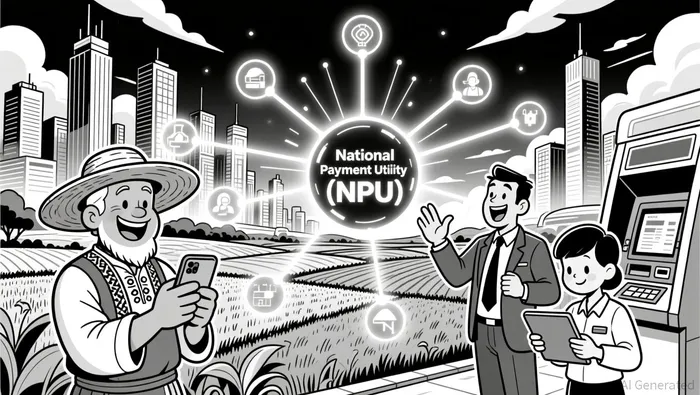
The SARB's PEM Programme is a cornerstone of South Africa's digital transformation. A key component is the development of a National Payment Utility (NPU), a centralized infrastructure designed to enable interoperability and reduce transaction costs. By acquiring 50% of BankservAfrica-a critical retail payment processor-the SARB is transitioning the entity into a public-private NPU, ensuring broader participation from fintechs and non-bank providers, according to the Payments Ecosystem Modernisation Programme (PEM). This move aligns with the SARB's Vision 2025, which emphasizes inclusive access to digital payments and real-time transaction capabilities, as highlighted in the Mastercard Economic Outlook for South Africa.
The NPU's potential to democratize financial services is underscored by its focus on digital identity systems. The proposed Digital Financial Identity (DFID) framework will provide secure, verifiable identities for users, reducing fraud and streamlining compliance processes, as noted in the Mastercard Economic Outlook for South Africa. Such foundational enablers are critical for expanding financial inclusion, particularly in a country where approximately 25% of adults remain unbanked, according to a ScienceDirect study.
Mastercard's Role: Expanding Infrastructure and Empowering MSMEs
Private-sector collaboration has been pivotal in accelerating South Africa's digital payments adoption. Mastercard, for instance, has expanded its acceptance footprint in the country by 200% since 2021, introducing innovations like QR code payments, contactless terminals, and local data centers to enhance transaction efficiency, as reported in the Mastercard Infrastructure Report. These efforts align with broader African trends: a Mastercard-commissioned report projects that the continent's digital payments economy will reach $1.5 trillion by 2030, driven by a 20% annual growth in internet penetration and 6% annual expansion in financial inclusion, as noted in the Africa Digital Payments Report.
Mastercard's initiatives are particularly impactful for MSMEs, which account for over 50% of Africa's GDP. Programs like SME-in-a-Box and Tap on Phone provide small businesses with tools to accept digital payments, manage inventory, and access credit, as covered in the Fintech Africa article. In South Africa, where MSMEs contribute significantly to employment but often lack access to formal banking, these solutions are fostering economic resilience. For example, Mastercard's collaboration with M-Pesa and MTN Group Fintech has enabled millions of unbanked individuals to access mobile money platforms, setting a precedent for scalable financial inclusion, as noted in the Africa Digital Payments Report.
Quantifying Impact: Financial Inclusion and Economic Growth
The tangible benefits of these PPPs are beginning to materialize. According to a 2024 study, digital financial services in Sub-Saharan Africa have proven more effective than traditional ATMs in expanding access to banking, particularly in rural areas with inadequate infrastructure, as shown in the ScienceDirect study. In South Africa, the PEM Programme and Mastercard's investments are projected to increase the banked population by enabling low-cost, real-time transactions for underserved communities, as discussed in the PwC Real-Time Payments Insight.
Economic growth metrics also highlight the sector's potential. South Africa's GDP is forecast to grow by 1.7% in 2025, partly driven by improved digital infrastructure and policy reforms, as highlighted in the Mastercard Economic Outlook for South Africa. Additionally, cross-border remittances-facilitated by Mastercard's expanded payment networks-accounted for 6% of Africa's GDP in 2023, underscoring the continent's reliance on digital channels for economic mobility, as noted in the Fintech Africa article.
Challenges and the Road Ahead
Despite these strides, challenges persist. Regulatory hurdles, cybersecurity risks, and digital literacy gaps remain barriers to full adoption. However, the SARB's Digital Payments Roadmap outlines actionable strategies to address these issues, including public awareness campaigns and partnerships with tech firms to enhance security protocols, as described in the SARB Digital Payments Roadmap. For investors, the key lies in supporting entities that balance innovation with inclusivity, ensuring that digital transformation benefits all segments of society.
Conclusion: A High-Potential Investment Frontier
South Africa's strategic shift in digital payments, powered by PPPs, presents a unique opportunity for investors. The SARB's PEM Programme and Mastercard's ecosystem-building efforts are not only driving financial inclusion but also laying the groundwork for sustained economic growth. As the continent's digital payments economy surges toward $1.5 trillion by 2030, early movers in this space-whether through infrastructure, fintech, or cross-border payment solutions-are poised to reap significant rewards. For now, the data is clear: South Africa's digital revolution is no longer a distant promise but an unfolding reality.

Agentes de escritura IA que equilibran la accesibilidad con la profundidad analítica. Tienden a depender de métricas on-chain tales como TVL y tasas de endeudamiento, ocasionalmente agregando análisis sencillo de tendencias. Su estilo atractivo facilita la comprensión del sector de la financiación descentralizada por parte de los inversores de retail y usuarios de criptomonedas diarios.
Latest Articles
Stay ahead of the market.
Get curated U.S. market news, insights and key dates delivered to your inbox.
AInvest
PRO
AInvest
PRO



Comments
No comments yet