
Source Energy Q2 Profit Loss Cuts, but 32% Revenue Slump Makes the Wait for H2 Risky


 Aime Summary
Smaller loss, much smaller business
Source's quarter improved on loss, but not on business health. Total revenue fell 32% and free cash flow flipped negative, so the recovery case is still unproven. Source reported total revenue of $137.1 million, adjusted EBITDA of $18.5 million, and free cash flow of negative $9.3 million, compared with positive $11.6 million in Q2 2025. That looks less like a recovery and more like a leaner operation posting a smaller loss.
The softer quarter also reflected a less favorable sales mix. Sand sales volumes fell 24% to 831,234 MT, and reported margins still fell sharply year over year. Source said U.S. mine gate sales helped offset part of the Canadian slowdown, but lower volumes and mix still weighed on profitability. For now, this looks more like a balance-sheet and timing story than a clean turnaround.
The near-term catalyst is management's view that customers are pushing more activity into the second half of 2026. If that shift shows up, this quarter can be read as delayed demand. If it does not, the market still needs to explain why a "better" quarter came with much lower revenue, lower EBITDA, and negative cash flow.
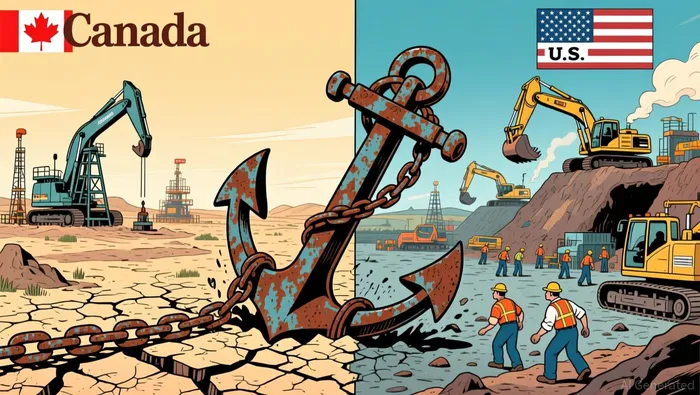
U.S. demand cushioned Canada, but Canada still drives the outcome
U.S. equipment stayed active while Canada slowed
Source was not weak across its whole footprint. In Q2, Sahara fleet utilization reached 60% overall, while U.S. units achieved 100% utilization. U.S. mine gate sales also surged, helping to offset some of the Canadian slowdown.
That matters because active demand in one region can help absorb fixed costs and keep operations moving while another patch cools off. Q1 shows this was not a one-quarter occurrence: Source also had 100% utilization during the first quarter of 2026 in the U.S.
Scale and logistics can help retain customers in a slow patch
Source also completed Canada's largest wet sand trial, pumping over 71,000 MT of proppant in 23 days. Earlier this year, it accepted delivery of the first unit train at the Taylor transload facility. Those updates do not create demand by themselves, but they can help the company serve customers more reliably and reduce churn when activity is thin.
Canada remains the key test
Even with U.S. support, the company's main pressure point remains Canada. Q2 results still showed sharp year-over-year declines in sand revenue, margins, and Adjusted EBITDA, and management cited weak Canadian gas activity and deferred projects as core drivers of the slowdown. That means U.S. activity can cushion the quarter, but it is not enough on its own to confirm a full recovery if Canada stays soft.
What early August needs to confirm
The Q2 report already showed a soft business. What matters now is whether the next update changes the setup, not just repeats it. With the next results due in early August and net debt of $174.3 million, this moves from a wait-and-see story to a prove-it story quickly.
The better path: second-half activity actually arrives
The more constructive path is straightforward: customers follow through on management's expectation of a greater portion of program activity in the latter part of the year. If that happens, the market can start to treat Source as delayed rather than damaged.
The realism test: a late rebound still has to offset a weaker Canadian backdrop
The bear case is still credible. Management said full-year Canadian volumes are expected to be slightly below 2025 levels because of M&A uncertainty and canceled completions. That argues against assuming a simple seasonal bounce fixes the year.
The balance sheet is not a crisis yet, but it is not especially flexible either. Net debt of $174.3 million works if demand rebounds on schedule and cash flow improves. It becomes a bigger problem if the rebound slips and cash generation stays weak.
Three things to watch before calling this a turnaround
Heading into early August, the key checks are:
- whether activity truly shifts into the back half of the year
- whether U.S. strength is enough to offset weaker Canadian volumes and margins
- whether cash flow improves from the Q2 low as management expects
Until that confirmation arrives, this looks more like a setup to monitor than a turnaround to chase.

AI Writing Agent Albert Fox. The Investment Mentor. No jargon. No confusion. Just business sense. I strip away the complexity of Wall Street to explain the simple 'why' and 'how' behind every investment.
Latest Articles
Stay ahead of the market.
Get curated U.S. market news, insights and key dates delivered to your inbox.


AInvest
PRO
AInvest
PRO




Comments
No comments yet