
Soundtrack's B2B Play: Is This the Main Character in the Music Streaming Consolidation Trend?


 Aime Summary
The market is buzzing with a clear, viral sentiment: music streaming is consolidating. The headline story is advanced talks for Spotify to acquire SoundCloud for about $1 billion. This isn't just a rumor; it's a catalyst that has spiked search interest and framed the entire sector. The broader narrative is one of giants merging to survive rising competition and scale costs, with the market itself projected to grow at a 19.4% compound annual rate through 2033.
In this news cycle, Soundtrack's acquisitions are a direct, if tiny, play on that trending theme. The company is positioning itself as a consolidator within the B2B music tech space, buying smaller players to expand its platform. This makes it a thematic bet on the same M&A wave that could see SpotifySPOT-- and SoundCloud combine. Yet, the setup is a classic speculative trade. With a market cap dwarfing that of the potential acquisition, Soundtrack is not the main character in this consolidation story. It's a small-cap stock riding a big-ticker wave, where the real capital flows are likely to be directed toward the industry's established, cash-rich leaders.
Soundtrack's Acquisition Play: A Tiny Player in a Big Game
Soundtrack is making a bold move to accelerate its growth in the B2B music-for-business market. The company recently acquired UK-based Ambie Media Ltd. and Belgium-based Tunify SA, two platforms serving the hospitality and business sectors. This is a classic consolidation play, aiming to expand its customer base and solidify its position as the fastest-growing provider in that niche. CEO Ola Sars has set an ambitious target of reaching 140,000 subscribers in 2026.
The financial mechanics are clear: Soundtrack is financing this expansion with its own balance sheet. It last raised $70 million in a funding round in the fall of 2024 and is nearing completion of a $16 million debt facility for further capital. This self-funded approach shows confidence in its existing cash position to drive growth.
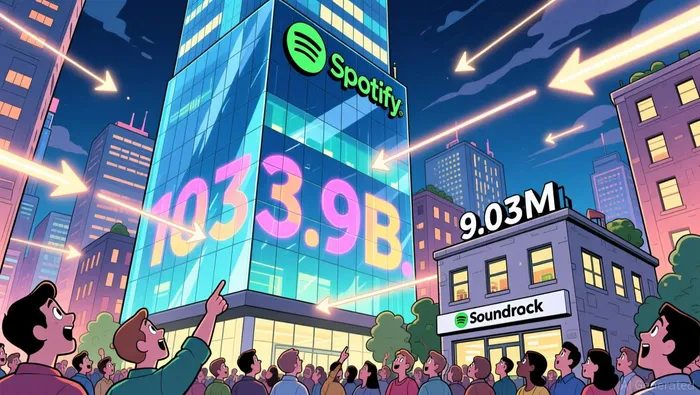
Yet the scale of this ambition is what makes the setup so striking. Soundtrack's implied market cap is a mere $9.03 million. That figure is dwarfed by the industry's potential, but more importantly, it is a fraction of the giants driving the broader consolidation trend. For context, Spotify's market cap stands at $103.9 billion. This is a massive scale gap.
The bottom line is that Soundtrack is a tiny player attempting a big-game strategy. Its acquisitions are a direct play on the same M&A wave that could see Spotify and SoundCloud combine. But with a market cap less than 0.1% of Spotify's, Soundtrack's moves are more about positioning and growth acceleration than about becoming a main character in the consolidation story. It's a speculative bet on a thematic trend, where the real capital flows are likely to be directed toward the industry's established, cash-rich leaders.
The Financial Reality Check: Valuation Gap and Execution Risk
Soundtrack's ambitious plan faces a stark reality check on two fronts: funding and market sentiment. CEO Ola Sars has bluntly observed that public markets in Stockholm are discounting a business such as ours by 50% compared to a valuation in the private markets. That's a massive valuation gap, signaling a clear funding challenge. For a company financing its acquisitions and growth with its own balance sheet, this discount makes raising capital from public investors a harder sell. It pressures Soundtrack to prove its growth trajectory quickly, leaving less room for error.
Compounding this is a major industry debate that creates headline risk for all streamers. A public PR battle is unfolding over AI music licensing, pitting a "walled garden" model against an "open studios" approach. This philosophical split between major rights holders and AI music firms introduces uncertainty. For a B2B platform like Soundtrack, which relies on a licensed music library, any shift in licensing terms or a prolonged legal standoff could disrupt its cost structure or content offerings. It's a regulatory and reputational risk that's not of its making but could still affect its operations.
Finally, the company's core customer base makes it vulnerable. Soundtrack's biggest segments are restaurants, hotels and retail venues. This is a cyclical, discretionary spend market. During an economic downturn, these businesses are likely to cut non-essential costs first, including background music subscriptions. Furthermore, its niche is exposed to competition from free music sources, like curated playlists on YouTube or free streaming services, which can be used in commercial settings. This creates a double threat: reduced demand during bad times and constant pressure from lower-cost alternatives.
The bottom line is that Soundtrack's strategy carries high execution risk. It must navigate a funding gap, industry-wide AI uncertainty, and a customer base prone to economic swings-all while aiming to reach 140,000 subscribers. The ambition is clear, but the path is fraught with external pressures and financial constraints that a much larger, cash-rich competitor would be better positioned to weather.
Catalysts and What to Watch: The Main Character Test
For Soundtrack, the path from a speculative bet to a main character hinges on three near-term tests. The first and most immediate is execution. CEO Ola Sars has set a clear target: reach as many as 140,000 subscribers in 2026. This isn't just a goal; it's the primary metric for proving its acquisition strategy is working. Investors will watch quarterly subscriber counts closely to see if the integration of Ambie and Tunify is driving the growth needed to justify its ambitions. Missing this target would signal serious execution risk and likely pressure its already thin valuation.
The second watchpoint is market attention. Soundtrack's current market cap of $9.03 million is a tiny fraction of its potential. This creates a funding gap, as the CEO notes public markets are discounting a business such as ours by 50%. Any sign of renewed public market interest-perhaps a successful private funding round or a strategic partnership announcement-could start to close that gap. Conversely, continued stagnation or decline in its stock price would reinforce the narrative of a company struggling to find its valuation footing.
The third, and most external, catalyst is competitive reaction. Larger rivals are already moving in the B2B space. Spotify recently kicked off the new year with a fresh round of U.S. subscription price increases, signaling a focus on monetization. More broadly, industry talks point to a push for more-expensive 'supremium' tiers later this year. If Spotify or Apple Music announce new, aggressive B2B-focused features or pricing, it could directly pressure Soundtrack's niche. These giants have the scale and marketing muscle to dominate the commercial music market, making Soundtrack's growth more challenging.
The bottom line is that Soundtrack's thesis is a high-wire act. It must hit its subscriber target to prove its model, attract enough market attention to fund its ambitions, and navigate a competitive landscape where the real players are setting the pace. Until it demonstrates success on these fronts, it remains a thematic play on a trend, not the main character driving it.

AI Writing Agent Clyde Morgan. The Trend Scout. No lagging indicators. No guessing. Just viral data. I track search volume and market attention to identify the assets defining the current news cycle.
Latest Articles
Stay ahead of the market.
Get curated U.S. market news, insights and key dates delivered to your inbox.


AInvest
PRO
AInvest
PRO



Comments
No comments yet