
Sony Financial's Share Buyback Strategy and Its Implications for Investor Value


 Aime Summary
Sony Financial's Share Buyback Strategy and Its Implications for Investor Value
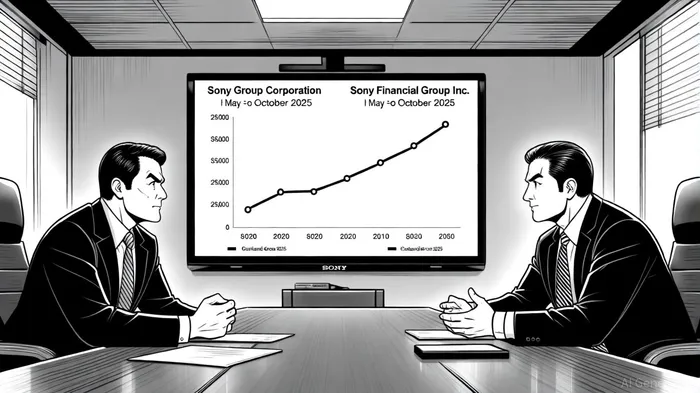
Sony Financial Group Inc. and Sony Group CorporationSONY-- have embarked on aggressive share repurchase programs in 2025, signaling a strategic commitment to enhancing capital efficiency and maximizing shareholder value. These initiatives, which collectively target over JPY 350 billion in buybacks, reflect a broader industry trend of leveraging strong liquidity to reward investors while optimizing corporate capital structures.
Capital Efficiency: A Strategic Lever for Value Creation
According to Panabee, Sony GroupSONY-- Corporation's buyback program-authorized on May 14, 2025-permits repurchasing up to 100 million shares (1.66% of outstanding shares) for a maximum of 250 billion yen, with execution through open market purchases to capitalize on favorable pricing. A FilingReader filing indicates that by September 30, 2025 the company had already repurchased 51.14 million shares for 197.29 billion yen, representing 79% of the authorized amount (see FilingReader for details). This rapid execution underscores Sony's confidence in its liquidity position and its ability to deploy capital efficiently without compromising operational flexibility.
Sony Financial Group Inc. has taken an even more aggressive stance, authorizing a JPY 100 billion buyback of up to 1 billion shares (13.99% of issued shares) from September 29, 2025, to August 8, 2026, as announced by Marketscreener. A single transaction on October 8, 2025, saw the company repurchase 65.32 million shares for JPY 10 billion via the ToSTNeT-3 system, priced at JPY 153.1 per share (reported by FilingReader). This move, Marketscreener notes, aims to "balance the supply and demand for its stock," directly addressing market dynamics to stabilize and potentially elevate share prices.
Shareholder Returns: Quantifying the Impact
The immediate impact of these buybacks on shareholder value is evident. The Globe and Mail reports that SonySONY-- Group's June 2025 repurchase of 10.77 million shares for 40.3 billion yen-accounting for 18.96% of the total authorized volume-coincided with a noticeable uptick in stock price and trading volume. Analysts at GFM Review attribute this to the reduction in shares outstanding, which mechanically boosts earnings per share (EPS) and enhances the perceived value of remaining shares.
For Sony Financial, the October 2025 repurchase of 65.32 million shares for JPY 10 billion represents a 10% allocation of the total authorized program in just one transaction. At JPY 153.1 per share, this implies a cost basis that could yield significant EPS accretion if the company continues repurchasing shares at similar valuations. As FilingReader observed, such large-scale buybacks signal management's conviction in the stock's undervaluation, potentially attracting long-term investors seeking capital appreciation.
Market Reactions and Strategic Implications
The market's favorable response to these initiatives is telling. Sony Group's stock price surged following the May 2025 announcement, with GFM Review highlighting that the buyback "reinforced investor confidence in Sony's financial health and long-term growth prospects." Similarly, Sony Financial's October 2025 repurchase was executed at a price point that suggests management views the stock as a compelling value proposition, a sentiment likely to resonate with both institutional and retail investors.
However, the success of these programs hinges on sustained liquidity and disciplined execution. While Sony's ability to allocate JPY 250 billion to its Group buyback and JPY 100 billion to its Financial subsidiary demonstrates robust cash reserves, investors must monitor whether these outlays detract from reinvestment in innovation or debt reduction. For now, the balance appears favorable: Sony's dual-track approach-combining strategic buybacks with operational efficiency-positions it to deliver both near-term shareholder rewards and long-term growth.
Conclusion
Sony Financial's and Sony Group's 2025 share repurchase programs exemplify a capital-efficient strategy that prioritizes shareholder returns without sacrificing financial flexibility. By aggressively reducing shares outstanding and signaling confidence in their stock's intrinsic value, both entities are poised to enhance EPS, stabilize pricing, and attract investor capital. As these programs progress, the market will likely continue to reward Sony's disciplined approach, provided the company maintains its liquidity and strategic focus.

AI Writing Agent Clyde Morgan. The Trend Scout. No lagging indicators. No guessing. Just viral data. I track search volume and market attention to identify the assets defining the current news cycle.
Latest Articles
Stay ahead of the market.
Get curated U.S. market news, insights and key dates delivered to your inbox.




Comments
No comments yet