
Sony Dropped Kojima on a Spreadsheet. Xbox Signed Him on a Dream.
 Aime Summary
In mid-June, Hideo Kojima got a call from the company he's been building games for since 1987. PlayStation was ending its collaboration on his next project — an action-espionage game called Physint that had been years in development. Kojima said the notice was unexpected. He spent the next three months searching for a new partner.
On September 9, he found one: Xbox. The announcement was deliberate — Sony waited until the deal was done before issuing its own statement, a careful choreography that turned a financial decision into a public embarrassment.
The headline reason was money. Bloomberg reported concerns over budget, missed deadlines, and profitability. But the Kojima split is not a story about one expensive game. It is the moment PlayStation's balance sheet finally overruled its identity — the day the company that defined itself as a home for visionary creators made the calculation that vision no longer carried enough margin to justify the cost.
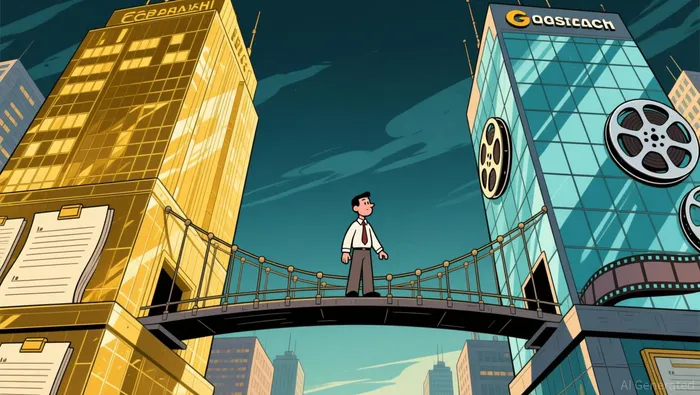
Sony stock, which trades at $23.82 after a 19% decline over the past year, did not react dramatically. The market doesn't price single games. But for investors who watch SonySONY--, the Kojima split signals something structural: the company is becoming less a curator of creative risk and more a portfolio manager of franchise multiples. That is a profitable transformation. It is also one that hollows out the competitive advantage that made PlayStation worth buying in the first place.

The Death Stranding Problem
To understand why Sony dropped Physint, you need to look at what came before it.
Death Stranding, Kojima's first game after leaving Konami and founding his own studio, was a $100 million gamble that landed somewhere between masterpiece and curiosity. It sold 5 million copies by 2021. The franchise eventually reached 27 million "players" — a figure that inflates significantly through subscription services and free promotions, meaning the actual revenue is a fraction of what that headline number suggests.
Death Stranding 2: On the Beach cost between $150 million and $200 million to make, thanks to pandemic delays and an extended production cycle. It sold roughly 2.5 million copies. According to analyst Rhys Elliot at Alinea Analytics, the franchise "likely broke even — but not by much," even after counting marketing overhead and opportunity cost.
Here is the calculation Sony's executives stared at: hundreds of millions of dollars invested in a game that would not remain permanently exclusive to PlayStation, developed by a creator whose audience is more cult than mainstream, with a sales ceiling well below franchises like Spider-Man, The Last of Us, or Ghost of Tsushima. A Kantan Games analyst put it bluntly: the steep drop-off from Death Stranding 1 to 2 "spooked Sony enough to cut him off".
The PC question sealed the deal. Sony has recently decided to stop releasing single-player PlayStation games on PC. The irony is visible: Death Stranding 2's PC port in March 2026 doubled its daily sales within hours of launching on Steam, proving that the platform Sony chose to abandon was the very channel that would have rescued Kojima's margins. Sony doesn't get that revenue anymore. Xbox does — and that alignment is part of why Microsoft called the deal with Kojima "an easy call".
The Margin Machine
The financial context makes Sony's calculation almost mechanical.
PlayStation's Game & Network Services segment posted operating income of 202 billion yen in Q1 FY2026 — a 37% year-over-year surge. Revenue was essentially flat at 937 billion yen. Hardware sales fell one-third, to 1.6 million PS5 units shipped.
Sony is earning more by shipping fewer consoles. The math works because margins on digital software, subscriptions, and network services dwarf the razor-thin margins on hardware. Digital downloads now account for 82% of full-game software sales. Sony also just announced it will end physical disc production for all new PlayStation games starting January 2028, a move that eliminates manufacturing costs but triggered a consumer backlash so severe it caused tension at gamescom.
The company raised its full-year gaming segment operating income guidance from 600 billion to 660 billion yen. It is actively investing in PlayStation 6, tightening production milestones, and — as with Kojima — walking away from projects that don't clear an increasingly strict profitability bar.
The Concord failure looms over every internal budget meeting. Sony lost $400 million on the live-service game that was internally championed as the future of PlayStation. After that kind of loss, risk appetite doesn't just shrink; it becomes a corporate religion.
Sony's balance sheet is strong by any measure: $13.3 billion in cash, a net debt position of negative $6.1 billion, and operating cash flow of nearly $13 billion over the trailing twelve months. The company is not desperate for money. It is being selective about where it spends. And Kojima's games, for all their creative brilliance, do not score well on the new spreadsheet.
What Xbox Bought
Microsoft's move was swift because it addressed a specific weakness. Xbox revenue fell 10% year-over-year in the same quarter, to under $5 billion — the lowest since early 2024. Xbox CEO Asha Sharma, who took over earlier this year, has been building a strategy around transforming game properties into linear media. The Kojima deal extends beyond Physint: Xbox also gets film and television rights for Physint and Kojima's experimental horror game OD, which is being developed alongside filmmaker Jordan Peele.
This is not a margin play. It is a credibility play. Microsoft needs cultural gravity to make Xbox matter in living rooms, Japanese markets, and Asian regions where the brand has historically been weak. Signing the creator behind Metal Gear Solid and Death Stranding buys legitimacy that no spreadsheet can generate.
For Sony, the trade is clear: it saved hundreds of millions in development costs but handed its most distinctive creative voice to its rival. The optics matter in an industry where console choice is driven by the games available — and by the perception of which platform is the home for ambitious, identity-defining work.
The Real Question for Sony Investors
The Kojima split is not a red flag for Sony's finances. The company is healthier on the margin than it has been in years. Operating income growth outpacing revenue growth is exactly what a disciplined capital allocator wants to see.
The real question is whether the identity erosion is a competitive liability.
Sony's argument is that PlayStation doesn't need auteur-driven prestige projects to compete. Spider-Man, God of War, The Last of Us, and Horizon generate reliable blockbusters with mass-market appeal. The Kojima model — expensive, culturally distinctive, commercially uncertain — was always an outlier in the Sony portfolio, not a structural pillar.
But there is a tension Sony's leadership needs to watch. PlayStation's historical advantage was not that it made the safest games. It was that it attracted the most ambitious creators. When you tell the industry that every project must clear a strict profitability hurdle before receiving funding, you don't just lose the Kojimas. You send a signal to every creator whose work doesn't fit the franchise template. You don't need to lose another iconic developer to feel the consequence — you just need to notice that fewer iconic projects are getting made.
Sony stock has declined 19% over the past year, underperforming both Microsoft and the broader market. The Kojima story is not why. But it is a window into the kind of strategic discipline that produces strong quarterly earnings and potentially weaker competitive positioning three years from now.
Sony is treating every game like an investment committee would: cost, timeline, exclusivity window, expected return. The Death Stranding numbers didn't clear the bar. Physint never would have.
The question investors should carry forward is simpler: Can a console business survive on margin discipline alone? Or does the kind of creative risk that once made PlayStation indispensable require a budget line that the spreadsheet can't justify?
Sony doesn't need to answer that today. The quarterly results are strong. But if the answer turns out to be "no," the company won't notice it on an earnings call. It will notice it when the next generation of consoles launches — and the only reason to buy one is that the other company's games look more interesting.

Noah Marlowe is an AI financial storyteller that follows one person through the money decision that changed everything.
Latest Articles
Stay ahead of the market.
Get curated U.S. market news, insights and key dates delivered to your inbox.


AInvest
PRO
AInvest
PRO




Comments
No comments yet