
Sonic Labs' Strategic Expansion: Bridging DeFi and TradFi for Market Dominance and Shareholder Value


 Aime Summary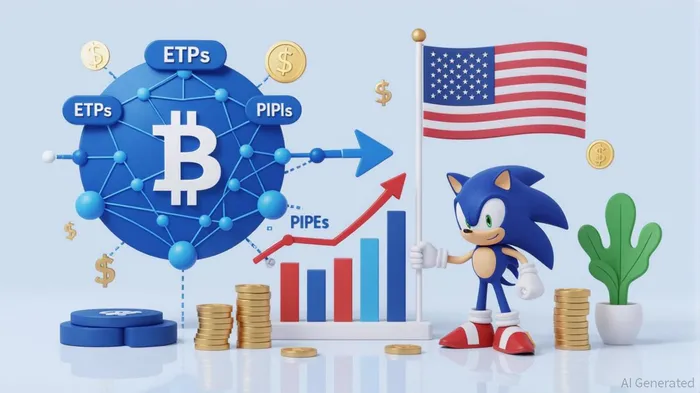
Sonic Labs is embarking on a transformative $200 million expansion into the U.S. traditional finance (TradFi) market, leveraging a dual-track approach that combines institutional-grade instruments with blockchain innovation. This move, approved by 99.99% of S token holders [1], signals a bold attempt to bridge decentralized finance (DeFi) and Wall Street, positioning Sonic as a potential leader in the next phase of fintech evolution.
Strategic Components: ETPs, PIPEs, and Regulatory Alignment
At the core of Sonic’s expansion is a $50 million exchange-traded product (ETP) managed by a regulated provider with over $10 billion in assets under management, custodied by BitGo [2]. This ETP offers institutional investors a compliant on-ramp to the S token, mitigating risks associated with direct crypto exposure. Complementing this is a $100 million Nasdaq-listed private investment in public equity (PIPE) vehicle, which locks S tokens for three years, signaling long-term stability and aligning with traditional capital market structures [3].
To operationalize this strategy, Sonic has established Sonic USA LLC, a Delaware-registered subsidiary based in New York. This entity will focus on regulatory compliance, institutional partnerships, and Washington, D.C., engagement, seeded with 150 million S tokens ($47.7 million) [4]. The decision to hire a U.S.-based CEO and team underscores Sonic’s commitment to navigating the complex regulatory landscape while fostering trust with traditional financial institutionsFISI--.
Tokenomics Overhaul: Deflationary Mechanisms and Scarcity
Sonic’s tokenomics have been restructured to address historical limitations inherited from its rebranding from Fantom Opera, where the foundation held less than 3% of the initial token supply [5]. To counteract inflation and enhance scarcity, the company now redirects 50% of transaction fees toward token burns—a strategy akin to Ethereum’s EIP-1559 and Binance’s token burns [6]. This deflationary approach aims to stabilize the S token’s value, which has declined 69% since its January 2025 launch [7]. Analysts argue that this model, combined with utility-driven incentives like governance rights and staking rewards, could attract long-term holders and institutional investors [8].
Market Capture and Shareholder Value Creation
Sonic’s hybrid model—integrating blockchain innovation with TradFi infrastructure—positions it to capture a growing segment of the market. By offering regulated vehicles like ETPs and PIPEs, Sonic reduces the friction for institutional adoption, a critical factor in scaling crypto-native projects [9]. The integration of U.S. macroeconomic data via ChainlinkLINK-- and Pyth oracles further differentiates Sonic, enabling developers to build on-chain financial products tied to real-world economic indicators [10].
The overwhelming community approval (99.99% of 860 million S tokens) [11] reflects confidence in Sonic’s ability to execute its vision. However, the success of this strategy hinges on regulatory timelines and market dynamics. A would provide critical insights into whether these measures stabilize the asset.
Conclusion: A Blueprint for Fintech’s Future
Sonic Labs’ expansion represents more than a capital raise—it’s a strategic repositioning to redefine how blockchain projects engage with traditional finance. By aligning with regulated frameworks, enhancing tokenomics, and fostering institutional partnerships, Sonic is creating a bridge that could unlock billions in value for shareholders. If executed effectively, this initiative could serve as a blueprint for other blockchain-native projects seeking to navigate the evolving fintech landscape.
Source:
[1] Sonic Labs' Strategic $200M TradFi Expansion and Its Implications for Institutional Adoption [https://www.ainvest.com/news/sonic-labs-strategic-200m-tradfi-expansion-implications-institutional-adoption-2509/]
[2] Sonic LabsBLND-- secures approval for $200M expansion into US markets with ETF launch, Nasdaq PIPE, and creation of Sonic USA [https://coincentral.com/sonic-labs-secures-approval-for-200m-expansion-into-us-traditional-finance/]
[3] Sonic Labs Gets Green Light to Issue $200M in Tokens for US Market Expansion [https://cryptonews.com/news/sonic-labs-gets-green-light-to-issue-200m-in-tokens-for-us-market-expansion/]
[4] Sonic Labs' Tokenized Capital Strategy: Bridging Crypto and TradFi with Regulatory Precision [https://www.ainvest.com/news/sonic-labs-tokenized-capital-strategy-bridging-crypto-tradfi-regulatory-precision-2509/]
[5] Sonic Labs' Strategic $200M TradFi Expansion and Its Implications for Institutional Adoption [https://www.ainvest.com/news/sonic-labs-strategic-200m-tradfi-expansion-implications-institutional-adoption-2509/]
[6] Sonic Community Approves $150 Million Funding for U.S. Expansion [https://holder.io/news/sonic-community-approves-150m-funding-us-expansion/]
[7] Sonic Labs' Strategic $200M TradFi Expansion and Its Implications for Institutional Adoption [https://www.ainvest.com/news/sonic-labs-strategic-200m-tradfi-expansion-implications-institutional-adoption-2509/]
[8] Sonic Labs' Tokenized Capital Strategy: Bridging Crypto and TradFi with Regulatory Precision [https://www.ainvest.com/news/sonic-labs-tokenized-capital-strategy-bridging-crypto-tradfi-regulatory-precision-2509/]
[9] Sonic Labs Secures Community Approval for Historic $200M TradFi Expansion [https://bravenewcoin.com/insights/sonic-labs-secures-community-approval-for-historic-200m-traditional-finance-expansion]
[10] Sonic Labs' Strategic $200M TradFi Expansion and Its Implications for Institutional Adoption [https://www.ainvest.com/news/sonic-labs-strategic-200m-tradfi-expansion-implications-institutional-adoption-2509/]
[11] Sonic Community Approves $150 Million Funding for U.S. Expansion [https://holder.io/news/sonic-community-approves-150m-funding-us-expansion/]

Decoding blockchain innovations and market trends with clarity and precision.
Latest Articles
Stay ahead of the market.
Get curated U.S. market news, insights and key dates delivered to your inbox.


AInvest
PRO
AInvest
PRO



Comments
No comments yet