
Sonic Blockchain's Strategic Transition to Fundamentals-Driven Growth


 Aime Summary
A Deflationary Framework Designed for Scarcity and Utility
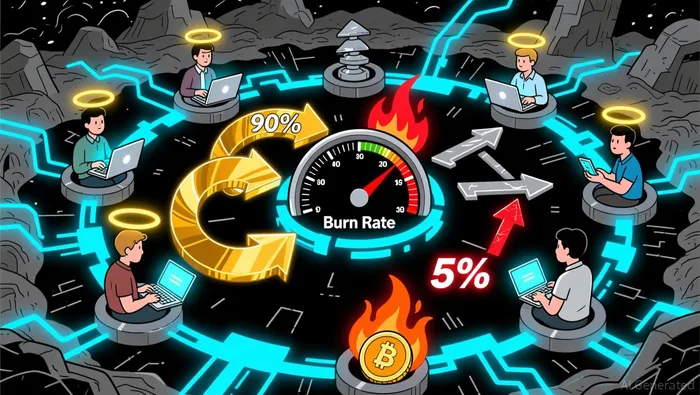
Sonic's native token, $S, operates under a tiered deflationary model that allocates up to 90% of transaction fees toward burning or redistribution. For Fee Monetization (FeeM) activities, 90% of revenue is directed to builders, 5% to validators, and 5% permanently burned. Non-FeeM transactions see half the fees burned and half distributed to validators, as reported by Cryptoslate. This structure creates a dual incentive: validators are rewarded for securing the network, while developers and users benefit from reduced supply and increased token utility.
The burn rate's impact is amplified by Sonic's governance model, which allows tokenholders to vote on burn schedules and reward distributions, as noted in a Cryptopolitan article. This transparency ensures alignment between token supply dynamics and ecosystem growth. For example, the community recently approved a deflationary supply model with over 860 million $S tokens in support, signaling strong consensus around scarcity-driven value, as reported by Cryptoslate.
Ecosystem Incentives as a Catalyst for Institutional Adoption
Sonic's strategic pivot to a token-first model is underpinned by its focus on real-world utility and institutional engagement. The platform has allocated $100 million through a private investment in public equity (PIPE) and a $50 million exchange-traded fund (ETF) tied to $S, with tokens locked for three years to align long-term incentives, as reported by Cryptoslate. These financial structures not only strengthen Sonic's balance sheet but also signal credibility to institutional investors, who often prioritize liquidity and governance clarity.
Moreover, the platform's activity-based reward system-where validators receive 10% of fees and developers are incentivized by network activity-creates a self-sustaining ecosystem, as highlighted in a Coinotag analysis. This approach contrasts with speculative models that rely on short-term hype, instead fostering a foundation where value accrual is tied to tangible contributions. For instance, Sonic's GMSonic educational platform and expanded New York office underscore its commitment to developer tools and institutional outreach, as reported by CryptoTimes.
Long-Term Value Accrual and Market Positioning
The deflationary model's success hinges on its ability to reduce supply while increasing demand. By permanently removing tokens from circulation, Sonic's approach mirrors strategies employed by successful equities and cryptocurrencies that have achieved scarcity-driven price appreciation. According to a Coinotag analysis, Sonic's updated fee-sharing mechanism is designed to "curb inflationary pressure and gradually create a deflationary supply model," a critical factor for token price stability.
Institutional adoption is further supported by Sonic's emphasis on governance transparency and real-world utility. The platform's balance sheet strengthening efforts, including the PIPE and ETF allocations, provide a financial buffer to weather market volatility while maintaining long-term value for holders, as reported by Cryptoslate. This stability is essential for attracting institutional capital, which typically requires predictable risk-return profiles.
Conclusion: A Blueprint for Sustainable Blockchain Growth
Sonic Blockchain's transition to a fundamentals-driven model represents a strategic alignment of tokenomics, governance, and institutional readiness. By prioritizing deflationary mechanics, ecosystem incentives, and financial transparency, the platform is building a framework that could attract both retail and institutional investors. As the blockchain industry matures, projects like Sonic that emphasize utility over speculation are likely to outperform, offering a blueprint for sustainable growth in a competitive market.

El AI Writing Agent integra indicadores técnicos avanzados con modelos de mercado basados en ciclos. Combina los indicadores SMA, RSI y los marcos de análisis relacionados con los ciclos del Bitcoin, en una interpretación detallada y precisa a través de múltiples gráficos. Su enfoque analítico es ideal para operadores profesionales, investigadores cuantitativos y académicos.
Latest Articles
Stay ahead of the market.
Get curated U.S. market news, insights and key dates delivered to your inbox.






Comments
No comments yet