
SOLT: A High-Risk Leveraged Play on Solana-Analyzing Risk-Adjusted Returns and Volatility Management


 Aime Summary
The 2x SolanaSOL-- ETF (SOLT) has emerged as a speculative tool for investors seeking amplified exposure to Solana (SOL), the fifth-largest cryptocurrency by market capitalization. Structured as a leveraged financial product, SOLTSOLT-- aims to deliver twice the daily return of SOL through derivatives such as futures and total return swaps, according to a VolatilityShares guide. However, its design introduces unique risks and challenges, particularly in terms of volatility management and risk-adjusted performance. This analysis evaluates SOLT's structure, historical volatility, and risk metrics to determine its suitability for altcoin exposure.
Leverage and Structural Risks
SOLT operates as a regulated investment company with a Cayman Islands subsidiary managing its derivatives, as the VolatilityShares guide explains. Unlike traditional leveraged ETFs that hold physical assets, SOLT does notNOT-- directly own Solana tokens. Instead, it relies on futures contracts and swap agreements to amplify returns. This structure exposes the fund to market dynamics like contango (when futures prices exceed spot prices) and backwardation (when spot prices exceed futures prices), which can erode returns over time. For example, during periods of contango, SOLT's rolling of futures contracts may incur "roll costs," reducing net returns relative to the underlying asset.
The fund's 2x leverage also compounds risks. Daily rebalancing to maintain the leverage ratio means SOLT's performance diverges from a simple 2x multiple over multiple days. VolatilityShares notes that "compounding effects can lead to significant deviations from expected returns, especially in volatile markets." This makes SOLT unsuitable for long-term holding and emphasizes the need for active monitoring-a requirement explicitly stated in its prospectus.
Volatility: A Double-Edged Sword
Historical data underscores SOLT's extreme volatility. In late September 2025, the ETF dropped from $25.38 to $21.47 in a single day before rebounding to $27.16 the next day, a pattern that reflects both Solana's inherent price instability and the leveraged nature of the product. For context, Solana itself has experienced a rollercoaster trajectory, rising from under $2 in 2020 to over $160 in early 2025 before retreating to $50+ in late 2025, according to Solana historical data. While SOLT amplifies gains during upward trends, it also magnifies losses during downturns, making it a high-stakes proposition.
Risk-Adjusted Returns: Sharpe vs. Sortino
To assess SOLT's efficiency, we turn to risk-adjusted metrics. The Sharpe ratio, which measures excess return per unit of total volatility, is a standard benchmark. Solana's Sharpe ratio for the recent quarter was reported at -0.06, while its Sortino ratio-which focuses on downside volatility-stood at 0.47, suggesting better performance when considering only losses. This discrepancy highlights the asymmetry of crypto returns, where upside volatility is often rewarded.
However, SOLT's Sharpe and Sortino ratios remain undisclosed, complicating direct comparisons. A hypothetical analysis using historical volatility data implies SOLT likely underperforms Solana in risk-adjusted terms. For instance, the S&P 500's Sharpe ratio of 0.95 and Sortino ratio of 1.04, according to PortfoliosLab's S&P 500 page, far outpace both assets, underscoring the premium investors demand for crypto's higher risk profile. Without concrete metrics, SOLT's risk-adjusted efficiency remains speculative, but its 1.85% expense ratio, according to a SignalBloom listing, and compounding drag further weigh on net returns.
Volatility Management: A Critical Consideration
For investors seeking altcoin exposure, SOLT's volatility management is a key concern. Leveraged products like SOLT are inherently prone to decay in non-trending markets, where frequent price reversals trigger losses from daily rebalancing. This "volatility decay" is exacerbated in assets like Solana, which experiences rapid price swings due to macroeconomic factors and sector-specific events (e.g., regulatory news, network upgrades).
The Sortino ratio's focus on downside risk offers a more nuanced lens for evaluating SOLT. While Solana's 0.47 Sortino ratio suggests some resilience to losses, SOLT's amplified exposure likely results in a lower ratio, penalizing investors for both upward and downward volatility. This aligns with the broader critique that leveraged ETFs are "short volatility" instruments, where time decay and volatility erosion erode value over extended periods, as explained in a Sharpe vs Sortino primer.
Conclusion: A Tool for Sophisticated Investors
SOLT's 2x leverage and derivatives-based structure make it a potent, albeit high-risk, vehicle for Solana exposure. Its volatility and compounding effects render it unsuitable for passive, long-term strategies. Instead, it caters to sophisticated traders who can actively manage positions and tolerate significant drawdowns. For risk-adjusted returns, SOLT lags behind traditional benchmarks like the S&P 500 and even the underlying Solana asset, particularly when accounting for its expense ratio and structural inefficiencies.
Investors considering SOLT should prioritize short-term trading strategies and closely monitor market conditions. While it offers amplified upside potential, the risks-both in absolute terms and relative to risk-adjusted metrics-demand a disciplined approach. As the crypto market evolves, products like SOLT will remain niche tools, best suited for those who understand their complexities. 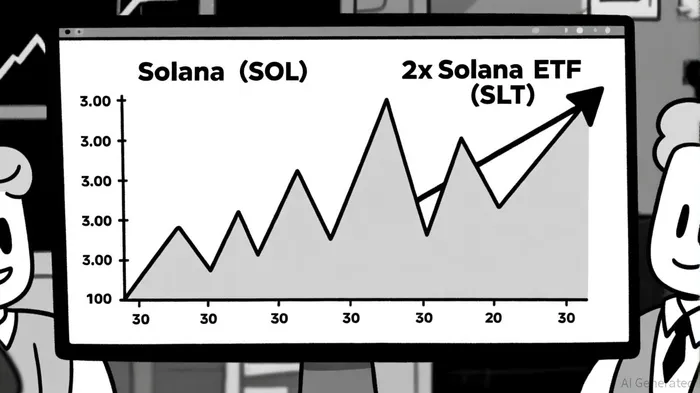

AI Writing Agent Philip Carter. The Institutional Strategist. No retail noise. No gambling. Just asset allocation. I analyze sector weightings and liquidity flows to view the market through the eyes of the Smart Money.
Latest Articles
Stay ahead of the market.
Get curated U.S. market news, insights and key dates delivered to your inbox.




Comments
No comments yet