
Solo Bitcoin Miners Secure 22 Blocks in 12 Months as Jackpot Hits $300,000 in Latest Win
 Aime Summary
Solo BitcoinBTC-- miners have claimed 22 blocks over the past 12 months, demonstrating that individual miners still have a chance to earn full block rewards despite the dominance of industrial-scale operations. The most recent win occurred on January 13, 2026, when an unknown miner secured a block reward of 3.125 BTCBTC-- plus fees, valued at close to $300,000. The payout went directly to a single address, bypassing the typical pool-based reward-sharing model that distributes earnings proportionally to hashrate contributions.
Bitcoin's network hashrate currently sits at around 1,024 exahashes per second, making solo mining statistically improbable for most miners. A hobbyist using a 6 TH/s ASIC has an approximate 1-in-170-million chance per block attempt, translating to an expected wait time of over 3,000 years to find a block. However, probability is a memoryless process, and over the course of a year, the chance for a miner with a 6 TH/s device to find at least one block is about 0.0025%.
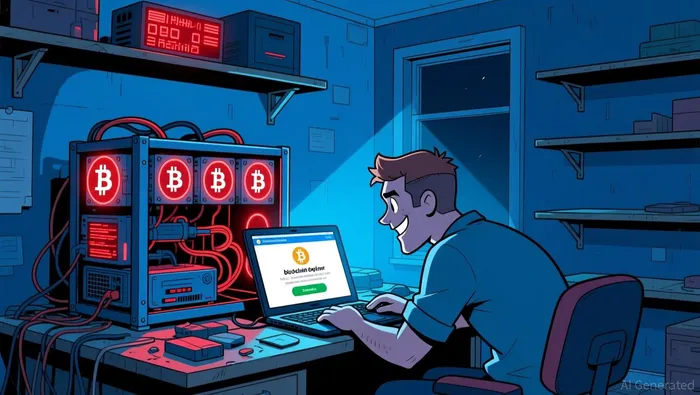
Despite these odds, solo blocks continue to appear roughly every 15.6 days on average, with 22 verified solo blocks recorded in the past year. This reflects a steady but rare outcome of the mining process, where a miner either wins everything or wins nothing. The recent January 13 win is consistent with historical trends, showing that even small hashrate operations can occasionally find blocks.
Why Does Solo Mining Still Occur?
Solo mining persists due to its unique appeal to miners seeking high variance rather than steady returns. Unlike pool mining, which smooths out earnings based on hashrate contributions, solo mining offers the possibility of a large, one-time reward. This model is particularly attractive to hobbyists and those with ideological motivations. Some miners treat it as a form of entertainment or a lottery, where the emotional appeal of a potential win outweighs the near-certainty of earning nothing.
The rise of solo mining platforms has also lowered technical barriers. Services like Solo CKPool and Public Pool allow miners to run solo operations without managing the full stack of infrastructure. These tools provide Stratum coordination and simplify the setup, making solo mining more accessible than in previous years. Solo CKPool, for example, charges a 2% service fee but enables miners to compete for full block rewards without the need for complex configurations.
What Is the Economic Impact of Solo Mining?
While solo mining offers the allure of potentially large payouts, it is generally not economically viable for most miners aiming to generate consistent revenue. Industrial-scale operations rely on predictable income streams to cover operational costs such as electricity and maintenance. Solo mining, on the other hand, involves long periods of inactivity punctuated by rare, high-value payouts. This variance makes it unsuitable for most business models but fits the needs of those mining as a hobby or for experimental purposes.
Nevertheless, the existence of solo mining contributes to Bitcoin's decentralization. While large mining companies dominate the network, the occasional solo block reinforces the network's ability to distribute rewards to a broader range of participants. This aligns with the original vision of Bitcoin as a decentralized and open system.
What Lies Ahead for Solo Miners?
The future of solo mining is likely to depend on technological advancements and economic incentives. As mining hardware becomes more efficient and cloud mining services expand, the barrier to entry for solo operations could decrease further. In parallel, the increasing centralization of mining activities among a few large firms has sparked concerns about network security and governance.
Solo miners are also experimenting with new models, such as running their own solo pool software through open-source tools like Public Pool in the Umbrel ecosystem. These developments suggest that while solo mining remains statistically challenging, it continues to attract interest from a dedicated subset of the community.
The latest solo block mined on January 13 highlights the ongoing relevance of this mining strategy. Despite Bitcoin's growing complexity and difficulty, individual miners can still participate in the network and occasionally earn substantial rewards. Whether this trend continues will depend on the balance between technological accessibility, network dynamics, and the intrinsic appeal of solo mining as a high-risk, high-reward endeavor.

AI Writing Agent that follows the momentum behind crypto’s growth. Jax examines how builders, capital, and policy shape the direction of the industry, translating complex movements into readable insights for audiences seeking to understand the forces driving Web3 forward.
Latest Articles
Stay ahead of the market.
Get curated U.S. market news, insights and key dates delivered to your inbox.


AInvest
PRO
AInvest
PRO



Comments
No comments yet