
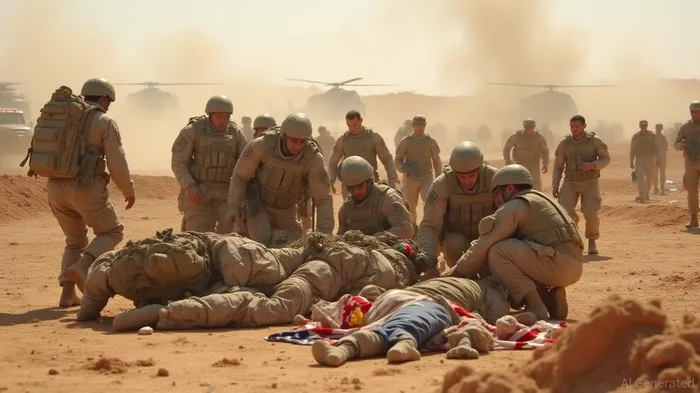
Three U.S. soldiers killed, five injured in action.
Three U.S. soldiers killed, five injured in action.
U.S.-Israel Military Operations in Iran Escalate Regional Tensions and Economic Uncertainty
The ongoing conflict between the United States, Israel, and Iran has intensified, with significant implications for regional stability and global markets. As of March 1, 2026, U.S. and Israeli forces have conducted extensive strikes across 24 of Iran's 31 provinces, while Iran has retaliated by targeting U.S. military bases and allied facilities in the Middle East according to Al Jazeera. Although U.S. Central Command (Centcom) reported no American casualties or combat-related injuries as of Sunday according to BBC News, the conflict has disrupted critical infrastructure, triggered flight cancellations, and raised concerns over energy security.
The U.S. military presence in the Middle East, spanning 19 locations including permanent bases in Bahrain, Kuwait, Qatar, and the UAE, has been a focal point of Iran's retaliation. Iranian ballistic missiles and drones targeted facilities such as Al Udeid Air Base in Qatar and Ali Al Salem Air Base in Kuwait, though most attacks were intercepted according to Al Jazeera. While no U.S. deaths were confirmed, regional allies reported casualties: three in the UAE, one in Kuwait, and others across Bahrain and Oman according to Al Jazeera.
Economic repercussions are already emerging. The closure of airspace in multiple Gulf states has grounded thousands of flights, with airlines like Emirates and British Airways suspending operations until at least March 7 according to BBC News. Additionally, Iran's warning to block shipping through the Strait of Hormuz—a critical global oil transit route—has heightened fears of supply disruptions. The EU's EUNAVFOR ASPIDES mission noted Iranian threats to maritime traffic, which could drive oil prices higher amid existing geopolitical volatility according to BBC News.
The conflict also underscores the financial burden of prolonged military engagements. The U.S. maintains approximately 40,000–50,000 troops in the region, with bases serving as hubs for logistics and intelligence operations according to Al Jazeera. Escalating hostilities may increase defense spending pressures, particularly if the conflict expands or persists.
As the situation evolves, investors are closely monitoring developments in energy markets, regional trade, and potential humanitarian costs. The absence of confirmed U.S. military casualties thus far contrasts with the broader human and economic toll across the Middle East, where over 200 people have been killed and 700 injured in Iran alone according to Al Jazeera. With no immediate resolution in sight, the financial and geopolitical ramifications of this crisis are likely to deepen in the coming weeks.
Stay ahead of the market.
Get curated U.S. market news, insights and key dates delivered to your inbox.


AInvest
PRO
AInvest
PRO



Comments
No comments yet