
SolarEdge Plunges 30 Percent as Weak Guidance Triggers Record $0.62 Billion Turnover
 Aime Summary
Market Snapshot
Shares of SolarEdge Technologies Inc.SEDG-- experienced a dramatic selloff on Wednesday, August 5, 2026, with the stock plummeting 30.48% to reach its lowest closing level in nearly four months. The sharp decline pushed the stock down to approximately $34.22, marking a significant departure from its year-to-date performance, which had seen gains of nearly 30%. Trading activity surged in tandem with the volatility; the company recorded a trading volume of $0.62 billion, representing a staggering 261.23% increase from the previous session. This massive spike in turnover ranked SolarEdgeSEDG-- as the most actively traded stock in the market for the day, underscoring the intensity of investor reaction to the company’s latest financial disclosures. The sell-off not only erased recent gains but also dragged down the broader solar sector, with peers such as First Solar, Enphase Energy, and Sunrun also posting losses following the news.
Key Drivers
The primary catalyst for the severe correction in SolarEdge’s valuation was the company’s third-quarter revenue guidance, which fell significantly short of Wall Street expectations. Despite reporting second-quarter earnings that beat analyst estimates, management projected third-quarter sales to range between $310 million and $340 million. This forecast was well below the consensus estimate of approximately $365 million to $371 million, depending on the data source cited. The guidance implied a sequential decline in revenue and signaled that the company’s recovery trajectory may be more uneven than previously anticipated. Investors, who had been buoyed by the strong second-quarter results, reacted swiftly to the downward revision, interpreting the miss as a sign of persistent headwinds in key markets.
A major contributor to the weak outlook is the continued softness in SolarEdge’s European business, which has historically been a critical growth engine for the company. Management indicated that the decline in third-quarter sales would be driven primarily by weakness in Europe, compounded by seasonal factors. While European revenue had more than doubled year-over-year in the second quarter, the company warned that this momentum is not sustainable in the immediate term. Additionally, SolarEdge noted continued weakness in the U.S. residential solar market, a sector that had shown signs of stabilization but remains fragile. The combination of soft European demand and lackluster U.S. residential activity has left the company with a narrower path to growth than analysts had modeled.
In contrast to the disappointing forward-looking statements, the second-quarter financial results presented a mixed picture of operational improvement. SolarEdge reported second-quarter revenue of $346.2 million, a 19.6% increase year-over-year, and exceeded earnings per share estimates by reporting a non-GAAP profit of $0.05 per share compared to expected losses. Gross margins also expanded significantly to 27.5%, up from 11.1% in the prior year period. However, the company remains unprofitable on a GAAP basis, posting a net loss of $30.8 million. Analysts noted that while the operational metrics showed progress, the GAAP losses and the weak guidance overshadowed the positive second-quarter data, leading to a "sell the news" reaction.
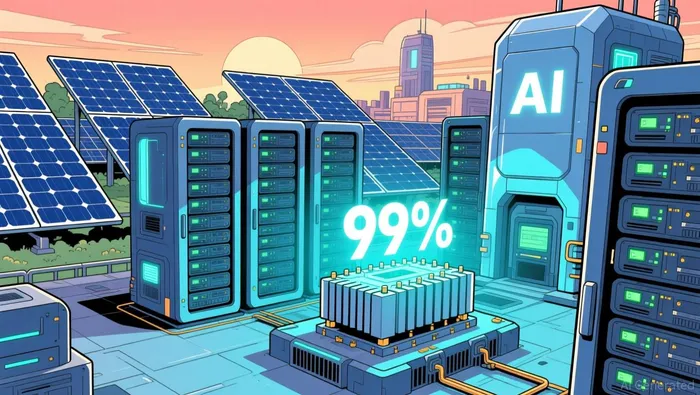
Despite the current turmoil, SolarEdge is attempting to pivot toward the artificial intelligence and data center sectors, a move that had previously supported its stock rally earlier in the year. The company has been developing a solid-state transformer (SST) designed to handle the high electric loads of data centers more efficiently. During the earnings call, CEO Shuki Nir highlighted that the project had shifted to live demonstrations, with a prototype showing 99% efficiency. While management expects a fully working proof-of-concept by the end of the year and pilot programs at data centers by 2027, the timeline for volume shipments remains distant, targeting 2028. For investors focused on near-term financials, this long-term AI narrative was insufficient to offset the immediate revenue concerns.
The market’s reaction also reflects broader skepticism regarding the sustainability of SolarEdge’s turnaround. Although the company returned to non-GAAP operating profitability for the first time since 2023 and generated positive free cash flow, the high fixed costs and the need for continued capital expenditure—projected between $60 million and $80 million for 2026—remain a burden. The stock’s volatility, having recorded numerous moves greater than 5% in the past year, indicates that investors remain cautious. The sharp decline suggests that while SolarEdge has stabilized its core solar business, the transition to new high-growth areas like AI infrastructure is still in its early stages and carries significant execution risk.

Stay ahead of the market.
Get curated U.S. market news, insights and key dates delivered to your inbox.


AInvest
PRO
AInvest
PRO




Comments
No comments yet