
Solar Surge or Setback? Navigating U.S. Energy Policy Uncertainty for Profitable Investments
The U.S. solar industry stands at a crossroads. A proposed policy shift—the "One Big Beautiful Bill Act" (OBBBA)—threatens to slash the Residential Clean Energy Tax Credit (ITC), which has fueled solar adoption for decades. While this could disrupt long-term growth, it may also accelerate near-term demand, creating opportunities for strategic investors. Let's dissect the risks and rewards.
Policy Shockwaves: A Catalyst for Immediate Solar Demand
The OBBBA proposes to eliminate the 30% tax credit for residential solar installations by December 2025, nearly a decade earlier than its original expiration under the Inflation Reduction Act (IRA). For a $20,552 solar system, losing the credit would add $8,978 in costs, making affordability a critical hurdle. This deadline has already triggered a rush to install systems before the end of 2025, with solar installers like 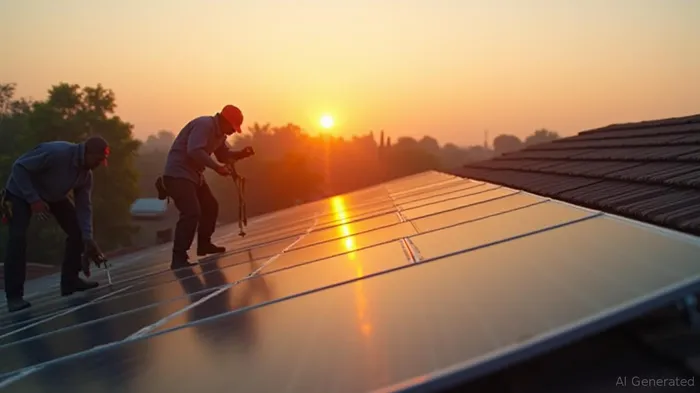 CBS Solar reporting a 40% surge in inquiries.
The stock price of First Solar (FSLR), a leading solar panel manufacturer, has risen 25% in 2025 amid this demand spike. However, the broader solar sector faces uncertainty. If the OBBBA passes, analysts predict a 30% drop in residential solar capacity by 2030, risking job losses and reduced investment. Investors must weigh short-term gains against long-term policy risks.
Utilities and Renewables: Winners and Losers in the Shuffle
The policy shift creates uneven opportunities for energy companies. Utilities with strong renewable portfolios, like NextEra Energy (NEE), may benefit from the surge in solar installations, as they can leverage their grid infrastructure to manage distributed energy resources.
NextEra's revenue has grown 18% annually since 2022, driven by its 45GW+ renewables pipeline. However, utilities reliant on fossil fuels, such as Duke Energy (DUK), could face headwinds if solar adoption accelerates faster than expected.
Renewable firms face a paradox: near-term growth but long-term uncertainty. Companies like SunPower (SPWR), which focuses on high-efficiency residential systems, may see a temporary sales boom. Meanwhile, firms exposed to third-party ownership models—such as Sunrun (RUN), which relies on leases and PPAs—are at risk if the ITC's elimination disrupts their financing structure.
Strategic Investment Themes: Where to Deploy Capital
Solar Infrastructure Plays:
Invest in companies with scalable projects or those insulated from policy risks. TerraForm Power (TERP), a yieldco backed by Brookfield Renewable, offers exposure to long-term contracted solar assets. Its dividend yield of 6.5% reflects stable cash flows from utility-scale projects.Supply Chain Resiliency:
Firms meeting the OBBBA's “Foreign Entities of Concern” (FEOC) requirements could thrive. Enphase Energy (ENPH), which manufactures U.S.-based solar inverters, is well-positioned. Its stock has risen 30% in 2025 as developers prioritize domestic suppliers to qualify for credits.Energy Storage and Grid Tech:
The rush to install solar will boost demand for storage solutions. Tesla's (TSLA) Powerwall and Megapack batteries are critical to grid stability.
Tesla's energy storage revenue hit $6.5B in 2024, up 70% from 使年. Firms like Fluor (FLR) and ABB (ABB) also benefit from grid modernization projects.Policy-Proof ETFs:
The Invesco Solar ETF (TAN) offers diversified exposure to the sector. While volatile, it has outperformed the S&P 500 by 15% year-to-date, capturing the solar boom.
Risks and Red Flags to Avoid
- Policy Uncertainty: The Senate may amend the OBBBA, delaying the ITC's expiration. Investors should monitor bipartisan negotiations and track amendments like the “Solar Extension Act” proposed by Sen. Ron Wyden (D-OR).
- Supply Chain Bottlenecks: China's dominance in polysilicon and panels could limit FEOC-compliant supply. Firms like 1366 Technologies (拉 SIX) working on U.S. manufacturing are speculative but high-risk bets.
- Overcapacity Risks: A post-2025 market crash could hit solar installers. Avoid companies with high debt or reliance on residential leases.
Final Call: Position for the Solar Surge, but Stay Nimble
The OBBBA's passage is far from certain, but its mere proposal has already altered market dynamics. Investors should:
1. Buy the dip: Use near-term volatility in solar stocks (e.g., SPWR, ENPH) to accumulate positions.
2. Focus on resilience: Prioritize firms with FEOC-compliant supply chains or grid-related technologies.
3. Hedge with utilities: NextEra and Brookfield Renewable (BEP) offer stable dividends amid sector shifts.

The Senate's vote could redefine the solar landscape. Keep an eye on amendments to the OBBBA—particularly extensions of the ITC—and be ready to pivot as clarity emerges. For now, the solar sector's short-term momentum makes it a compelling, albeit turbulent, arena for risk-tolerant investors.
Recommendation: Overweight solar infrastructure and storage ETFs (TAN, TERP) while underweighting pure-play residential installers exposed to policy risk. Maintain a 5–10% allocation to this theme, rebalancing as policy outcomes crystallize.

Stay ahead of the market.
Get curated U.S. market news, insights and key dates delivered to your inbox.






Comments
No comments yet