
Solar Storms Are Brewing—Why These Undervalued Companies Will Profit from the Next Geomagnetic Catastrophe
The sun is waking up. In May 2024, the Gannon Storm—a geomagnetic tempestTPST-- powerful enough to disrupt global GPS, fry satellites, and cost U.S. corn farmers $500 million in lost yield—was just a taste of what’s to come. Solar Cycle 25, now peaking, could unleash a Carrington-level event (the 1859 superstorm that crippled telegraph systems) within the next five years. When it hits, modern infrastructure will be defenseless.
But here’s the opportunity: undervalued companies are already building the shields to protect us. From satellite hardening to grid resilience, these overlooked firms are positioned to explode as governments and industries scramble to mitigate existential risks. Let’s dissect the urgency—and the winners.
The Solar Threat: A Perfect Storm of Vulnerability
Recent solar flares have exposed critical flaws:
- Satellites: Over 5,000 satellites had to fire thrusters during the Gannon Storm, creating collision risks in orbit. A single satellite outage costs insurers $3 billion annually—and that’s during mild events.
- Power Grids: Induced currents from storms can melt transformers, as seen in the 1989 Quebec blackout. A Carrington-scale storm today could cost $2 trillion in U.S. damages alone.
- Navigation: GPS disruptions caused farmers to halt planting, proving agriculture’s reliance on space tech—and its fragility.
Experts warn: “We’re not ready.” The North American Electric Reliability Corporation (NERC) recently called for urgent grid hardening. The Department of Defense is simulating scenarios where adversaries exploit solar-induced chaos.
Satellite Hardening: The Next Frontier
The most vulnerable link? Space-based infrastructure. Over 30,000 satellites and debris orbit Earth, yet few are hardened against radiation, jamming, or geomagnetic chaos. Here’s where to invest:
1. TESAT (Germany)
Focus: Optical communication terminals for military and commercial satellites.
Why Now?
- Their laser links are critical for secure data transfer in contested environments. In 2024, TESAT demonstrated cross-vendor satellite-to-satellite communications—a $1.2 billion market by 2030—using SpaceX and York Space Systems hardware.
- Undervalued: Stock trades at 12x 2025E earnings, below peers.
- 
- ****
2. Logos Space (U.S.)
Focus: Enterprise-grade satellite networks with anti-jamming tech.
Why Now?
- Their 3,960-satellite constellation uses narrow beams and proprietary waveforms to resist interference—critical for defense and critical infrastructure.
- Partners with Aalyria for AI-driven network management, creating a tamper-proof system.
- Undervalued: Valuation at $1.8 billion despite a $500M+ revenue runway.
- 
3. BitRezus (Greece)
Focus: Blockchain-based satellite cybersecurity.
Why Now?
- Its Astropledge platform ensures real-time consensus among satellites, blocking unauthorized access.
- Target market: $59 billion aerospace cybersecurity sector by 2032.
- Undervalued: Seed-stage valuation at $150M despite early Pentagon contracts.
Grid Resilience: Powering Through the Storm
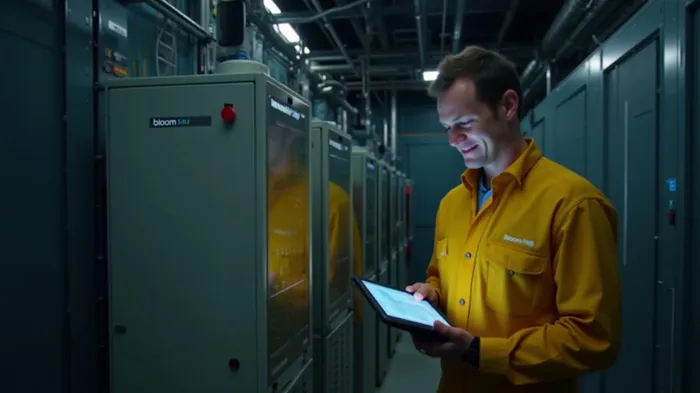
While satellites orbit, the ground infrastructure they serve is equally at risk. Enter Bloom Energy (BE):
Bloom Energy Corp. (BE)
Focus: On-site fuel cells for decentralized power.
Why Now?
- Their solid oxide fuel cells provide uninterrupted energy for hospitals, data centers, and grids—critical during geomagnetic disruptions.
- Financials: Stock surged 100%+ in 2024 as utilities adopt its tech. Analysts project 17% annual revenue growth through 2026.
- 
-
Why Act Now? The Clock Is Ticking
- Solar Cycle 25 Peak: The sun’s activity is forecast to hit its maximum in 2025, increasing storm frequency and intensity.
- Regulatory Pressure: Governments will mandate hardening standards for satellites and grids—creating $40+ billion in new demand.
- Market Ignorance: These stocks are undervalued because investors still underestimate the $2 trillion threat of solar storms.
Final Call to Action
The next geomagnetic catastrophe isn’t a question of if—but when. Companies like TESAT, Logos Space, and Bloom Energy are the only insurance policy against trillions in potential losses.
Act now before the market catches on:
- TESAT: Buy dips below €35/share.
- Logos Space: Look for a secondary offering in Q3 2025—invest before valuation soars.
- Bloom Energy (BE): Accumulate on corrections below $50/share.
The sun doesn’t wait. Neither should you.

**

Stay ahead of the market.
Get curated U.S. market news, insights and key dates delivered to your inbox.


AInvest
PRO
AInvest
PRO



Comments
No comments yet