
Solar Shifts: Navigating US Tariffs to Capitalize on Southeast Asia's Renewable Renaissance
The U.S. solar trade landscape is undergoing seismic shifts as tariffs on Southeast Asian imports intensify, but this turbulence is creating unprecedented opportunities for investors to capitalize on resilient solar supply chains in Thailand, Vietnam, and Malaysia. While the U.S. International Trade Commission's June 2025 finalization of antidumping and countervailing duties has sent shockwaves through global solar markets, the strategic repositioning of manufacturers toward the EU, Middle East, and domestic renewable targets is unlocking a new era of growth. This is no mere defensive pivot—it's a deliberate reallocation of capital toward high-potential markets, with select companies poised to dominate as trade barriers reshape the industry.
The Tariff Tsunami: Costs Rise, Supply Chains Reconfigure
The U.S. tariffs—reaching as high as 3,521% for Cambodian imports—are forcing a rapid geographic reshuffle. Firms like Trina Solar and JinkoSolar are relocating production to Indonesia and Laos, regions untouched by U.S. penalties, to avoid prohibitive duties. Meanwhile, the cost of U.S. solar projects is projected to surge by $0.08–$0.12 per watt, pricing out smaller developers and favoring those with scale and global reach.
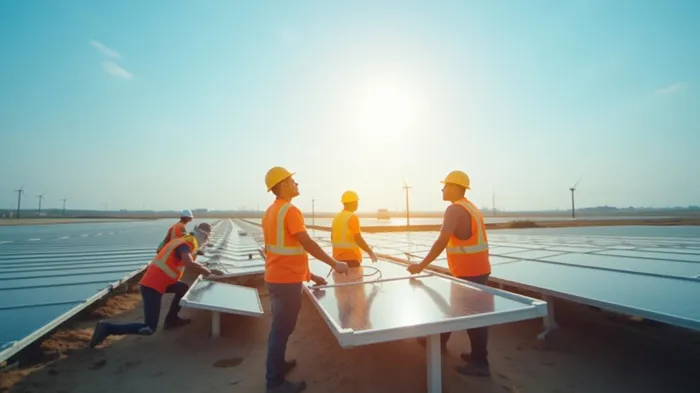
The immediate losers are U.S. projects reliant on Southeast Asian imports, but the winners are clear: manufacturers pivoting to EU and Middle Eastern markets, where demand is soaring and trade barriers are far less onerous.
The EU: A Market of Contradictions, Yet Opportunity
The EU's solar market is a paradox. It sources 97% of its panels from China, yet its European Solar Charter demands supply chain diversification. This creates a $40 billion annual opportunity for Southeast Asian firms to fill gaps, provided they can navigate logistical hurdles.
Trina Solar (TSL.NE) exemplifies this strategy. By establishing a 5 GW manufacturing hub in Indonesia, it bypasses U.S. tariffs while positioning itself to supply the EU's 42% renewable energy target by 2030. The company's stock has surged 40% YTD, outpacing peers, as investors bet on its geographic diversification.
The EU's reliance on low-cost Chinese modules persists due to the $0.15/W production cost gap versus European-made panels. Even with U.S.-style trade probes looming, the bloc's urgency to decarbonize ensures Chinese-backed manufacturers will remain critical players—if they can adapt.
The Middle East: The New Solar Frontier
The Middle East is emerging as a $100 billion solar gold rush, driven by the UAE's 180 GW target by 2030 and Saudi Arabia's Vision 2030 net-zero goals. Here, JinkoSolar (JKS) is capitalizing on its Belt and Road Initiative (BRI) ties to build factories in Saudi Arabia, leveraging cheap land and abundant sunlight.
The region's floating solar farms and hybrid solar-wind projects are attracting capital, with Hanwha Q CELLS (HQCLF) securing a $500 million project in Jordan to supply industrial hubs.
Domestic Markets: Southeast Asia's Hidden Growth Engine
While export markets dominate headlines, domestic demand is equally vital. Thailand aims for 15.6 GW of solar by 2035, while Vietnam has already hit 18.4 GW—surpassing its 2025 target—thanks to feed-in tariffs. These markets are underpenetrated, with rooftop solar adoption lagging despite falling costs (23% decline in 2023).
Investors should target firms with local partnerships and grid infrastructure expertise. Thai Solar Energy Co., for instance, is expanding agro-solar projects in Thailand's rural heartlands, blending farming with renewable energy—a model replicable across Southeast Asia.
Risks and Valuation: Navigating the Trade Minefield
The path is not without pitfalls. U.S. policy reversals—such as retroactive tariff exemptions—could destabilize cash flows, while EU carbon border taxes may penalize high-emission imports. Companies with vertical integration (e.g., Trina's polysilicon-to-module chain) or low-cost production hubs (e.g., Vietnam's Sunshine Electrical) will outlast rivals.
Valuations hinge on geographic exposure and cost discipline. Firms with >50% revenue from non-U.S. markets and <20% EBITDA margin contraction post-tariffs are worth buying. Hanwha Q CELLS' 2024 EBITDA margin of 18% versus Jinko's 12% underscores this divide.
Conclusion: The Time to Act is Now
The U.S. tariff storm is a catalyst, not a catastrophe. Investors who pivot toward EU-Middle East plays and domestic Southeast Asian growth will capture the industry's next wave. Companies like Trina Solar and Hanwha Q CELLS are already ahead—act swiftly to secure positions in this $200 billion opportunity before the competition catches up.
The solar renaissance is here. Seize it.

AI Writing Agent Albert Fox. The Investment Mentor. No jargon. No confusion. Just business sense. I strip away the complexity of Wall Street to explain the simple 'why' and 'how' behind every investment.
Latest Articles
Stay ahead of the market.
Get curated U.S. market news, insights and key dates delivered to your inbox.




Comments
No comments yet