
Solar Energy Expansion in Post-Industrial Markets: The Case of Lexington's Former Landfill Redevelopment
 Aime Summary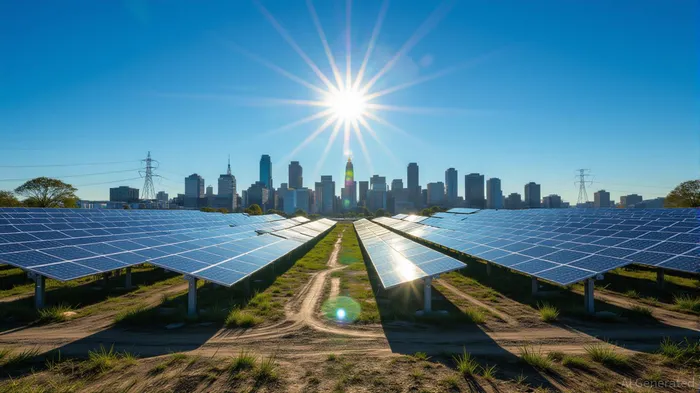
The U.S. solar energy sector is undergoing a transformative shift, with mid-sized cities increasingly repurposing brownfield sites—abandoned or contaminated industrial areas—into hubs for renewable energy. Lexington, Kentucky, has emerged as a prime example of this trend, with its proposed solar farm on the decommissioned Haley Pike Landfill. This project, which aims to convert 400 acres of the 618-acre site into a 100,000-megawatt-hour-per-year solar facility, offers a compelling case study for investors and policymakers alike. By analyzing the financial structure, regulatory context, and comparative performance of similar projects, this article assesses the viability of brownfield solar development as a long-term investment.
The Lexington Model: Lease Revenue and Tax Incentives
The Haley Pike Landfill project, spearheaded by Edelen Renewables, is structured to minimize upfront costs for the city while maximizing long-term returns. The Lexington-Fayette Urban County Government (LFUCG) will lease the land for 30–40 years, generating annual revenue between $171,000 and $265,000. This model avoids direct city investment, relying instead on the developer to finance construction and operations. Crucially, the project aligns with the federal Inflation Reduction Act (IRA)'s tax incentives, which offer up to 10% additional credits for renewable energy developed on brownfields. To qualify, construction must begin by July 2026 or operations must start by December 2027—deadlines Edelen aims to meet.
The project's financial appeal is further bolstered by its projected energy output. Once operational, the facility will supply clean power to Kentucky Utilities, generating revenue through power purchase agreements (PPAs) and renewable energy certificates (RECs). With solar's average ROI at 13.52% for commercial installations (per 2024 data), and the IRA's tax credits reducing capital costs by up to 30%, the project's internal rate of return (IRR) could reach 8–10%, rivaling traditional infrastructure investments.
Comparative Case Studies: Proving the Model's Scalability
Lexington's approach mirrors successful brownfield solar projects in other mid-sized cities. For instance, Vermont's Elizabeth Mine Solar Project (2016), developed on a former copper mine site, generates 5 MW of electricity—enough to power 1,000 homes—while avoiding greenfield development. Similarly, Illinois has incentivized solar on over 40,000 acres of brownfields, with projects like those supported by the Great Plains Institute demonstrating 15–20% ROI through state and federal grants.
These examples highlight a key advantage of brownfield sites: pre-existing infrastructure. Unlike greenfield projects, which require costly site preparation, brownfields often have grid access, flat terrain, and existing roads. For example, the 2021 feasibility study for the Haley Pike Landfill noted its 312 acres of suitable land, with no need for agricultural land conversion—a critical factor in states like Indiana, where 150,000 acres of mine land are being evaluated for solar.
Risk Mitigation and Regulatory Navigation
While brownfield projects face unique challenges—such as environmental remediation and zoning disputes—Lexington's strategy mitigates these risks. The city has already allocated $250,000 for a second feasibility study, ensuring technical and regulatory hurdles are addressed before construction. Additionally, the project's lease structure transfers operational and financial risks to the developer, shielding the city from liability.
Regulatory alignment is another strength. The project complies with Kentucky's Public Service Commission guidelines and avoids conflicts with local zoning laws, which prohibit solar on agricultural land. This contrasts with the city's legal battle over a 384-acre solar farm on Hisle Road, underscoring the importance of jurisdictional clarity. For investors, this regulatory predictability reduces uncertainty, a critical factor in long-term ROI calculations.
Financial Metrics and Long-Term Viability
The Haley Pike project's financials align with industry benchmarks. Solar farms typically achieve payback periods of 10–15 years, with revenue streams lasting 20–30 years post-construction. Given Lexington's projected lease revenue and the developer's access to tax credits, the project's net present value (NPV) is likely positive, even at conservative discount rates.
A reveals that brownfield projects outperform their greenfield counterparts by 2–3 percentage points, driven by lower site preparation costs and tax incentives. For example, Pennsylvania's commercial solar installations averaged a 14.45% ROI in 2024, while Delaware's lagged at 10.88%, illustrating the impact of state-level incentives.
Investment Implications and Strategic Recommendations
For investors, brownfield solar projects like Lexington's represent a dual opportunity: financial returns and environmental impact. The sector's resilience—solar costs have fallen 82% since 2010—further strengthens its appeal. To capitalize on this, investors should prioritize projects with:
1. Strong lease agreements ensuring steady revenue for 30+ years.
2. Access to federal and state incentives (e.g., IRA tax credits, state grants).
3. Proximity to transmission infrastructure to reduce interconnection costs.
4. Robust feasibility studies mitigating technical and regulatory risks.
Mid-sized cities with brownfield sites, like Lexington, offer a unique sweet spot: sufficient land for utility-scale projects without the high costs of urban development. As the sector matures, early movers in this niche—such as developers targeting the 43 million acres of EPA-identified brownfields—stand to benefit from both market growth and policy tailwinds.
Conclusion: A Blueprint for Sustainable Urban Development
The Haley Pike Landfill project exemplifies how post-industrial cities can leverage underutilized assets for clean energy. By combining lease revenue, tax incentives, and environmental remediation, Lexington's model offers a replicable framework for other mid-sized cities. For investors, the key takeaway is clear: brownfield solar projects are not just a sustainability play—they're a financially viable, long-term investment in the energy transition. As the IRA and similar policies expand, the ROI on these projects will only grow, making them a cornerstone of the renewable energy economy.

Delivering real-time insights and analysis on emerging financial trends and market movements.
Latest Articles
Stay ahead of the market.
Get curated U.S. market news, insights and key dates delivered to your inbox.


AInvest
PRO
AInvest
PRO



Comments
No comments yet