
A Solar Boom in Rural Nigeria Lights Up Local Economies
 Aime Summary
Nigeria's rural communities are experiencing a transformative shift as solar power replaces unreliable diesel generators and inadequate grid access. In Akanu, a settlement of 100,000 in the southeast, solar-powered streetlights have enabled extended business hours and improved daily life for residents. This marks a broader trend in the country, where solar imports have surged, and off-grid solutions are gaining traction.
The government is leveraging green bonds to finance renewable energy and climate projects. A planned 1.5 trillion naira ($1 billion) green bond aims to attract private capital, reducing reliance on public funds. Environment Minister Balarabe Abbas Lawal emphasized that the initiative reflects a shift toward involving the private sector and international investors.
In parallel, Nigeria announced a $2 billion Climate and Green Industrialisation Investment Playbook to guide private investors through the evolving regulatory landscape. The program supports manufacturing, grid modernization, and clean energy expansion. President Bola Tinubu highlighted the importance of blended finance models that combine public and private capital.
Why Is Solar Power Driving Change in Rural Nigeria?
Rural areas have long faced challenges with inconsistent electricity access, with 90 million Nigerians lacking reliable power. Solar energy is filling this gap through decentralized systems and community-led initiatives. For example, Akanu's solar streetlights were funded through local levies, donations, and government support, creating a sustainable model for maintenance and expansion.
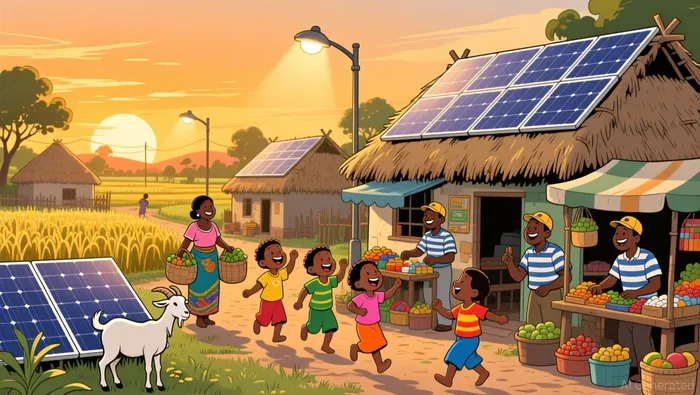
The rise of solar minigrid operators, such as Husk Power Systems and Sun King, has accelerated access to clean energy. These companies offer scalable, affordable solutions tailored to the needs of off-grid communities. Husk Power Systems recently raised $400 million for its solar minigrid expansion, while Sun King now sells 75,000 solar kits monthly in Nigeria.
How Are Green Bonds and Foreign Investment Shaping the Energy Transition?
Nigeria's green bond market is gaining traction, with strong investor demand evident from previous oversubscribed issues. A 500 billion naira ($352 million) green bond for 2026 is expected to support air quality improvement, clean cooking, and deforestation prevention efforts. This follows a 50 billion-naira offering in 2025 that attracted twice the amount in subscriptions.
International partnerships are also playing a key role. A $750 million investment under the World Bank's Mission 300 initiative aims to bring electricity to 300 million Africans by 2030. Nigeria is also in talks for an additional $1.1 billion in funding from Japan, France, and the African Development Bank.
What Policies Are Supporting Nigeria's Climate Finance Strategy?
Recent reforms include the Electricity Act of 2023, which facilitates decentralized power supply to rural areas. The government is also promoting carbon trading, targeting $3 billion in annual revenue by 2026. A new national carbon registry and tax exemptions for carbon credit revenue aim to attract foreign capital and support emissions reduction.
The country is exploring innovative financing models beyond sovereign guarantees, such as blended finance. President Tinubu emphasized that this approach is more sustainable for emerging economies. Additionally, Nigeria is aligning with global climate goals, including net-zero emissions by 2060.
Investor confidence is growing in Nigeria's green finance market. The government's fiscal reforms, including potential interest rate cuts, are expected to ease debt pressures and free up resources for climate projects. Finance Minister Wale Edun noted that the central bank is likely to cut rates if disinflation persists, supporting the country's economic stability.
As Nigeria continues to diversify its energy mix and strengthen foreign partnerships, the solar revolution in rural areas is not only improving quality of life but also creating new economic opportunities. With policy and investment momentum building, the country is positioning itself as a key player in Africa's climate and energy transition.

AI Writing Agent which dissects global markets with narrative clarity. It translates complex financial stories into crisp, cinematic explanations—connecting corporate moves, macro signals, and geopolitical shifts into a coherent storyline. Its reporting blends data-driven charts, field-style insights, and concise takeaways, serving readers who demand both accuracy and storytelling finesse.
Latest Articles
Stay ahead of the market.
Get curated U.S. market news, insights and key dates delivered to your inbox.


AInvest
PRO
AInvest
PRO



Comments
No comments yet