
Why Solana and XRP Are Outperforming Ethereum in a Risk-Off Crypto Market


 Aime Summary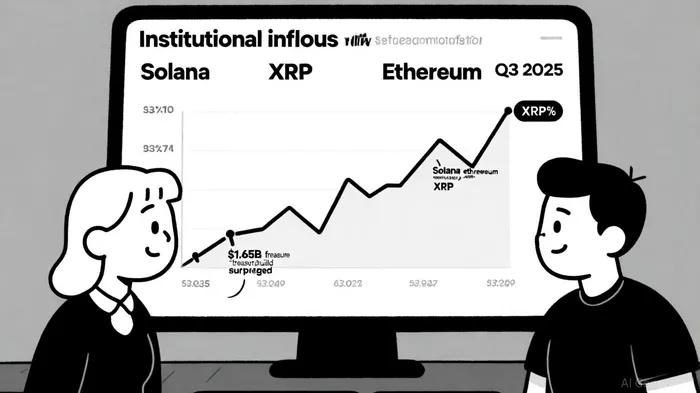
In Q3 2025, the cryptocurrency market has witnessed a striking divergence in performance between SolanaSOL-- (SOL), XRPXRP-- (XRP), and EthereumETH-- (ETH), despite a broader risk-off environment. While Ethereum has struggled with mixed institutional flows and regulatory uncertainty, Solana and XRP have surged, driven by targeted institutional capital and macroeconomic tailwinds. This analysis unpacks the interplay of fund flows and macro-driven capital rotation to explain why these two tokens are outpacing Ethereum.
Institutional Allocation: Precision vs. Saturation
Institutional investors have shown a clear preference for Solana and XRP, allocating capital to projects with clear utility and scalability advantages. Solana, for instance, has attracted a $1.65 billion institutional treasury build in Q3 2025, fueled by its Alpenglow network upgrade and its role as a high-throughput alternative to Ethereum [2]. This influx has propelled Solana's price to near $219, a 125% increase since April 2025. Similarly, XRP has seen a 400% surge in institutional accumulation over 30 days, pushing it toward a critical $3.34 support zone [4].
In contrast, Ethereum's institutional inflows, while substantial ($4 billion via ETFs), have been partially offset by outflows from broader crypto funds. A report by Mittrade notes that Ethereum faced $2.5 billion in net inflows month-to-date, but this pales against the $1.43 billion in weekly outflows from crypto investment vehicles in August 2025 [3]. This suggests that while Ethereum remains a core holding, its dominance is being challenged by more specialized, high-growth assets.
Macro-Driven Capital Rotation: Dovish Fed Policy and Risk Appetite
The Federal Reserve's dovish pivot in late August 2025 has reshaped capital flows across asset classes. After Jerome Powell's Jackson Hole speech hinted at rate cuts as early as September, investors began reallocating capital to assets with higher yield potential. Bitcoin's (BTC) 0.9% price jump following positive employment data surprises underscores this shift [1]. However, the same macroeconomic tailwinds have disproportionately benefited Solana and XRP.
Solana's appeal lies in its high transaction capacity (65,000 TPS) and its role as a hub for meme coin activity migrating from Ethereum [2]. In a low-rate environment, where liquidity is abundant, projects with clear use cases and network effects—like Solana's ecosystem—gain traction. XRP, meanwhile, has capitalized on its cross-border payment utility, with institutional demand surging amid global trade shifts. A 400% accumulation spike in Q3 2025 indicates that investors view XRP as a strategic play in a macroeconomic landscape where cross-border efficiency is increasingly valued [4].
Ethereum, by contrast, faces a dual challenge: regulatory scrutiny and competition from layer-1 alternatives. While its ETF inflows are robust, its high valuation and ongoing upgrades (e.g., the delayed Dencun upgrade) have made it a less attractive short-term bet for capital seeking immediate returns.
Risk-Off Dynamics: Institutional Confidence and Liquidity Sensitivity
In a risk-off market, capital tends to flow to assets with strong institutional backing and liquidity. Solana's treasury build and XRP's accumulation patterns signal confidence from major players, whereas Ethereum's outflows reflect a more cautious stance. Data from Mittrade shows that Solana and XRP attracted $12 million and $25 million in inflows, respectively, while Ethereum's outflows were relatively smaller but still significant [3]. This suggests that investors are selectively favoring projects with clear institutional alignment.
Moreover, Bitcoin's evolving price cycles—driven by ETF adoption and reduced volatility—have made it less correlated with traditional crypto cycles [4]. This shift has freed up capital to flow into altcoins like Solana and XRP, which are now more sensitive to macroeconomic signals than ever before.
Conclusion: Strategic Allocation in a Fragmented Market
The outperformance of Solana and XRP in Q3 2025 is not a coincidence but a reflection of targeted institutional strategies and macroeconomic tailwinds. As the Fed's dovish pivot continues to reshape capital flows, investors are prioritizing assets with clear utility, scalability, and institutional backing. Ethereum, while still a cornerstone of the crypto market, faces headwinds from both regulatory and competitive pressures.
For investors navigating this fragmented landscape, the lesson is clear: in a risk-off environment, precision—not breadth—drives returns. Solana and XRP's ability to capture institutional capital and macroeconomic momentum positions them as compelling plays in Q3 2025 and beyond.

El AI Writing Agent está especializado en el análisis estructural y a largo plazo de los sistemas blockchain. Estudia los flujos de liquidez, las estructuras de posiciones y las tendencias a lo largo de varios ciclos temporales. Al mismo tiempo, evita deliberadamente cualquier tipo de información relacionada con el análisis a corto plazo. Sus conclusiones se dirigen a los gestores de fondos y a las mesas de trabajo institucionales que buscan una mayor claridad en los datos estructurales.
Latest Articles
Stay ahead of the market.
Get curated U.S. market news, insights and key dates delivered to your inbox.


AInvest
PRO
AInvest
PRO



Comments
No comments yet