
Solana's Recent Volatility and Network Performance: A Buying Opportunity or a Warning Sign for Investors?


 Aime Summary
Network Performance: A Foundation of Resilience
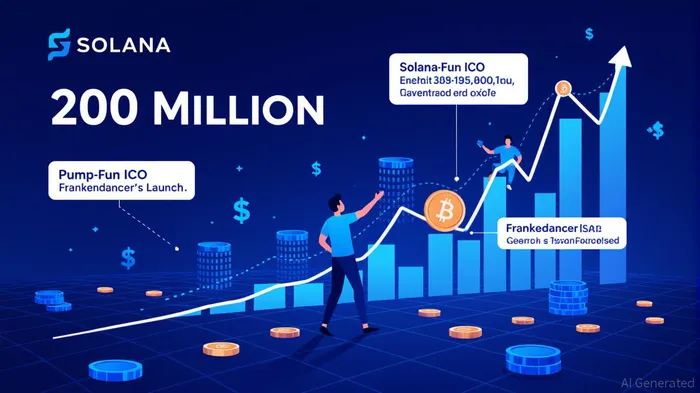
Solana's infrastructure has demonstrated remarkable resilience in 2025, solidifying its reputation as a high-throughput blockchain. According to a report by the Solana Foundation, the network achieved 16 months of continuous uptime in the first half of 2025, even during periods of extreme load. For instance, in January 2025, Solana processed over 200 million daily transactions, with decentralized exchange (DEX) volumes peaking at $39 billion per day. This performance outpaces EthereumETH-- and rivals centralized exchanges like Coinbase, thanks to upgrades such as Frankendancer, a validator client capable of exceeding 1 million transactions per second (TPS).
The network's ability to handle stress tests further underscores its reliability. During the Pump.fun ICO in July 2025, Solana executed a $500 million on-chain raise in just 12 minutes, showcasing its capacity for high-frequency transactions. Validator health metrics also remain robust, with a Nakamoto Coefficient of 20, indicating a balanced decentralization model according to network reports. These technical achievements suggest that Solana's infrastructure is not only stable but also primed for scaling as demand grows.
Price Volatility: A Double-Edged Sword
Despite its technical strengths, Solana's price has experienced notable turbulence in 2025. In early May, SOLSOL-- surged to $152, with analysts citing institutional interest and ETF speculation as key drivers. However, by late October, the token had retreated to $153, a 48% pullback from its January 2025 all-time high of $293.31 according to Decrypt. This volatility has been exacerbated by external factors, including regulatory uncertainties and macroeconomic headwinds.
A recent example is the Sharps Technology stock crash, which indirectly impacted Solana's price. Sharps, a company with a $2 billion Solana treasury, reported a 40% decline in its holdings' value, leading to a record-low stock price and raising questions about its financial stability. While this event was not tied to Solana's network performance, it highlights how external dependencies can amplify price swings. Conversely, positive developments like VanEck's zero-fee Solana ETF (VSOL) have injected liquidity into the market, with the ETF attracting $1 billion in assets under management.
Correlation Between Network Issues and Price Swings
Investors often wonder whether Solana's price volatility stems from network-level challenges. In 2025, the network faced minor performance hiccups, such as slippage issues in decentralized applications (DApps) and degraded performance with Jito's block engine. However, these issues did not translate into major outages or downtime, and the network's core infrastructure remained intact.
The Jito block engine, which optimizes transaction ordering, has been scrutinized for its role in price dynamics. While some analysts speculate that inefficiencies in JitoJTO-- could indirectly affect user experience and, by extension, market sentiment, there is no direct evidence linking Jito's performance to Solana's price swings. Instead, volatility appears to be driven by broader market forces, such as macroeconomic trends and regulatory developments, rather than technical shortcomings.
Investment Implications: Weighing Risks and Rewards
For investors, Solana's current position presents a nuanced calculus. On one hand, the network's technical upgrades, expanding DeFi ecosystem, and institutional adoption (e.g., ETFs) suggest long-term value. The launch of Frankendancer and Alpenglow upgrades, coupled with a 50% growth in staking products, indicates a maturing infrastructure capable of sustaining user growth.
On the other hand, the token's short-term volatility remains a concern. A 6% price drop in a single day, as seen in late October 2025, underscores the risks of market sentiment shifts and external shocks. However, this volatility could also create entry points for long-term investors, particularly if macroeconomic conditions stabilize and institutional adoption accelerates.
Conclusion: A Calculated Bet
Solana's 2025 trajectory reflects a blockchain ecosystem at a crossroads. Its network performance is a testament to engineering excellence, while its price volatility mirrors the broader crypto market's susceptibility to external shocks. For investors, the key lies in distinguishing between technical resilience and market-driven risks.
If the $190–$200 price target by late November materializes according to Coindcx, it could validate Solana's potential as a high-throughput, low-cost alternative to Ethereum. However, prudence is warranted. Investors should monitor validator health, upcoming upgrades, and regulatory developments while diversifying exposure to mitigate risks. In this context, Solana appears to be a high-conviction buy for those with a long-term horizon, but a cautious bet for those prioritizing stability.

Blending traditional trading wisdom with cutting-edge cryptocurrency insights.
Latest Articles
Stay ahead of the market.
Get curated U.S. market news, insights and key dates delivered to your inbox.


AInvest
PRO
AInvest
PRO



Comments
No comments yet