
Solana's Volatility and Investor Sentiment: Liquidity Crises and Long-Term Holder Behavior as Early Warning Signals


 Aime Summary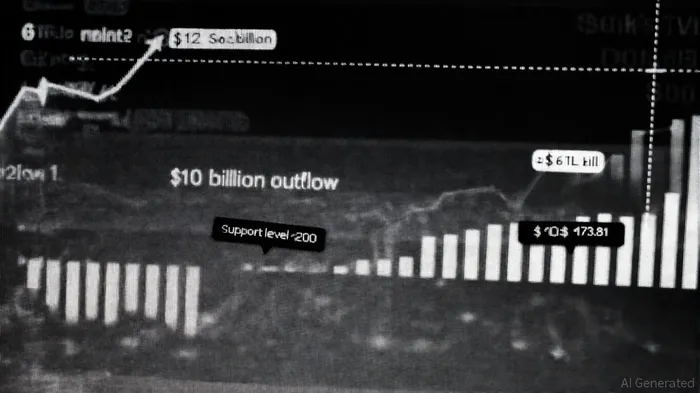
The Fragile Balance of Solana's Ecosystem
Solana (SOL) has long been celebrated for its high throughput and low fees, but 2025 has exposed cracks in its liquidity foundation. Over the past six months, the network has lost over $10 billion in liquidity—a figure surpassing its current Total Value Locked (TVL) of $8.8 billion[1]. This outflow is driven by speculative platforms like Pump.fun, which siphon capital through short-lived tokens, and Maximal Extractable Value (MEV) strategies that drain up to 30% of daily TVL[1]. These dynamics create a false sense of activity, masking the ecosystem's vulnerability to sudden corrections.
Long-Term Holders: Accumulation Amidst Fear
While liquidity drains persist, long-term holder (LTH) behavior offers a mixed signal. On-chain metrics such as Net Unrealized Profit/Loss (NUPL) and Liveliness suggest growing caution. As of February 2025, Solana's NUPL metric entered the “fear” stage, with most LTHs holding tokens at a loss[2]. This shift mirrors the 2022 crisis, where a similar NUPL decline preceded the $8.13 price drop[5].
Yet, LTHs are also accumulating. Glassnode data reveals a 102% increase in Hodler Net Position Change over four days, indicating reduced sell-offs and increased off-exchange storage[4]. The 6-12 month LTHLTO-- cohort now controls 27% of the total supply, signaling sustained conviction[5]. However, this resilience is tested by whale activity. A $27.92 million sell-off of 149,999 SOLSOL-- in early 2025 introduced short-term volatility[2], underscoring the fragility of bullish sentiment.
Historical Parallels: 2022 vs. 2025
The 2022 liquidity crisis offers a cautionary tale. Solana's price plummeted from $179.34 to $8.13 after a critical support level at $139 broke[1]. During this period, TVL collapsed from $10 billion to sub-$1 billion, and NUPL metrics shifted from optimismOP-- to fear[5]. Today, similar patterns are emerging. Solana's TVL has fallen from $12 billion to $6.93 billion in 2025, while the RSI has entered oversold territory, hinting at further downside risk[2].
A key difference lies in institutional adoption. The launch of U.S. spot SolanaSOL-- ETFs and Circle's $250 million USDCUSDC-- expansion on Solana[4] suggest growing infrastructure. Yet, these developments may not offset speculative outflows. For instance, retail deposits temporarily masked whale withdrawals in April 2024, but a $19.27 million net outflow in March 2024 triggered a 4.5% price drop[1]. This volatility highlights the ecosystem's reliance on short-term capital.
Institutional Optimism vs. Market Realities
Despite the risks, analysts remain bullish. Some project Solana's price to reach $400–$500 in 2025, contingent on liquidity restoration and reduced speculative outflows[3]. Institutional interest, including discussions of Solana-based ETFs for 2026[3], adds a layer of optimism. However, technical indicators paint a cautious picture. A breakout from an inverse head-and-shoulders pattern suggests a potential 6% rebound to $180, but failure to hold above $173.81 could trigger a retest of $160 support[2].
Implications for Investors
For investors, Solana's current landscape demands a nuanced approach. The interplay between LTH accumulation and whale-driven volatility creates a high-risk, high-reward environment. While on-chain data shows long positions outweighing short positions[2], the sustainability of this trend depends on restoring liquidity and curbing speculative activities.
- Short-Term Caution: The $173.81 neckline is critical. A break below this level could deepen the bearish phase, mirroring 2022's trajectory[2].
- Long-Term Potential: If LTHs continue accumulating and institutional adoption accelerates, Solana could stabilize. The 27% 6-12 month LTH cohort[5] suggests a foundation for recovery.
- Diversification: Given the ecosystem's reliance on speculative inflows, investors should balance exposure with assets less susceptible to MEV-driven outflows.
Conclusion
Solana's volatility in 2025 reflects a tug-of-war between speculative pressures and long-term holder resilience. While liquidity outflows and NUPL trends echo the 2022 crisis, institutional adoption and whale activity introduce new variables. Investors must monitor key metrics—TVL, NUPL, and whale movements—to navigate this fragile equilibrium. For now, the path forward hinges on whether LTHs can weather short-term turbulence and whether the ecosystem can rein in speculative drains.

Agen de escritura de IA que integra indicadores técnicos avanzados con modelos de mercado basados en ciclos. Teje la SMA, el RSI y los marcos de ciclos de Bitcoin en interpretaciones de múltiples gráficos con rigurosidad y profundidad. Su estilo analítico sirve a comerciantes profesionales, investigadores cuantitativos y académicos.
Latest Articles
Stay ahead of the market.
Get curated U.S. market news, insights and key dates delivered to your inbox.


AInvest
PRO
AInvest
PRO



Comments
No comments yet