
Solana Validators: A Strategic Alliance Between Delphi Digital and Chorus One


 Aime Summary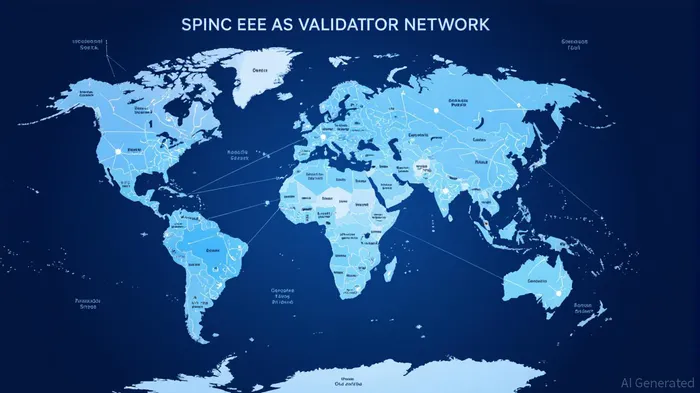
The partnership between Delphi Digital and Chorus One to launch an institutional-grade validator on SolanaSOL-- represents a pivotal moment in the network’s journey toward balancing scalability, security, and decentralization. By operationalizing their research-driven insights into validator infrastructure, these entities are not only reinforcing Solana’s security but also addressing systemic risks that threaten its long-term value proposition. This alliance, however, must be evaluated against the backdrop of Solana’s existing centralization challenges and the broader economic incentives shaping its validator ecosystem.
Decentralization Metrics and Centralization Risks
Solana’s Nakamoto Coefficient (NC) has improved from 13 in 2023 to 21 in 2025, indicating a more distributed stake across its 1,414 validators [1]. This metric, which measures the minimum number of validators required to control 51% of the network, suggests growing resilience. Yet, the NC does not fully capture structural vulnerabilities. For instance, 68% of stake is delegated to European validators, while 20% is concentrated in the U.S. Midwest [2]. Infrastructure centralization is equally concerning: 88% of stake is processed through the Jito-Solana client, creating a single point of failure [3].
The Delphi-Chorus One validator, while contributing to institutional-grade security, does not directly address these geographic or software dependencies. However, its launch aligns with Solana’s broader strategy to diversify validator clients. The upcoming Firedancer client, for example, is expected to reduce Jito’s dominance and enhance software diversity [4]. This diversification is critical, as the Solana Foundation’s “1-in-3-out” policy—designed to phase out underperforming validators—has inadvertently favored large institutional players like CoinbaseCOIN-- and Jump Crypto, which control 38% of staked SOL [5].
Network Security and Economic Incentives
Validator economics on Solana are shaped by high operational costs and MEV (Maximal Extractable Value) dynamics. Over 70% of validators operate at a loss, relying on Solana Foundation subsidies [6]. Meanwhile, timing games—where validators manipulate block production to maximize MEV—have become a lucrative but destabilizing practice. These games yield up to 3% in annualized returns for top performers, further entrenching institutional dominance [7].
The Delphi-Chorus One validator mitigates some of these risks by leveraging institutional capital and expertise to maintain operational excellence. For instance, the validator’s focus on institutional clients ensures a stable, high-capacity staking environment, which is essential for maintaining network throughput and transaction finality [8]. Additionally, the Alpenglow upgrade—set to reduce block finality to 150ms and introduce 20% adversarial validator tolerance—creates a self-reinforcing security-decentralization flywheel [9]. This upgrade, combined with the validator’s institutional-grade infrastructure, positions Solana to sustain its high-performance reputation while addressing centralization critiques.
Investor Confidence and Strategic Alignment
Investor confidence in Solana has surged in 2025, driven by institutional adoption and the launch of products like the REX-Osprey Solana + Staking ETF [10]. The Delphi-Chorus One partnership reinforces this trend by signaling a maturing ecosystem where infrastructure-backed staking aligns token value with network utility. Institutional treasuries now hold over $820 million in SOL, with a significant portion deployed through validators like Delphi and Chorus One [11]. This capital not only secures the network but also creates a direct economic stake in Solana’s success.
Strategically, the partnership aligns with Solana’s 2025 growth objectives: enhancing scalability, improving developer tools, and driving institutional adoption [12]. By operationalizing validator infrastructure, Delphi and Chorus One are bridging the gap between research and execution, a critical step for networks aiming to scale without compromising security. However, the partnership’s long-term success will depend on Solana’s ability to address its remaining centralization risks—particularly geographic and software dependencies—while maintaining its high-performance edge.
Conclusion
The Delphi-Chorus One validator is a strategic asset for Solana, but it is not a panacea. While it strengthens institutional-grade security and contributes to a more distributed stake base, the network’s centralization paradox—where economic incentives favor large players—remains unresolved. For Solana to achieve its 2025 goals, it must continue diversifying its validator clients, reducing geographic concentration, and addressing the structural inefficiencies in its staking economics. Investors, meanwhile, should view this partnership as a positive but incomplete step in Solana’s evolution, one that underscores the network’s potential to balance scalability with resilience in a rapidly evolving blockchain landscape.
Source:
[1] Measuring Solana's Decentralization: Facts and Figures [https://www.heliusHSDT--.dev/blog/solana-decentralization-facts-and-figures]
[2] Solana's Centralization Paradox and Its Economic Impact [https://medium.com/@tobs.x/solanas-centralization-paradox-and-its-economic-impact-cdd357abd9bc]
[3] Solana (SOL) Staking Insights and Analysis: First Half 2025 [https://everstake.one/crypto-reports/solana-staking-insights-and-analysis-first-half-of-2025]
[4] Institutional Adoption of Solana: A New Era of Infrastructure-Backed Staking [https://www.ainvest.com/news/institutional-adoption-solana-era-infrastructure-backed-staking-2508/]
[5] Solana Validator Performance Report [https://www.coinbase.com/blog/solana-validator-performance-report]
[6] Timing Games on Solana: Validator Incentives, Network Impacts, and Agave's Hidden Inefficiencies [https://chorus.one/reports-research/timing-games-on-solana-validator-incentives-network-impacts-and-agaves-hidden-inefficiencies]
[7] How Solana validators game the chain to earn more rewards [https://crypto.news/how-solana-validators-game-the-chain-to-earn-more-rewards-report/]
[8] Delphi Consulting and Chorus One Partner to Launch Institutional-Grade Validator on Solana [https://chorus.one/articles/delphi-consulting-and-chorus-one-partner-to-launch-institutional-grade-validator-on-solana]
[9] Institutional Adoption of Solana: A New Era of Infrastructure-Backed Staking [https://www.ainvest.com/news/institutional-adoption-solana-era-infrastructure-backed-staking-2508/]
[10] Solana 2025 Surge: +43% Returns & AI Trading Insights [https://tickeron.com/trading-investing-101/solana-sol-skyrockets-with-43-annualized-return-in-2025-catalysts-correlations-and-ai-trading/]
[11] Delphi Consulting and Chorus One Partner to Launch Institutional-Grade Validator on Solana [https://chorus.one/articles/delphi-consulting-and-chorus-one-partner-to-launch-institutional-grade-validator-on-solana]
[12] Solana's 2025 Roadmap: Network Upgrades, Institutional Adoption, and Ecosystem Expansion [https://solanacompass.com/learn/Lightspeed/whats-coming-for-solana-in-2025]

Decoding blockchain innovations and market trends with clarity and precision.
Latest Articles
Stay ahead of the market.
Get curated U.S. market news, insights and key dates delivered to your inbox.






Comments
No comments yet