
Solana Surges in Payment Volume and Stablecoin Adoption Due to Low-Cost, High-Throughput Model
 Aime Summary
Solana's blockchain network has recorded a 755.3% year-on-year increase in payment volume, outpacing traditional financial institutions and competing blockchain networks according to reports. This growth is attributed to Solana's low-cost, high-throughput transaction model, which supports micropayments and large-scale retail use cases more effectively than EthereumETH-- and BNBBNB-- Chain. The performance of SolanaSOL-- in the payments ecosystem sets it apart from traditional and blockchain-based competitors.
Stablecoin transaction activity on Solana has surged, with total transfer volume rising from $306 billion to $972 billion in one year. This highlights the expanding role of Solana as a major network for stablecoin-based transactions. Stablecoins are widely used in the blockchain ecosystem for moving funds between exchanges and settling payments.
Fintech startups are adopting stablecoin payroll due to lower cross-border payment costs and regulatory clarity from the GENIUS Act. Stablecoin payroll eliminates the slow and expensive traditional wire transfers by enabling faster settlement and lower fees. This shift is driven by concrete operational advantages that fintech founders can measure against their existing payroll costs.
Why is Solana's Growth in Payment Volume Significant for Investors?
Solana's 755.3% year-on-year increase in payment volume is significant because it outpaces traditional financial institutions. This growth highlights Solana's ability to support micropayments and large-scale retail use cases more effectively than Ethereum and BNB Chain. Institutional adoption is also growing, with U.S. spot Solana ETFs approaching $950 million in inflows. These factors make Solana an attractive investment for those looking to capitalize on the expanding digital asset ecosystem.
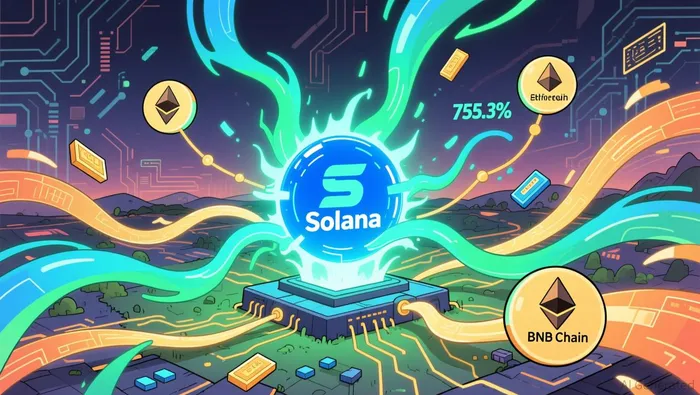
Solana's margin over Ethereum—a 130-point difference in growth rate—has been attributed to the network's involvement with stablecoin and "real-world asset" projects according to analysis. Stripe has turned to Solana to relaunch USDC payments, underscoring confidence in the network's capabilities. These developments have collectively propelled Solana's emergence as a dominant force in payment volume growth.
How is Solana Benefiting from the Rise in Stablecoin Transaction Activity?
Stablecoin transaction activity on the Solana blockchain has surged dramatically over the past year. Total transfer volume has increased from approximately $306 billion to $972 billion, representing a 3.2 times increase in activity. This growth reflects Solana's position as a major network for stablecoin transactions.
Stablecoins are digital assets designed to maintain a relatively stable value by being pegged to traditional currencies such as the US dollar. Unlike more volatile cryptocurrencies, stablecoins are widely used as transactional tools within the blockchain ecosystem. Traders, developers, and businesses frequently rely on stablecoins to move funds between exchanges, interact with decentralized finance protocols, and settle payments.
Solana has become one of the fastest-growing blockchain networks for digital asset transactions. The network was designed with a focus on high throughput and scalability, enabling it to process thousands of transactions per second. This capability makes it particularly attractive for applications that require frequent or large-volume transactions. Stablecoin transfers, which often occur in high volume within trading and financial applications, benefit from the network's speed and relatively low transaction costs.
What Does the Future Hold for Solana and Its Market Position?
Solana is transitioning from speculative trading to utility-driven growth. Analysts observe capital shifting toward protocols that generate value through actual usage, signaling a structural shift in the network's economic model. This shift is also seen in utility protocols like Mutuum Finance, which is developing lending and borrowing logic using mtTokens.
Institutional adoption is growing, with U.S. spot Solana ETFs approaching $950 million in inflows. Institutional buyers like Goldman Sachs and Morgan Stanley are supporting the price in the $80–$82 range. Network upgrades Alpenglow and Firedancer aim to reduce transaction finality and attract new users, such as payment companies and high-frequency trading firms. These developments highlight Solana's potential for continued growth and increased utility in the crypto ecosystem.
Despite these developments, the price of SOL remains down 72% from its all-time high. Continued on-chain performance and market acceptance may position Solana for a strong bull season under favorable conditions. The price of SOL currently stands at approximately $86, with a market capitalization of roughly $50 billion. Institutional interest is rising, with U.S. spot Solana ETFs approaching $950 million in cumulative inflows. A close above $96 could trigger a move toward $105, signaling a potential for continued growth.

Blending traditional trading wisdom with cutting-edge cryptocurrency insights.
Latest Articles
Stay ahead of the market.
Get curated U.S. market news, insights and key dates delivered to your inbox.


AInvest
PRO
AInvest
PRO



Comments
No comments yet