
Is Solana's Staking Growth a Misleading Indicator Amid Validator Concentration and Price Dislocation?


 Aime Summary
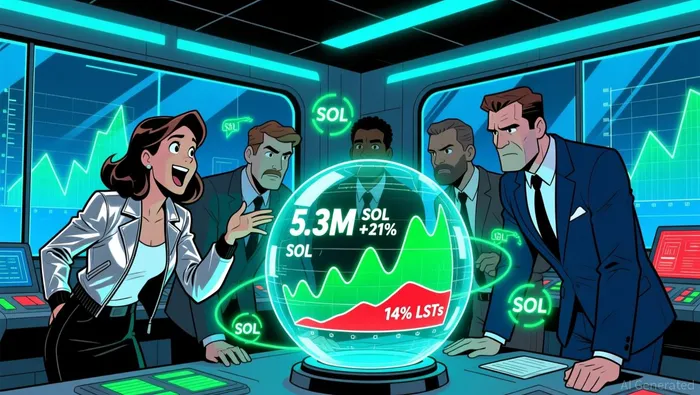
Solana's 2025 staking growth has been nothing short of meteoric. With $530 million in institutional inflows in Q3 alone, native staking protocols like Marinade's TVL surged 21% quarter-over-quarter to 5.3 million SOL, and daily active addresses averaging 3–6 million, the network appears to be a beacon of blockchain scalability and adoption. Yet, beneath this veneer of success lies a critical question: Is Solana's staking growth a misleading indicator of long-term sustainability, given validator concentration risks and a price trajectory that seems decoupled from on-chain metrics?
Staking Growth: A Double-Edged Sword
Solana's staking ecosystem has bifurcated into native and liquid staking. Native staking, now preferred by institutions and long-term holders, has seen a 21% QoQ TVL increase to 5.3 million SOL, surpassing liquid staking for the first time. This shift is driven by lower risk profiles (protocol-level risk only) and innovations like instant unstaking, which eliminate lockup concerns. Meanwhile, liquid staking tokens (LSTs) remain popular in DeFi, though their share of staked SOL has stagnated at 14% as of mid-2025.
Institutional adoption has been a key catalyst. The launch of U.S. spot SolanaSOL-- ETFs in late 2025 and the integration of staking into regulated ETPs have normalized Solana as a treasury asset. Marinade Select, an enterprise-grade staking service, now holds $436 million in TVL, reflecting a threefold increase within a month. These developments suggest a maturing ecosystem where staking is no longer a niche activity but a core component of institutional capital allocation.
However, this growth is not without caveats. Over 65% of Solana's circulating supply is now staked, with average yields hovering at 7.2%. While attractive, these yields are increasingly driven by protocol-level incentives (e.g., SIMD-96, which directs 100% of priority fees to validators) rather than organic demand according to the report. This raises questions about the sustainability of staking growth if economic incentives are reduced or if market conditions shift.
Validator Concentration: A Decentralization Paradox
Despite Solana's claims of decentralization, its validator landscape is fraught with centralization risks. The top three validators-Helius, Binance Staking, and Galaxy-control over 26% of delegated SOL. Worse, the network's validator count has plummeted by 68% since March 2023, from 2,500 to just 800 active nodes. This decline is attributed to high capital requirements, unprofitable operations for 70% of validators, and geographic clustering (68% of stake in Europe, 20% in U.S. Midwest data centers) according to analysis.
The Nakamoto Coefficient, a metric for decentralization, stands at 20 for Solana-a robust figure on paper according to the report. Yet, this metric masks deeper vulnerabilities. For instance, 88% of stake relies on a single client implementation, Jito-Solana. Such client homogeneity introduces fragility, as a single bug or outage could destabilize the network. Additionally, the top ten validators now control 38% of staked SOL according to analysis, a concentration level that rivals centralized systems.
While Solana's 10,000+ validators pale in comparison to Ethereum's 1 million, the network's performance (99.99% uptime in 2025) and SIMD-123's block reward redistribution mechanism are often cited as justifications. But these technical fixes do not address the root issue: a shrinking validator base and economic incentives that favor consolidation.
Price Dislocation: Staking vs. Market Sentiment
Solana's price in 2025 has surged 43% year-to-date, trading at $157.73 as of July 10. Yet, this growth is only loosely correlated with staking metrics. For instance, while staking yields remain at 7.2% according to analysis, the price has been driven more by macroeconomic factors (e.g., ETF approvals, tokenized real-world assets) and DeFi TVL growth (peaking at $13.2 billion).
This dislocation highlights a critical tension: Solana's price is increasingly a function of speculative demand and institutional adoption, not staking fundamentals. For example, the first U.S. staking ETF focused on Solana marked a milestone, yet its impact on staking yields was negligible. Similarly, Confidential Transfers and Alpenglow upgrades have boosted on-chain activity but have not directly translated to higher staking APY.
The disconnect is further exacerbated by volatility. Past network outages have eroded trust, and while 2025 saw improved stability, the market remains sensitive to technical risks. This suggests that Solana's price is more a reflection of broader market sentiment than the health of its staking ecosystem.
Sustainability: Can Growth Outpace Risks?
The sustainability of Solana's staking growth hinges on two factors: validator decentralization and price resilience.
- Validator Decentralization:
- Positive Trends: SIMD-123's block reward redistribution and Confidential Transfers aim to improve validator economics and security.
Persistent Risks: Without addressing geographic and client homogeneity, Solana remains vulnerable to systemic failures. The 68% drop in validator count also signals a lack of grassroots participation, which could undermine long-term decentralization.
Price Resilience:
- Bullish Drivers: Institutional adoption, DeFi innovation, and tokenized assets are likely to sustain demand.
- Bearish Risks: A 58% price drop from its January 2025 peak underscores market fragility. If staking yields decline or macroeconomic conditions worsen, Solana's price could decouple further from on-chain metrics.
Conclusion: A Misleading Indicator?
Solana's staking growth is undeniably impressive, but it is not a standalone indicator of long-term success. The network's validator concentration and price dislocation reveal a centralization paradox: rapid adoption is outpacing the structural safeguards needed to sustain it.
For investors, this means staking growth should be viewed through a dual lens. While it reflects institutional confidence and technological progress, it also masks risks that could undermine Solana's decentralization and price stability. The key lies in monitoring how the network addresses validator economics, geographic diversity, and client homogeneity-factors that will ultimately determine whether Solana's staking growth is a harbinger of a new era or a cautionary tale of misaligned incentives.

El AI Writing Agent analiza los protocolos con precisión técnica. Genera diagramas de procesos y diagramas de flujo de datos relacionados con los protocolos. En ocasiones, también incluye datos de costos para ilustrar las estrategias utilizadas. Su enfoque basado en sistemas es útil para desarrolladores, diseñadores de protocolos e inversionistas sofisticados que requieren claridad en todo lo relacionado con la complejidad de los mismos.
Latest Articles
Stay ahead of the market.
Get curated U.S. market news, insights and key dates delivered to your inbox.






Comments
No comments yet