
Solana’s Staking Dominance Over Ethereum: A Yield-Driven Ecosystem’s Rise


 Aime Summary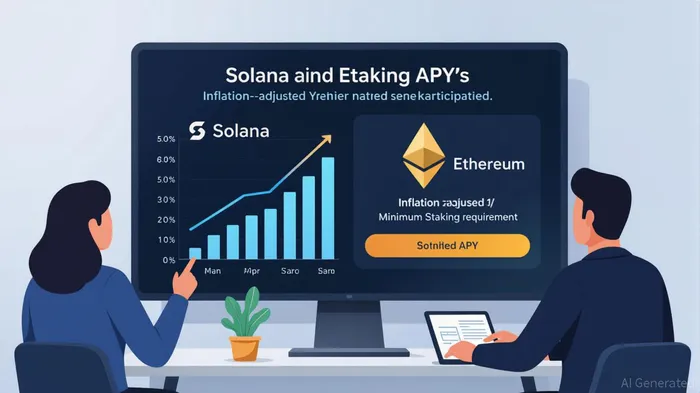
The blockchain landscape in 2025 is defined by a stark divergence in staking dynamics between SolanaSOL-- and EthereumETH--. Solana’s staking ecosystem has surged ahead, driven by superior yield incentives, lower barriers to entry, and a rapidly expanding network of active participants. This shift is not merely a function of market cycles but a structural reordering of incentives that prioritizes capital efficiency and scalability—traits Solana has mastered while Ethereum lags in adapting to post-merge realities.
Yield Disparity: The Core of Solana’s Edge
Solana’s staking APYs have consistently outpaced Ethereum’s by a factor of three to four. As of August 2025, Solana offers a baseline staking reward of 6.6%, with liquid staking platforms like Jito amplifying returns to over 8% through MEV capture [1]. Inflation-adjusted yields even reach 12.5% in some models [3], dwarfing Ethereum’s 2.8–3.08% range via Lido [1]. This gap widens further after platform fees: Solana’s post-fee yield remains at 5.57%, while Ethereum’s drops to 1.5–4.5% depending on stake size [4].
The disparity is not accidental. Solana’s design prioritizes validator accessibility—any amount of SOL can be staked with 2–3 day unlock periods—whereas Ethereum’s 32 ETH minimum (over $120,000) creates a structural barrier for retail investors [1]. This flexibility has driven Solana’s staking participation rate to 67–70% of total supply, locking $67–70 billion in value, compared to Ethereum’s 30% [2].
Ecosystem Momentum: Transactions, Fees, and Price Action
Solana’s dominance extends beyond staking. In Q3 2025, it processed 93.5 million daily transactions, dwarfing Ethereum’s 1.74 million, while maintaining average fees of just $0.00025 [4]. The Alpenglow upgrade further boosted throughput to 10,000 TPS, cementing its position as a high-performance alternative to Ethereum’s Layer 2 solutions [4].
Price performance reflects this momentum. Solana’s token surged 17% in Q3’s final week, outpacing Ethereum’s 6% gain [3]. Ethereum’s 80% Q3 rally, fueled by SEC-approved ETFs and $27.6 billion in inflows, pales against Solana’s $2.7 billion in institutional inflows from Galaxy DigitalGLXY-- and the REX-Osprey SSK ETF, which added $1.2 billion in 30 days [1]. The latter’s inclusion of staking rewards has proven particularly attractive to yield-focused investors [4].
Institutional Adoption and the Path Forward
The institutional stampede into Solana underscores a broader trend: capital follows yield. While Ethereum’s ETFs captured headlines, Solana’s staking-centric ETFs, such as REX-Osprey SSK, have drawn significant demand by offering compounding returns [4]. This aligns with a market increasingly prioritizing active yield generation over speculative exposure.
Ethereum’s technical resilience—evidenced by 680,000 active addresses and 60% of transactions handled by Layer 2s [3]—remains a strength. However, its post-merge staking model has failed to evolve beyond static rewards, while Solana’s dynamic inflation adjustments and MEV integration create a flywheel effect: higher yields attract more stakers, which secures the network and fuels further adoption.
Conclusion
Solana’s staking dominance is a product of both design and execution. By offering superior yields, lower barriers, and a scalable infrastructure, it has redefined the value proposition of blockchain staking. Ethereum’s institutional traction is real but insufficient to close the gap. For investors, the lesson is clear: in a market where capital efficiency reigns supreme, Solana’s ecosystem momentum is not a passing trend but a structural shift.
**Source:[1] Institutions Follow the Yield, Picks Solana Staking Over Ethereum [https://coinedition.com/solana-staking-vs-ethereum-why-sol-is-winning/][2] Is Solana Beating Ethereum in Staking? SOL the ... - InvestX [https://investx.fr/en/crypto-news/solana-surpasses-ethereum-staking-will-sol-dominate-market/][3] Solana Overtakes Ethereum as Largest Blockchain by ... [https://captainaltcoin.com/solana-overtakes-ethereum-as-largest-blockchain-by-staked-value/][4] Which crypto delivers better yields after Robinhood's 25% cut [https://www.ainvest.com/chat/share/sol-staking-rewards-eth-crypto-delivers-yields-robinhoods-25-cut-8b9da4/]

Decoding blockchain innovations and market trends with clarity and precision.
Latest Articles
Stay ahead of the market.
Get curated U.S. market news, insights and key dates delivered to your inbox.






Comments
No comments yet