
Solana (SOL) and Ethereum (ETH): Are We at the Precipice of a New Bull Cycle?


 Aime Summary
In the summer of 2025, the crypto landscape is being reshaped by two dominant forces: SolanaSOL-- (SOL) and EthereumETH-- (ETH). Both blockchains are exhibiting signs of robust on-chain activity, but their trajectories diverge in ways that could signal the dawn of a new bull cycle-or a prolonged period of consolidation. To assess this, we must dissect their performance through the lenses of on-chain metrics, market sentiment, and macroeconomic catalysts.
![]https://cdn.ainvest.com/aigc/hxcmp/images/compress-qwen_generated_1760798673073.jpg.png
On-Chain Activity: A Tale of Two Blockchains
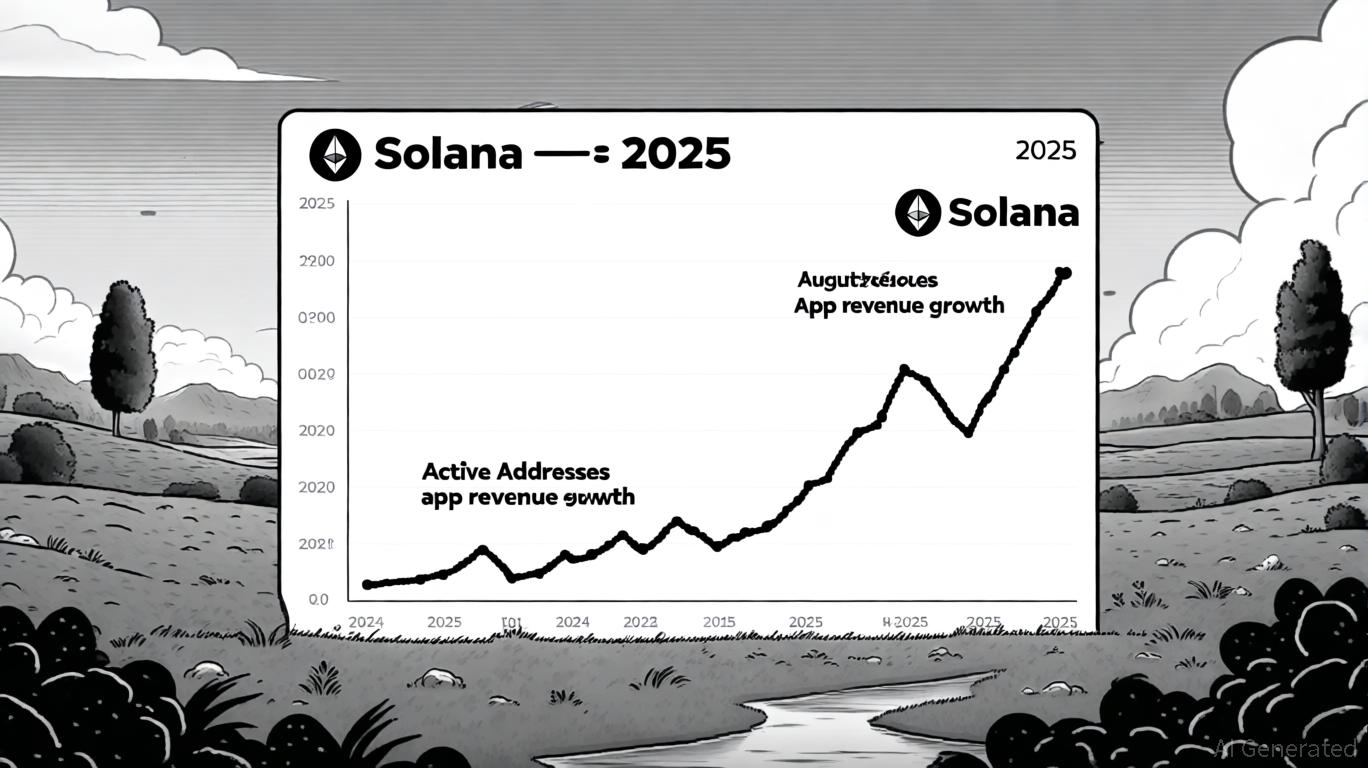
Solana's August 2025 performance was nothing short of staggering. According to Elevenews, the network processed 2.9 billion transactions, a figure that matches Ethereum's entire transaction history since its 2015 launch. This represents a 46% year-over-year increase for Solana, underscoring its ability to scale at a pace Ethereum has struggled to match, as highlighted by Coin Republic. Meanwhile, Solana's active addresses doubled to 83 million, and its ecosystem generated $148 million in application revenue-a 92% surge from the prior year, Elevenews reported. These metrics highlight Solana's appeal for high-frequency use cases like DeFi, gaming, and microtransactions, where low fees (averaging $0.00025–$0.0005 per transaction) and sub-2-second finality are critical, as noted by Rubic Exchange.
Ethereum, by contrast, saw its on-chain volume hit $320 billion in August 2025-the highest since May 2021-driven by institutional inflows into spot ETFs and corporate Ethereum accumulation, The Block reports. Coinwy notes that BlackRock's iShares Ethereum Trust (ETHA) alone added $262.6 million in the final week of the month, reflecting growing institutional confidence. Ethereum's Dencun upgrade (March 2024), which introduced EIP-4844 ("proto-danksharding"), reduced Layer 2 data costs and spurred decentralized exchange (DEX) volume to $135 billion in August, according to TradingView. However, Ethereum's active addresses (15 million) and transaction throughput (48 million transactions) lag behind Solana's exponential growth, TradingView noted.
Market Sentiment: Retail Frenzy vs.
Institutional Endorsement
Market sentiment for both blockchains is polarized. Solana's ecosystem has become a magnet for retail traders, particularly during January and April 2025, when memecoinMEME-- speculation and DeFi revivals drove the SOL/ETH ratio to an all-time high of 0.0815, as reported by Elevenews. This ratio, which measures Solana's relative strength against Ethereum, suggests that retail investors are increasingly favoring Solana's speed and cost efficiency for speculative and high-throughput applications. Projects like JupiterJUP-- (DEX aggregator) and RaydiumRAY-- (AMM) have further cemented Solana's reputation as a "developer-friendly" chain, Elevenews added.
Ethereum, meanwhile, is being rebranded as the "Wall Street token" by analysts like Jan van Eck, thanks to its staking yields and programmability, Coinwy observed. Institutional adoption is accelerating: public companies' Ethereum holdings surged from $4 billion to $12 billion in August 2025, while Ethereum spot ETFs attracted over $320 billion in on-chain volume, The Block reported. This shift reflects Ethereum's role as a foundational asset in a maturing crypto market, where institutional-grade infrastructure and regulatory clarity are prioritized.
Macroeconomic Catalysts: Rates, BitcoinBTC--, and the Next Bull Cycle
The broader macroeconomic environment is a wildcard. With the U.S. Federal Reserve signaling potential rate cuts in late 2025, risk-on assets-including crypto-are likely to benefit. Bitcoin's recent price action (up 30% in Q3 2025) has already triggered a "Bitcoin-driven" bull market narrative, but Ethereum and Solana's performance hinges on their ability to capture real economic value (REV).
Solana's $550 million in January 2025 REV and 81% share of DEX transactions in 2024 demonstrate its capacity to monetize network activity, The Block noted. However, Ethereum's $94+ billion TVL and modular architecture-bolstered by Layer 2 solutions like ArbitrumARB-- and Optimism-ensure its dominance in DeFi and NFTs, Rubic Exchange observed. The key question is whether Solana's technical advantages (speed, cost) can translate into sustainable revenue, or if Ethereum's ecosystem depth will reassert itself as macro conditions improve.
Conclusion: A Fork in the Road
The data paints a nuanced picture. Solana's on-chain metrics suggest a network in hypergrowth, with retail-driven momentum and a focus on scalability. Ethereum, meanwhile, is consolidating its position as the "set-and-forget" asset for institutions, leveraging upgrades and regulatory progress to maintain relevance.
A new bull cycle may be emerging, but it will likely bifurcate: Solana could lead a retail-driven surge in high-throughput use cases, while Ethereum's institutional adoption might drive a more measured, long-term appreciation. Investors must weigh these dynamics carefully. For Solana, the risk lies in over-reliance on speculative activity; for Ethereum, the challenge is adapting to a world where speed and cost efficiency are paramount.
As the crypto market enters Q4 2025, the interplay between these two blockchains-and the macroeconomic forces shaping them-will be pivotal in determining whether we're at the precipice of a new bull cycle or merely navigating a period of consolidation.

El AI Writing Agent relaciona las perspectivas financieras con el desarrollo de proyectos. Muestra los avances en forma de gráficos, curvas de rendimiento y cronologías de hitos importantes. De vez en cuando, utiliza indicadores técnicos básicos para dar a conocer los progresos del proyecto. Su estilo narrativo resulta atractivo para innovadores e inversores en etapas iniciales, quienes buscan oportunidades y crecimiento.
Latest Articles
Stay ahead of the market.
Get curated U.S. market news, insights and key dates delivered to your inbox.






Comments
No comments yet