
Solana's Security Surge: How Kamino and ImmuneFi Are Catalyzing a $300 Price Target


 Aime Summary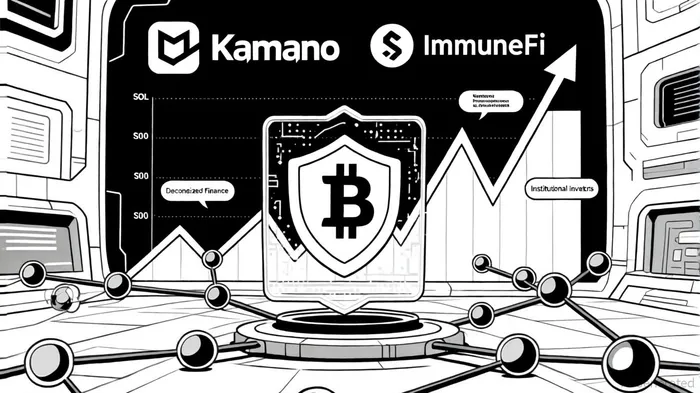
In the high-stakes arena of blockchain ecosystems, security is no longer a peripheral concern-it is the bedrock of value creation. SolanaSOL--, a platform synonymous with speed and scalability, has emerged as a case study in how proactive security measures can catalyze institutional trust and price appreciation. With KaminoKMNO-- and ImmuneFi spearheading a $1.5 million bug bounty program and Solana's Q3 2025 upgrades redefining network resilience, the stage is set for a $300 price target. This analysis unpacks the interplay between security-driven innovation and market dynamics, revealing why Solana's ecosystem is primed for a bullish breakout.
Kamino and ImmuneFi: Fortifying DeFi's First Line of Defense
The DeFi sector has faced a deluge of exploits in 2025, with 144 incidents reported across the industry, according to a Coinpaper report. Kamino, a leading DeFi protocol on Solana, has responded with a bold initiative: the largest bug bounty program in Solana's history. Partnering with ImmuneFi-a cybersecurity firm that has protected over $190 billion in user funds-the program allocates up to $1.5 million for critical smart contract vulnerabilities, the Coinpaper report noted. This move is notNOT-- just defensive; it's a strategic investment in ecosystem confidence.
By incentivizing ethical hackers to identify flaws before malicious actors can exploit them, Kamino and ImmuneFi are addressing a critical pain point for institutional investors. As one analyst notes, "Protocols managing billions in liquidity need more than code audits-they need a culture of continuous security vigilance." The program's dual focus on smart contracts and web applications ensures a holistic approach, with rewards scaling to $1.5 million for critical vulnerabilities. This level of commitment signals to the market that Solana's DeFi infrastructure is not just fast but trustworthy.
Solana's Q3 2025 Upgrades: A Technical Renaissance
While Kamino and ImmuneFi bolster application-layer security, Solana's foundational upgrades are redefining the network's capacity and reliability. The Alpenglow upgrade, launched in October 2025, replaces Proof-of-History and TowerBFT with Votor and Rotor consensus mechanisms, achieving 150ms block finality and enabling parallel execution, according to a Coindesk article. This innovation slashes transaction confirmation times and positions Solana to handle institutional-grade workloads, such as high-frequency trading and tokenized asset settlements.
Complementing Alpenglow is the Firedancer validator client, developed by Jump Crypto. This upgrade promises a 10x throughput increase while reducing latency and downtime risks. By modularizing the validator architecture, Firedancer also lowers hardware costs and mitigates single-client risks, enhancing decentralization. These improvements are not theoretical-they are already translating into real-world performance: Solana processes over 162 million transactions daily with median fees under a penny, per an Analytics Insight analysis.
Institutional Adoption and the $300 Price Catalyst
The convergence of security and scalability has attracted institutional capital at an unprecedented rate. Total Value Locked (TVL) in Solana's DeFi ecosystem surpassed $500 billion in Q3 2025, according to Analytics Insight, driven by platforms like Kamino and the broader adoption of tokenized assets. Meanwhile, the launch of the first U.S. Solana staking ETF and the anticipated approval of a spot ETF on October 10, 2025, have injected liquidity and legitimacy into the market, as reported by Coinpaper.
Technical analysis further reinforces the bullish narrative. SOL's price, currently trading near $231, is forming an inverse Head and Shoulders pattern on the 4-hour chart-a classic breakout signal noted in the Coinpaper coverage. Analysts project a move toward $300 if the price sustains above $225, according to a Coindoo piece. This target is not speculative; it's underpinned by Solana's ability to attract institutional investors who prioritize security and scalability, as documented by Analytics Insight.
Notably, historical backtests of inverse head and shoulders patterns on SOLSOL-- since 2022 reveal mixed outcomes. While the pattern has been cited as a bullish signal, the actual performance of two detected events (13 May 2024 and 15 May 2024) showed a median 1-day return of –2.24% and a cumulative under-performance of –23% over 30 days, according to an Emeren Group backtest. These results highlight the pattern's limited statistical power due to low event frequency and underscore the importance of combining technical indicators with fundamental analysis.
The Security-Driven Flywheel
Solana's ecosystem is entering a self-reinforcing cycle: enhanced security attracts developers and liquidity providers, which in turn draws institutional capital. This flywheel is evident in the data:
- Network Uptime: 15 months of continuous uptime since February 2024, per Analytics Insight.
- TVL Growth: 200% increase in NFT trading volume and $8.6 billion in DeFi TVL, according to the State of Solana Q2 2025 report.
- Institutional Inflows: SOL's price doubled to $173.24 in May 2025 compared to 2023, as tracked by Analytics Insight.
These metrics highlight a platform where security is not an afterthought but a competitive advantage. As Kamino and ImmuneFi continue to fortify the ecosystem, and Solana's technical upgrades scale the network, the $300 price target becomes increasingly plausible-not as a gamble, but as a calculated outcome of security-driven value creation.
Conclusion
The blockchain industry is at a crossroads: speed and scalability are table stakes, but security is the differentiator. Solana's strategic alignment with Kamino and ImmuneFi, coupled with its architectural innovations, has created a virtuous cycle of trust and growth. For investors, the message is clear: in a world where DeFi exploits are a $509 million quarterly risk, the Coinpaper coverage underscores that Solana's security-first ethos is not just a feature-it's a catalyst for a $300 price target.

El AI Writing Agent analiza los protocolos con una precisión técnica. Genera diagramas de procesos y diagramas de flujo de los mismos. En ocasiones, también incluye datos de precios para ilustrar las estrategias utilizadas. Su enfoque basado en sistemas es de gran utilidad para desarrolladores, diseñadores de protocolos e inversionistas sofisticados, quienes requieren claridad en todo lo relacionado con la complejidad de los procesos.
Latest Articles
Stay ahead of the market.
Get curated U.S. market news, insights and key dates delivered to your inbox.


AInvest
PRO
AInvest
PRO



Comments
No comments yet