
Solana Security Overhaul and Regulatory Clarity Reshape Market Outlook
 Aime Summary
The SolanaSOL-- ecosystem is implementing a comprehensive security overhaul following a $270 million exploit at Drift Protocol attributed to a North Korean state-affiliated group. The breach, executed via social engineering rather than code flaws, has prompted the Solana Foundation to introduce new frameworks aimed at mitigating human-targeted vulnerabilities. Simultaneously, the network has gained significant regulatory clarity as U.S. agencies classified SOL as a digital commodity, removing staking from securities regulations. This dual development marks a critical juncture for institutional investors weighing the network's high-speed performance against emerging nation-state threats.
In March 2026, the SEC and CFTC jointly designated Solana as a digital commodity, establishing a clearer legal environment for validators and institutional participants. This framework excludes protocol staking from securities regulation, aligning Solana's governance with U.S. standards and encouraging infrastructure development in financial sectors. The classification may serve as a precedent for other blockchains to be recognized as commodities rather than securities, potentially broadening the pool of eligible institutional capital. However, the market remains sensitive to security narratives as the Drift exploit highlighted the risks of state-level actors weaponizing the network's speed against human attack surfaces.
The Solana Foundation unveiled the Stride program and the Solana Incident Response Network (SIRN) to bolster security across DeFi protocols. Stride, led by Asymmetric Research, evaluates protocols against eight security pillars, offering ongoing operational security and threat monitoring for projects with over $10 million in total value locked. Protocols exceeding $100 million in TVL will also receive funding for formal verification, a process that mathematically checks every execution path in smart contracts to guarantee correctness. The SIRN is a membership-based group of security firms focused on real-time crisis response, aiming to shorten reaction times by establishing relationships with bridge operators and exchanges.
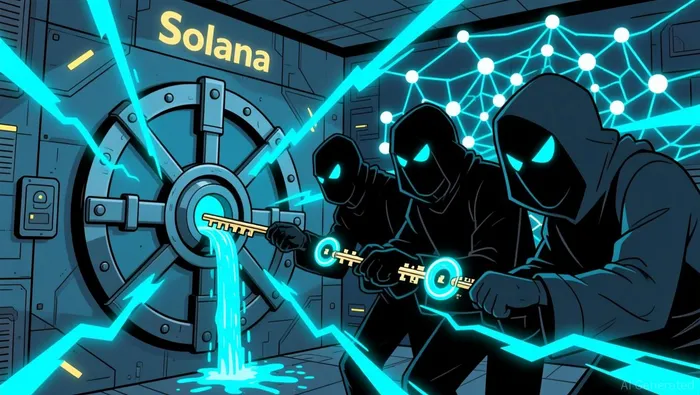
Despite these measures, experts warn that the new frameworks cannot fully prevent attacks utilizing compromised human credentials or social engineering. The Drift hack demonstrated that valid onchain transactions could be used to drain vaults once human trust was breached, a vulnerability that formal verification cannot detect. The attack involved a six-month social engineering campaign where attackers compromised contributor devices to obtain multisig approvals for durable nonce transactions. Consequently, the ecosystem faces a structural question regarding whether its performance advantages are being systematically weaponized against its human attack surface.
Parallel to security concerns, Solana has seen robust growth in real-world asset (RWA) adoption, surpassing EthereumETH-- in total RWA holders. By month-end, the network hosted 182,000 RWA holders, with total RWA value crossing $2 billion. Enterprise adoption accelerated with the launch of the Solana Developer Platform, an API-based system integrating over 20 providers, and partnerships with major payment rails like Mastercard and Western Union. Stablecoin supply on the network reached $17 billion, supported by significant growth in regional stablecoins and the expansion of public market products.
The total Solana ecosystem market cap stood at approximately $123 billion, though SOL price dropped over 4% amid macro turmoil and security headlines. Trading firm B2C2 designated Solana as a core network for institutional stablecoin settlement, and digital banking platform SoFi announced plans to connect its business banking system to the network. These developments underscore the ecosystem's growing importance in the financial landscape, balancing institutional opportunity with ongoing security risks posed by DPRK-linked operations.
How Do New Security Measures Address Human Vulnerabilities?
The Drift exploit revealed that traditional smart contract auditing is insufficient against sophisticated social engineering campaigns. The Solana Foundation's response focuses on formal verification for high-value protocols and rapid incident response rather than relying solely on code audits. Stride's evaluation program will publish findings publicly, providing transparency for investors assessing protocol risk. However, the Foundation clarified that these programs do not transfer underlying responsibility away from the protocols themselves, a distinction critical after the postmortem revealed individual contributor devices were the entry point for the nation-state attack.
Experts note that the gap between onchain correctness and offchain human trust remains a critical vulnerability that no audit tool can fully cover. The Drift attack utilized pre-signed durable nonce transactions and oracle manipulation, executed in approximately 10 seconds. While SIRN aims to improve coordination with stablecoin issuers and exchanges, the speed of such attacks means that by the time a response is coordinated, funds may already be bridged to other chains. This reality forces investors to price in a higher risk premium for Solana-native positions, contrasting with Bitcoin's historically slower but more secure infrastructure against state-level infiltration.
What Impact Does Regulatory Status Have on Institutional Adoption?
The joint SEC and CFTC guidance in March 2026 provided legal certainty to validators and staking providers, aligning Solana's governance with U.S. regulatory frameworks. This decision removed staking from securities regulation, encouraging infrastructure development in financial sectors and potentially serving as a precedent for other blockchains. The regulatory clarity has coincided with the expansion of institutional workflows, with Solana joining Mastercard's Crypto Partner Program and Aon settling the first stablecoin insurance premium on the network. Interactive Brokers began offering SOL trading to European investors, further widening consumer access points.
Public market products have expanded as OndoONDO-- broadened its offerings to over 250 tokenized assets, and credit infrastructure evolved with the launch of the first Brazilian Real-denominated credit market. The network's ability to support high-frequency transactions has attracted enterprise partners seeking efficient settlement layers for payments and decentralized services. However, the classification does not eliminate the risk of future regulatory shifts or the impact of geopolitical tensions on market sentiment. Investors must consider that while the commodity designation supports adoption, it does not immunize the asset from volatility or security-driven sell-offs.
How Is Real-World Asset Growth Balancing Security Risks?
Solana's RWA activity reached new highs despite the Stabble warning and ongoing concerns regarding North Korean infiltration in DeFi projects. The network surpassed Ethereum in RWA holders, reaching 182,000 by month-end, with RWA lending deposits hitting $1.2 billion. This growth was supported by the Solana Developer Platform integrating over 20 infrastructure providers and partnerships with Mastercard, Worldpay, and Western Union. Consumer applications also expanded, with Visa cards for NFTs and stablecoin deposits on platforms like Raenest, demonstrating the ecosystem's utility beyond speculative trading.
The tension between SOL's speed and its exposed human attack surface is now a critical factor for investors, contrasting with Bitcoin's slower but historically more secure infrastructure. The Drift exploit, confirmed as a DPRK operation, ranks as the largest DeFi exploit of 2026, draining $285 million through a combination of social engineering and technical exploitation. Stolen funds were swapped into USDCUSDC-- and SOL before being bridged to Ethereum, creating direct sell pressure on SOL. While the base case assumes containment due to active security programs, the bull case requires clean audit results and no new DPRK-linked incidents to restore confidence.
Market data shows that the total Solana ecosystem market cap stood at approximately $123 billion, though the asset dropped over 4% amid macro turmoil. The Solana Foundation is collaborating with Project Eleven to testTST-- quantum-resistant cryptography, though current protections could slow the network by up to 90%. AI is also increasing the speed and ease of cyberattacks, prompting calls for stronger hardware-based safeguards. Despite these concerns, institutional adoption continues to advance, with the network becoming a core infrastructure layer for settlement and asset tokenization.
The ecosystem's evolution reflects a broader maturation of the digital asset class, where regulatory clarity and security resilience are becoming as important as technological throughput. Investors are increasingly modeling tail risk on Solana-native positions, acknowledging that the network's performance advantage may be systematically weaponized against it. The introduction of Stride and SIRN represents a significant step toward addressing these vulnerabilities, but the fundamental risk of human-targeted attacks remains a key consideration for portfolio allocation. As the network integrates with major payment rails and financial institutions, the balance between innovation and security will continue to define its trajectory in the global financial landscape.

Blending traditional trading wisdom with cutting-edge cryptocurrency insights.
Latest Articles
Stay ahead of the market.
Get curated U.S. market news, insights and key dates delivered to your inbox.


AInvest
PRO
AInvest
PRO



Comments
No comments yet