
Solana Secures Regulatory Clarity as Alchemy Injects $20M to Accelerate Ecosystem Growth
 Aime Summary
Solana is advancing through a pivotal quarter marked by regulatory clarity and significant infrastructure investment. The network has secured a clearer designation as a digital commodity under U.S. federal law, providing a more stable legal framework for validators and institutional participants. Concurrently, Alchemy announced a $20 million injection of non-dilutive infrastructure credits to accelerate application development and boost transaction velocity within the ecosystem.
These developments arrive as SolanaSOL-- continues to expand its Real-World Asset (RWA) footprint, surpassing EthereumETH-- in total holder count and reaching $2 billion in RWA value. Major asset managers including Canary Capital and Grayscale have filed for spot Solana ETF products, signaling growing institutional appetite despite the token trading well below its historical highs.
However, the narrative is tempered by structural realities regarding token economics and market volatility. While the network generates substantial fee revenue, these flows go to validators rather than token holders, leaving passive investors without yield on their capital.
How Has Solana's Regulatory Status Changed Recently?
In March 2026, Solana achieved a significant regulatory milestone when U.S. authorities issued joint guidance from the SEC and CFTC classifying SOL as a digital commodity. This classification explicitly excluded protocol staking from securities regulation, creating a clearer operating environment for validators and institutional players.
The regulatory clarity coincided with broader enterprise adoption, including Solana joining Mastercard's Crypto Partner Program and Interactive Brokers beginning to offer SOL trading to European investors. These moves suggest that institutional workflows are adapting to the network's improved legal standing, potentially paving the way for deeper integration with traditional finance.
What Impact Will Alchemy's Infrastructure Fund Have on Development?
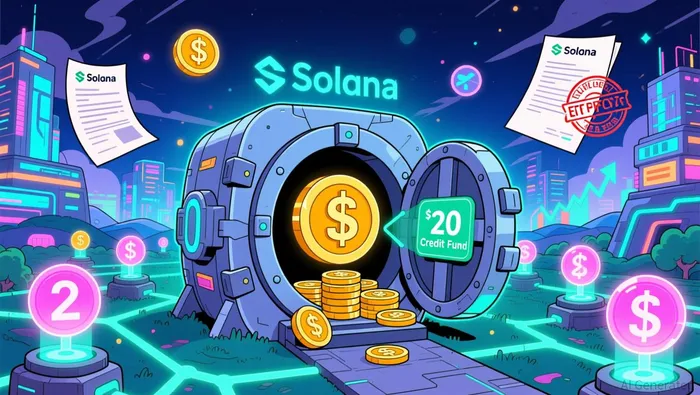
Alchemy is directly injecting $20 million in credits into the Solana developer ecosystem to remove early-stage cost barriers. Each eligible team can access up to $25,000 in infrastructure credits, which are applied as teams build and testTST-- on Alchemy's Solana stack.
This liquidity play is designed for maximum impact with zero friction, requiring no commitment or lock-in from developers. By covering usage costs directly, the fund aims to accelerate the pace at which new applications are tested and launched, thereby boosting network transaction volume from the ground up.
The initiative targets a network already moving at high velocity, which processed a record $650 billion in stablecoin volume in February. The primary risk noted by analysts is whether this credit-driven activity will translate into sustained, high-value traffic if underlying decentralization or reliability challenges resurface.
Why Are Institutional Investors Filing for Solana ETFs Despite Price Volatility?
Canary Capital and Grayscale are among the latest asset managers to file for spot SOL ETF products, expanding the roster of institutional issuers competing for SEC approval. Bloomberg ETF analyst Eric Balchunas noted that a SOL ETF approval would represent the third crypto spot product approved by the SEC, following BitcoinBTC-- and Ethereum.
Spot Solana ETFs in Canada and Europe have already crossed $1 billion in combined assets under management. However, these products recorded $4.24 million in net outflows over five trading days, highlighting a divergence between long-term accumulation and short-term redemptions.
Despite the institutional interest, structural limitations remain for token holders. SOL holders do not receive any share of the network's fee revenue, as validators capture transaction fees instead. This means that holding SOL or a SOL ETF generates zero income, with returns dependent entirely on spot price appreciation.
Analysts maintain varying price targets, with Standard Chartered projecting a year-end target of $295 based on on-chain activity and DeFi fee revenue. Conversely, others like Michaeel van de Poppe suggest SOL needs to hold $75 support to avoid a retest of $55. The consensus remains cautiously optimistic on ETF catalysts but tepid on underlying holder economics.
What Are the Key Risks Facing the Solana Ecosystem?
A primary concern for investors is the lack of yield generation for passive token holders. Capital sitting idle in a SOL position earns nothing while waiting for price recovery. This structural issue is compounded by the fact that SOL holders capture none of the network's economic output through their tokens alone.
Additionally, the network faces technical and competitive pressures. While the technical foundation is improving, any resurfacing of network reliability challenges could cause initial developer enthusiasm to fade quickly. Furthermore, the network is introducing critical upgrades like Multiple Concurrent Proposers to address transaction ordering and censorship resistance.
Quantum computing also poses a credible but manageable medium-to-long-term threat to the cryptographic security of Bitcoin and the broader ecosystem, including Solana. Analysts urge a shift from viewing this as an existential risk to a system upgrade cycle requiring proactive scaling of quantum-resistant technologies.
The broader market context remains volatile, with SOL trading around $83, significantly below its all-time high near $260. This price action reflects a complex interplay of regulatory progress, infrastructure investment, and persistent structural limitations in token economics.
Institutional workflows are evolving, with Solana Company appointing Madelene Gani as COO and Deputy CFO to drive yield expansion and business diversification. This strategic shift aims to optimize treasury operations and scale global financial infrastructure for Solana exposure.
Ultimately, the ecosystem's success will depend on its ability to sustain high-velocity growth while addressing the disconnect between network revenue and token holder returns.

Blending traditional trading wisdom with cutting-edge cryptocurrency insights.
Latest Articles
Stay ahead of the market.
Get curated U.S. market news, insights and key dates delivered to your inbox.


AInvest
PRO
AInvest
PRO



Comments
No comments yet