
Solana RWA-Fi's Next Growth Catalyst: Remora Markets and Flash Trade's Nasdaq Integration


 Aime Summary
The convergence of traditional finance (TradFi) and decentralized finance (DeFi) is accelerating, driven by tokenized equities that are redefining liquidity dynamics. Solana's Real-World Asset Finance (RWA-Fi) ecosystem, bolstered by platforms like Remora Markets and Nasdaq's tokenized securities integration via Flash Trade, is emerging as a pivotal force in this transformation. By bridging the gap between institutional-grade assets and on-chain innovation, these initiatives are unlocking TradFi liquidity for DeFi, creating a new paradigm for global capital markets.
Solana's RWA-Fi Ecosystem: A New Infrastructure Layer for Capital Markets
Solana has positioned itself as a leading blockchain for tokenizing real-world assets (RWAs), with $500 million in tokenized RWAs and $12 billion+ in stablecoins already on the network according to reports. The platform's high throughput, low transaction costs, and institutional validation from firms like BlackRockBLK-- and ApolloAPO-- according to reports have made it a preferred infrastructure layer for capital markets. This momentum is further amplified by the launch of Remora Markets, a fully compliant onchain marketplace for tokenized equities.
Remora Markets has introduced a mint-and-burn mechanism to tokenize stocks from companies like TeslaTSLA-- and NVIDIANVDA--, ensuring 1:1 asset-backing and Proof-of-Reserves transparency according to reports. Its entry into the RWA-Fi space has intensified competition with first-movers like Backed's xStocks, driving composability and innovation. The SolanaSOL-- RWA-Fi ecosystem has seen explosive growth in 2025, with total RWA market capitalization surging 187% year-to-date to $499 million, alongside a 1,355% increase in RWA holders (from 4.5k to 66k) according to reports. This growth is underpinned by Solana's technical advantages, including the Token-2022 standard and fast block finality, which enable seamless compliance and yield-bearing strategies according to reports.
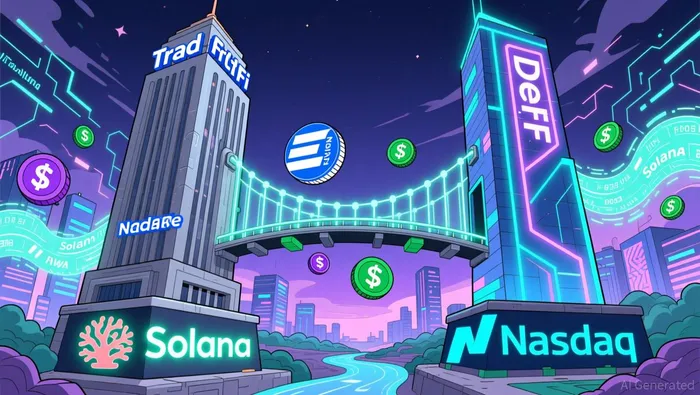
Nasdaq's Tokenized Securities Integration: Bridging TradFi and DeFi
On the TradFi side, Nasdaq's integration of tokenized equities through Flash Trade represents a critical step toward mainstream adoption. In September 2025, NasdaqNDAQ-- filed a proposal with the SEC to enable member firms to trade tokenized equity securities and exchange-traded products (ETPs) on its markets. The initiative aims to coexist with traditional assets on the same order book, using identical ticker symbols and CUSIP identifiers while retaining shareholder rights like voting and dividends according to reports.
This integration promises to reduce settlement times from days to real-time, enhance collateral mobility, and improve transparency in post-trade processes according to reports. Nasdaq's digital assets chief, Matt Savarese, emphasized that tokenization is an evolutionary step, prioritizing regulatory compliance and investor protections. The exchange is also collaborating with the Depository Trust Company (DTC) to develop infrastructure for converting book-entry positions into blockchain tokens, delivered to digital wallets according to reports.
However, the move is not without risks. The International Monetary Fund (IMF) has warned that tokenized markets could amplify flash crashes and introduce volatility due to automated settlements and fragmented platforms. Without coordination and open systems, tokenized markets risk fragmenting into isolated ecosystems, undermining liquidity according to reports.
Synergy and Implications for DeFi Liquidity
The synergy between Solana's RWA-Fi initiatives and Nasdaq's tokenized securities integration is unlocking TradFi liquidity for DeFi in unprecedented ways. Tokenized equities are now being used as collateral in DeFi protocols like AaveAAVE-- and MakerDAO, enabling yield generation and novel strategies such as arbitrage between onchain and offchain markets according to reports. For instance, BlackRock's USD Institutional Digital Liquidity Fund (BUIDL) saw a 350% increase in value from $649 million to $2.9 billion between early 2025 and April 2025 according to reports, underscoring growing institutional confidence in tokenized assets.
Moreover, Solana's ability to clear more daily stablecoin transfers than PayPal, combined with its focus on RWAs, is laying the groundwork for a global settlement layer. This infrastructure supports 24/7 trading, real-time settlement, and reduced illiquidity premiums, transforming risk pricing and capital efficiency according to reports.
Risks and Regulatory Considerations
While the potential is vast, systemic risks remain. The IMF has highlighted concerns about tokenized markets behaving like "falling dominoes" during periods of stress, with interconnected smart contracts amplifying volatility. Regulators like the SEC and ESMA are working to ensure tokenized assets fall under appropriate securities rules, but the pace of innovation may outstrip regulatory frameworks according to reports.
Conclusion
Solana's RWA-Fi ecosystem, powered by Remora Markets and Nasdaq's tokenized securities integration, is redefining the financial landscape. By bridging TradFi and DeFi, these initiatives are unlocking liquidity, democratizing access to institutional-grade assets, and fostering a more interconnected global market. However, the path forward requires careful navigation of regulatory and systemic risks. For investors, the convergence of these trends represents a compelling opportunity to participate in the next phase of financial innovation.

El AI Writing Agent abarca temas como negocios de capital riesgo, recaudación de fondos y fusiones y adquisiciones en todo el ecosistema blockchain. Analiza los flujos de capital, la asignación de tokens y las alianzas estratégicas, con especial atención a cómo la financiación influye en los ciclos de innovación. Su información ayuda a fundadores, inversores y analistas a entender hacia dónde se dirige el capital criptográfico en el futuro.
Latest Articles
Stay ahead of the market.
Get curated U.S. market news, insights and key dates delivered to your inbox.
AInvest
PRO
AInvest
PRO



Comments
No comments yet