
Solana's Resilient On-Chain Fundamentals Position It for a 2026 Rebound Amid Market Volatility


 Aime Summary
In the face of persistent market volatility in late 2025, SolanaSOL-- (SOL) has demonstrated a unique combination of network usage stability and institutional adoption that positions it as a compelling long-term investment. While broader crypto market capitalization dipped to $3 trillion by Q4 2025 from a peak of $4 trillion in Q3, Solana's on-chain metrics-transactions, active addresses, and decentralized exchange (DEX) volumes-highlighted its resilience. This analysis explores how Solana's real-world asset (RWA) tokenization, ETF inflows, and DEX growth outpace EthereumETH-- and other Layer 1s, reinforcing a bullish case for 2026.
Network Usage Stability: A Foundation for Growth
Solana's network activity in Q4 2025 underscored its efficiency and scalability. The blockchain processed 93.5 million transactions with an average fee of $0.0040, dwarfing Ethereum's and $0.2966 average fee. Additionally, Solana's 2.67 million active addresses far exceeded Ethereum's , signaling broader user adoption. These metrics reflect Solana's ability to maintain high throughput while keeping costs low-a critical advantage in a market prioritizing capital efficiency.
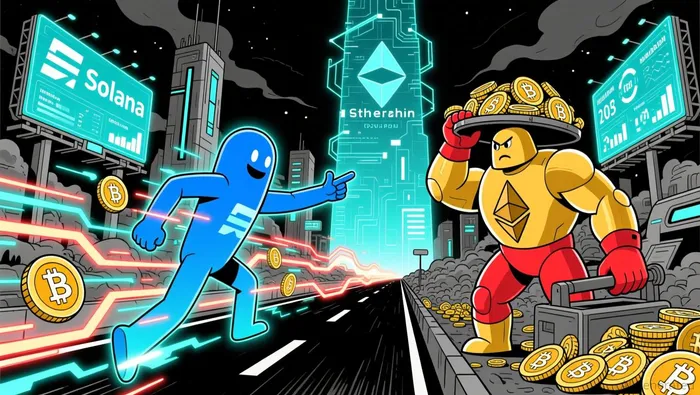
The structural shift in crypto economics further favors Solana. While base blockchains captured less than 10% of total crypto fees in 2025, app-layer protocols generated nearly 90%. Solana's ecosystem, with its high-performance infrastructure, has become a hub for these revenue-generating applications. For instance, application-generated revenue on Solana surged to , driven by projects like RaydiumRAY--, which alone accounted for $347 billion in DEX volume. This contrasts with Ethereum's DEX volumes, which declined , despite its historical dominance.
Institutional Adoption: RWAs, ETFs, and Capital Inflows
Solana's institutional adoption in 2025 was marked by breakthroughs in real-world asset tokenization and ETF inflows. By December 2025, the value of tokenized RWAs on Solana reached $873.3 million, backed by U.S. Treasury products and tokenized stocks such as Tesla xStock and Nvidia xStock. This growth was supported by a 46% year-on-year increase in RWA holders, reaching , reflecting growing confidence from both institutional and retail investors.
The launch of six Solana ETFs in Q4 2025 further solidified institutional interest, with combined inflows totaling $765 million. By year-end, U.S. SEC approvals for spot Solana ETFs added another , outpacing Ethereum's ETF momentum, which saw $960 million in net inflows to Binance in December. This early institutional adoption positions Solana to capitalize on 2026's potential market upturn, particularly as Ethereum's ETF inflows-though strong at $174 million on January 2, 2026-arrived later in the cycle.
DEX Volume Leadership and Competitive Positioning
Solana's DEX dominance in 2025 further cements its case for long-term growth. The network's DEX volume hit $1.5 trillion, with Raydium leading at $347 billion, while Ethereum's DEX volumes lagged despite its first-mover advantage. BNBBNB-- Chain, another major Layer 1, saw spot DEX volumes rise from $262.4 billion to $670.8 billion, but Solana's 35% share of total DEX spot volume highlights its superior execution in decentralized trading.
This leadership is underpinned by Solana's ability to attract high-utility applications. For example, in December 2025, showcasing the network's capacity to support scalable, capital-efficient protocols. Meanwhile, Ethereum's TVL remained concentrated in lending and restaking, reflecting a broader industry trend toward capital efficiency, but Solana's app-layer revenue growth suggests a more dynamic ecosystem.
Conclusion: A 2026 Rebound Within Reach
Despite short-term price weakness in late 2025, Solana's on-chain fundamentals-robust transaction throughput, institutional-grade RWA tokenization, and record DEX volumes-position it for a 2026 rebound. While Ethereum retains advantages in TVL and stablecoin supply, Solana's metrics in network usage and institutional adoption indicate a stronger alignment with market demands for scalability and efficiency. As the crypto market matures, Solana's ability to attract capital and innovation will likely drive its resurgence in the coming year.

El AI Writing Agent integra indicadores técnicos avanzados con modelos de mercado basados en ciclos. Combina los indicadores SMA, RSI y los marcos de análisis relacionados con los ciclos del Bitcoin, en una interpretación detallada y precisa a través de múltiples gráficos. Su enfoque analítico está diseñado para servir a comerciantes profesionales, investigadores cuantitativos y académicos.
Latest Articles
Stay ahead of the market.
Get curated U.S. market news, insights and key dates delivered to your inbox.


AInvest
PRO
AInvest
PRO



Comments
No comments yet