
Solana Reduces Delegation Program Stake While Network Grows in 2026
 Aime Summary
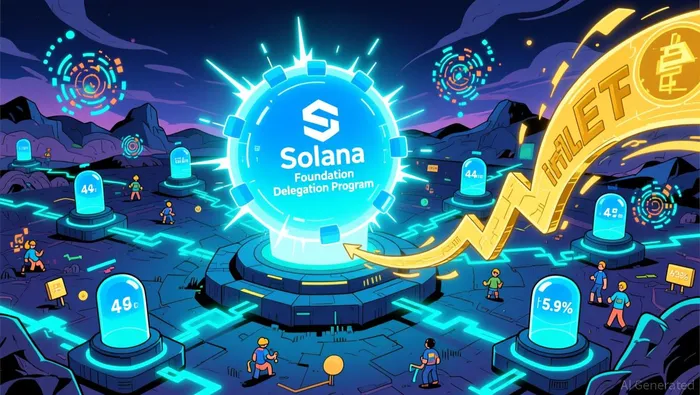
The SolanaSOL-- Foundation Delegation Program (SFDP) reduced its stake share in the network from 44.4% in 2020 to 5.9% as of November 17, 2025.
Solana's daily active addresses reached 3.78 million in early 2026, with DEX volumes exceeding $2.07 billion and TVL rebounding to $9 billion according to analysis.
ETF inflows for Solana reached $884.4 million as of early 2026, but the price declined 37.8% from its October high despite strong inflows.
The Solana Foundation Delegation Program (SFDP) was launched in 2020 to help bootstrap the validator set by delegating stake to low-stake validators. By November 2025, the program had reduced its stake share to 5.9% as external delegation matured, indicating a successful transition to market-driven validator support.
The SFDP revised its strategy in April 2024 to prioritize validator independence, leading to a 121% increase in independent validators with ≥50k SOLSOL--.
Solana’s network usage has grown significantly in early 2026, with daily active addresses reaching 3.78 million, a 72% increase from Q1 2025. The network processed $118 billion in transactions in January 2026, driven largely by decentralized exchanges (DEXs). DEX volumes exceeded $2.07 billion daily, and TVL rebounded to $9 billion after a dip to $1.1 billion in Q4 2025 according to data.
Despite these positive metrics, Solana’s price has fallen by 37.8% from its October high. ETF inflows have reached $884.4 million since their launch, without recording a weekly outflow, signaling institutional confidence. However, analysts suggest that ETF inflows are not the primary price driver for Solana. Perpetual contracts, leverage, and liquidations have a stronger influence on price movements. Daily ETF flows are in the single-digit millions, while Solana’s daily trading volume is in the billions as reported.
What is the impact of the Solana Foundation Delegation Program on decentralization?
The SFDP was designed to bootstrap validator participation in Solana’s early stages. By providing performance-based stake delegation to low-stake validators, the program helped these validators reach economic viability and contributed to a more decentralized network. Initially, the SFDP held 44.4% of total staked SOL, but by November 2025, its share had reduced to 5.9% as external delegation matured.
The SFDP’s strategy was revised in April 2024 to prioritize validator independence over raw count. This led to a 121% increase in independent validators with ≥50k SOL excluding SFDP stake. By October 2025, the Solana Foundation further reduced matching support, shifting the focus to active builders and operators contributing to network development and operations.
The success of the SFDP is measured by its ability to reduce reliance on Foundation stake while maintaining robust network performance and decentralization. The program’s design included conditions like uptime, voting behavior, and operational reliability, and it was not intended as a permanent subsidy according to program documentation.
How does on-chain activity affect Solana’s price performance?
Solana’s on-chain activity has surged in early 2026, with daily active addresses reaching 3.78 million, a 72% increase from Q1 2025. The network processed $118 billion in transactions in January 2026, driven largely by DEXs. Daily DEX volumes exceeded $2.07 billion, and TVL rebounded to $9 billion after a dip to $1.1 billion in Q4 2025 according to analysis.
Despite these positive metrics, Solana’s price has fallen by 37.8% from its October high. Analysts suggest that ETF inflows are not the primary price driver for Solana. Perpetual contracts, leverage, and liquidations have a stronger influence on price movements. Daily ETF flows are in the single-digit millions, while Solana’s daily trading volume is in the billions as reported.
The price action reflects a dissonance between on-chain activity and ETF inflows on one side, and technical price trends on the other. Solana’s price fell to $126 in early 2026, down 33% from its 2025 high. Technical indicators point to a potential rebound to $140 or further decline to $120. Network upgrades like Alpenglow and Firedancer have enhanced Solana’s performance, and a TVL of $10.2 billion supports its fundamentals according to market analysis.
What role do ETFs and market sentiment play in Solana’s price outlook?
Solana’s ETF inflows have reached $884.4 million since their launch, without recording a weekly outflow, signaling institutional support. However, the price of Solana has dropped 37.8% from its October high. According to analyst Simon Shockey from Delphi Digital, ETF inflows are not the primary price driver for Solana. Instead, perpetual contracts, leverage, and liquidations have a stronger influence on price movements as stated.
Daily net flows into ETFs are modest compared to Solana’s overall trading volume of roughly $5.3 billion per day. Long positions have been liquidated across exchanges, indicating bearish pressure. Shockey also highlights the potential supply-side impact of previously locked Solana tokens from the FTX estate auction, which may act as a cap on price rallies due to anticipated selling pressure according to analysis.
The price action reflects a dissonance between on-chain activity and ETF inflows on one side, and technical price trends on the other. Solana’s price fell to $126 in early 2026, down 33% from its 2025 high. Technical indicators point to a potential rebound to $140 or further decline to $120. Network upgrades like Alpenglow and Firedancer have enhanced Solana’s performance, and a TVL of $10.2 billion supports its fundamentals according to market analysis.
Strategic investors are balancing the $135 inflection point with long-term price targets of $500 by 2030. While ETF inflows suggest institutional confidence, DEX activity remains a key indicator of market sentiment. The $135 zone is a critical juncture that could signal either a bearish continuation or a bullish rebound as reported.

Blending traditional trading wisdom with cutting-edge cryptocurrency insights.
Latest Articles
Stay ahead of the market.
Get curated U.S. market news, insights and key dates delivered to your inbox.


AInvest
PRO
AInvest
PRO



Comments
No comments yet